How ChatGPT and other AI assistants recommend local businesses
ChatGPT, Perplexity, Google AI, Gemini, Copilot and Claude each find local businesses differently. What each reads, how each cites, and what to fix first.
The short answer
ChatGPT recommends businesses it finds through web search, after rewriting the question and adding the person's rough location. Perplexity, Google's AI, Gemini, Copilot and Claude work the same broad way but read different indexes and listings. Google's tools lean on Business Profile and Maps, Copilot on Bing, Claude often on Yelp. None documents a paid place in the answer, so being complete and consistent everywhere is the job.
- Every major assistant searches the web before it names a local business, then cites some of what it read.
- They search different places. Google's AI and Gemini lean on Business Profile and Maps, Copilot on Bing, Perplexity on its own index, and Claude often on Yelp.
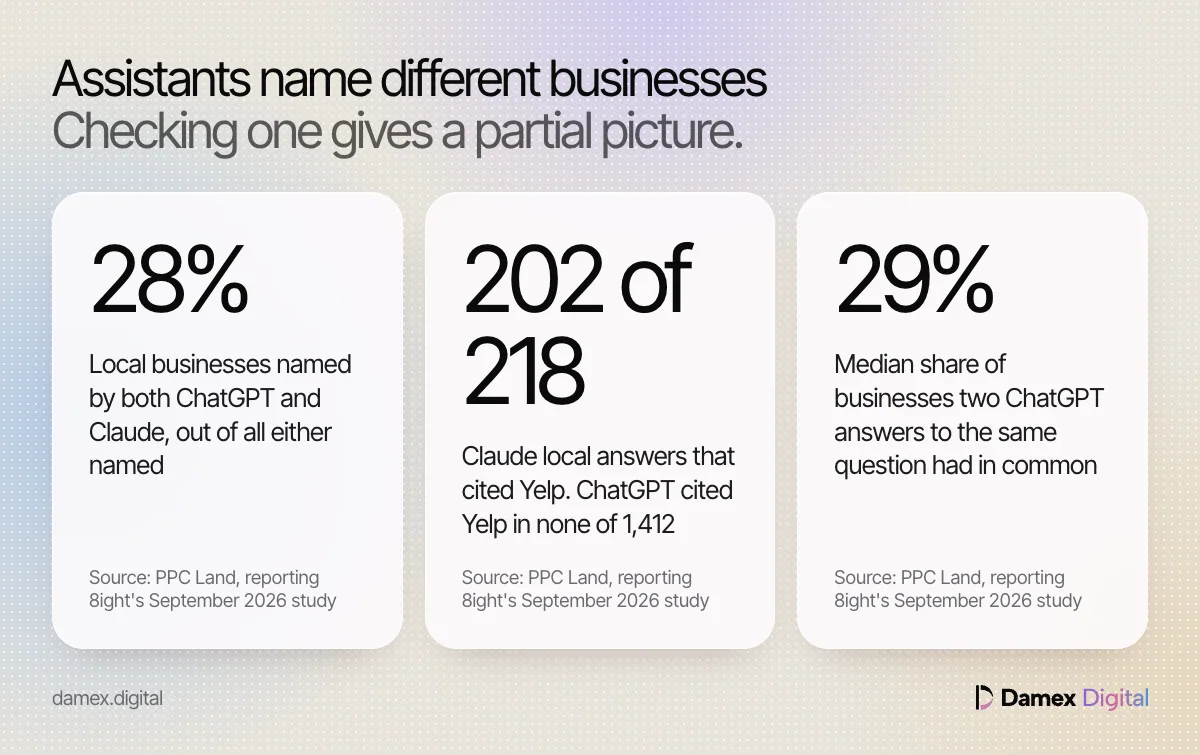
- In one study, ChatGPT and Claude agreed on only 28% of the businesses either of them named.
- None of them documents a way to buy a place inside the answer, so the work is the same everywhere: crawlable pages, matching listings, steady reviews.
- Check each assistant monthly with the same questions, because one answer is a single sample.
- Who this is for
- Owners of US local service businesses in home services, health practices and auto repair
- What to do first
- Let every AI search crawler read your site, then make Google, Bing, Apple and Yelp match
- Engines covered
- ChatGPT, Perplexity, Google AI Overviews and AI Mode, Gemini, Microsoft Copilot and Claude
On this page 18 sections
- 01What do the main AI search terms mean?
- 02Why does it matter which assistant a customer asks?
- 03How does ChatGPT recommend businesses?
- 04How does Perplexity choose local businesses?
- 05How do Google AI Overviews and AI Mode pick local businesses?
- 06How does Gemini find places?
- 07How does Microsoft Copilot find local businesses?
- 08How does Claude find and cite businesses?
- 09How do the six AI assistants compare?
- 10Where do the engines agree, and where do they differ?
- 11How do you get recommended by every AI assistant?
- 12Does Google Business Profile help with ChatGPT and other assistants?
- 13Can you pay to advertise your business on ChatGPT or other assistants?
- 14How does this work for each trade?
- 15Example: one plumber, six assistants, two months
- 16What are the most common mistakes owners make with AI search?
- 17How do you check what each assistant says about you?
- 18How Damex does it
A homeowner with a burst pipe used to search and scroll through ten blue links. More of them now ask an assistant instead, and it answers with a short list of three or four businesses. If you’re not on that list, the call goes to someone who is.
So how does ChatGPT recommend businesses, and do Perplexity, Google, Gemini, Copilot and Claude do it the same way? Broadly, yes: each one searches, reads and cites. In the detail, no. They search different indexes, read different listings and show sources differently. This guide compares all six from each company’s own documentation, then turns the differences into one fix list.
Key takeaways
- Every major assistant searches the web before naming a local business, then shows some of the sources it read.
- Google AI Overviews, AI Mode and Gemini lean on Google Business Profile and Maps. Copilot is powered by Bing's index. Perplexity has its own crawler.
- In one 2026 study, ChatGPT and Claude agreed on only 28% of the local businesses either of them named.
- None of the six documents a way to pay for a place inside the answer, and Google says there's no way to pay for a better local ranking.
- Most of the work is shared: let each AI search crawler in, match your listings, ask every customer for a review, and publish pages that answer questions.
- Measure each assistant monthly with the same questions, because answers change from run to run.
What do the main AI search terms mean?
AI search is when an assistant looks things up on the web while it writes its answer, instead of relying only on what it learned in training. For a local business, the answer is built from whatever the assistant can find and read about you today. A few terms explain how that works.
- AI search lets an assistant search the live web and show links. All six assistants in this guide do it.
- A crawler is the robot that reads your pages for a search index, such as OAI-SearchBot for ChatGPT or PerplexityBot for Perplexity.
- Grounding means anchoring an answer in sources found at the time of the question.
- A citation is a linked source shown with the answer. A mention is your business named in the text. Mentions bring the calls.
- Query fan-out is Google’s term for splitting one question into several related searches.
How AI search works, in one line: rewrite the question, search, read, answer, cite. SEO and AI search share the first half, which is why our guide to SEO vs AEO vs GEO treats them as one job.
Why does it matter which assistant a customer asks?
It matters because the assistants don’t agree. Independent tests in 2026 found that two assistants asked the same local question at the same moment usually name different businesses and cite different websites. A business can be recommended by one and missing from the next, so checking one engine gives you a partial picture.
28%
When ChatGPT and Claude answered the same local trade question at the same moment, only 81 of the 294 businesses either one named (28%) were named by both.
202 of 218
Claude cited Yelp in 202 of its 218 local answers in 8ight's study, while ChatGPT cited Yelp in none of 1,412.
81,817
Google's AI Mode cited 81,817 unique third-party domains for local businesses in BrightLocal's tracking, against 8,541 for AI Overviews and 6,025 for ChatGPT.
Source: BrightLocal: Top sources and directories for local AI search
93%
Around 93% of the domains cited across BrightLocal's 1,355 tracked locations were individual business websites.
Source: BrightLocal: Top sources and directories for local AI search
29%
When ChatGPT got the same question twice, a median 39 minutes apart, the two answers shared a median 29% of the businesses named.
How does ChatGPT recommend businesses?
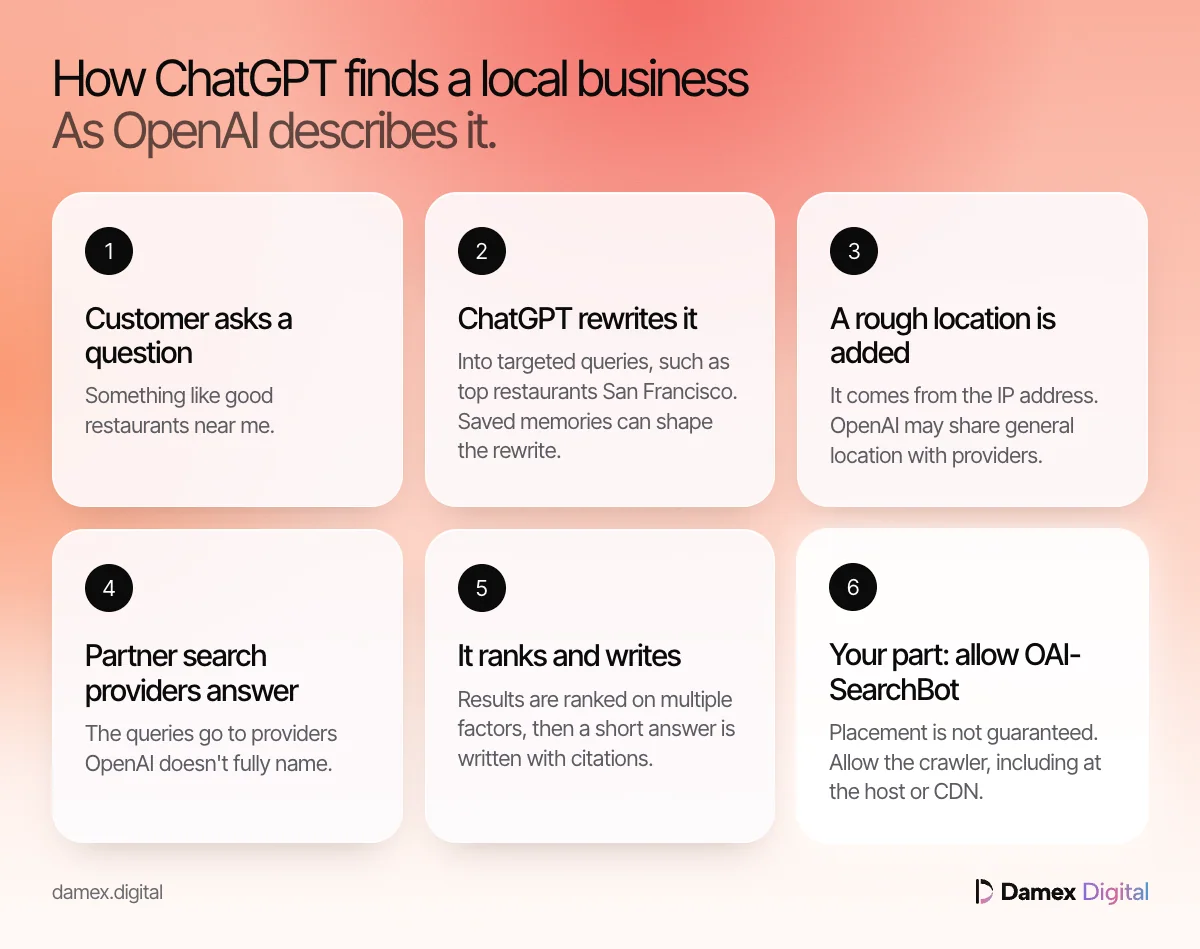
ChatGPT recommends businesses by searching the web, not from a directory of its own. OpenAI says ChatGPT search rewrites the customer’s question into one or more targeted queries, adds a rough location from the IP address and sends those queries to partner search providers. It then ranks results using multiple factors and writes a short answer with citations.
How does ChatGPT find a business?
Per OpenAI’s help page on searching the web, “good restaurants near me” can become a search for “top restaurants San Francisco”, and saved memories can shape the rewrite. OpenAI may share the person’s general location with third-party providers to show “nearby business listings”, without naming them. Answers may show citations, a Sources list and, on phones, a map.
OpenAI says placement “is not guaranteed”. The one thing it asks of site owners is to allow its OAI-SearchBot crawler, including at the host or CDN. For the ChatGPT-specific steps, read how to get your business recommended by ChatGPT and the ChatGPT engine guide.
How does Perplexity choose local businesses?
Perplexity answers from its own live web search and shows numbered citations for every answer. It runs its own crawler, PerplexityBot, and recommends that site owners allow it. We found no business listing to claim in its documentation, so your website and the pages that mention you do the work.
Perplexity’s help centre says each answer includes “numbered citations linking to the original sources”, which makes it the easiest engine to audit. Its crawler documentation says PerplexityBot surfaces and links websites in search results and isn’t used to crawl content for AI foundation models. Blocking it costs visibility without protecting you from training. More is in how to get your business on Perplexity and our Perplexity engine guide.
How do Google AI Overviews and AI Mode pick local businesses?
Google’s AI Overviews and AI Mode are built on Google Search, so they pick from pages and listings Google has already indexed. Google says there are no extra requirements or special markup. A page must be indexed and eligible to show with a snippet, and your Business Profile information should be up to date.
Google’s guide to AI features says both may use “query fan-out”, running several related searches across subtopics and data sources, and that AI Overviews “often don’t trigger”. For local details, Google compiles its listings from crawled web content such as your website, from users and owners who claim listings through Business Profile, from licensed third-party data and from its own interactions with a business.
BrightLocal found Google’s AI tools used Business Profile for “virtually every location”, with Yelp second. Our guide to how Google AI Overviews choose local businesses goes deeper, and the AI Overviews engine guide lists the controls.
How does Gemini find places?
Gemini finds places through Google Maps. Google says the Gemini app uses public Maps information to find businesses and give their addresses, descriptions, websites, ratings and opening hours. For a local business, that means your Google Maps listing, which your Business Profile controls, is the record Gemini reads first.
Google’s Gemini help page on places uses questions like “Where’s the closest coffee shop and what time does it open?” Business names in the answer link to their Maps pages, and Gemini can use device location with permission.
So Gemini fixes are mostly Business Profile fixes: correct hours, a working website link and honest reviews. Our Gemini engine guide and Google Business Profile guide cover the setup.
How does Microsoft Copilot find local businesses?
Copilot is powered by Bing’s search index, so a site Bing can’t crawl is a site Copilot can’t use. Microsoft also points local businesses to Bing Places, saying it helps keep address, hours and contact details current and “eligible for inclusion in AI-generated responses”. Copilot then builds its answer from pieces of several sources.
Microsoft Advertising’s guide to content for AI search answers says Copilot is “powered by Bing’s search index” and warns against hiding answers in tabs, PDFs or images. Copilot also reports citations back to site owners. Bing’s AI Performance report, launched in February 2026, shows how often your pages are cited across Copilot and Bing’s AI summaries, and the same post recommends IndexNow. See the Copilot engine guide and our Bing Places guide.
How does Claude find and cite businesses?
Claude searches the live web when a question needs current information, and Anthropic says every search response includes citations. It runs a search crawler, Claude-SearchBot, separate from its training crawler. In the one large local study we found, Claude leaned heavily on directories and review sites, Yelp above all.
Anthropic’s help page on web search says image results are powered by Bing but doesn’t name the provider behind text results, so we don’t guess. Anthropic’s crawler page lists three robots: ClaudeBot for training, Claude-User for pages a person asks about, and Claude-SearchBot for search. Blocking Claude-SearchBot “may reduce your site’s visibility”, and robots.txt is the reliable control.
In 8ight’s study, Claude cited a directory or review site in 99.5% of its answers, against 65.3% for ChatGPT, so a complete Yelp page carries real weight.
How do the six AI assistants compare?
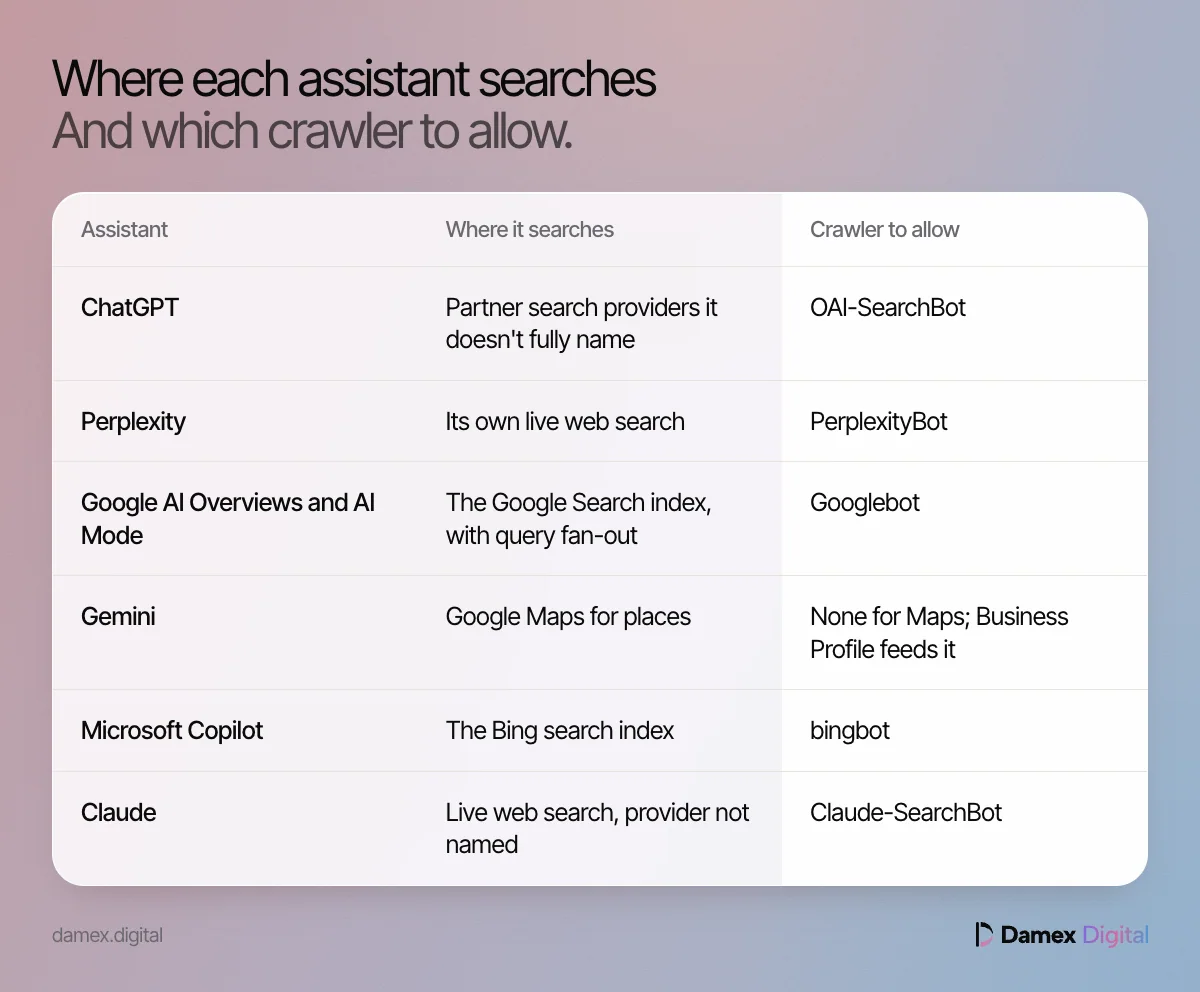
The six assistants share a pattern but differ in what they search, which crawler they need and how they show sources. The table shows which listing and which crawler matter for each one, drawn from each company’s own documentation linked above.
| Assistant | Where it searches | Crawler to allow | Local data it names | How it shows sources | Our guide |
|---|---|---|---|---|---|
| ChatGPT | Partner search providers it doesn’t fully name | OAI-SearchBot | Nearby business listings from unnamed third parties | Citations, a Sources list, a map on phones | ChatGPT |
| Perplexity | Its own live web search | PerplexityBot | None documented; your website does the work | Numbered citations on every answer | Perplexity |
| Google AI Overviews and AI Mode | The Google Search index, with query fan-out | Googlebot | Business Profile and Google’s local listings | Supporting links beside the answer | AI Overviews |
| Gemini | Google Maps for places | None for Maps; your Business Profile feeds it | Maps addresses, websites, ratings and hours | Place names that open Google Maps | Gemini |
| Microsoft Copilot | The Bing search index | bingbot | Bing Places details | Cited sources, reported in Bing Webmaster Tools | Copilot |
| Claude | Live web search, provider not named | Claude-SearchBot | None documented | Citations on every search answer | No guide yet |
All engine pages sit in our AI engine guides.
Where do the engines agree, and where do they differ?
They agree on the basics: each one searches before naming a business, shows sources, and documents no way to buy a place in the answer. They differ on the index they search, the crawler they need and the listing they lean on most. The differences tell you what to add for each engine.
Where they agree
- No documented paid spot. Google says there’s “no way to request or pay” for a better local ranking, per its local ranking help page. OpenAI says ChatGPT search placement isn’t guaranteed.
- They read the open web. In BrightLocal’s data, around 93% of cited domains were individual business websites.
- They show sources. So you can trace where a wrong detail came from.
Where they differ
- The index. Bing for Copilot, Google for Google’s tools, its own for Perplexity, unnamed providers for ChatGPT and Claude.
- The listing. Google’s tools lean on Business Profile and Maps. In 8ight’s data, ChatGPT cited government sites in about one answer in four, mostly licensing pages, while Claude cited none and favoured Yelp.
- The crawler. Allowing Googlebot does nothing for ChatGPT, and allowing OAI-SearchBot does nothing for Claude.
How do you get recommended by every AI assistant?
Fix what every engine shares first, then add the engine-specific steps. Open your site to each search crawler, make your listings match, claim the platforms each engine leans on, and build reviews and pages that answer questions. The first four steps take most businesses a week.
Week one: let every engine read and check you
Week one
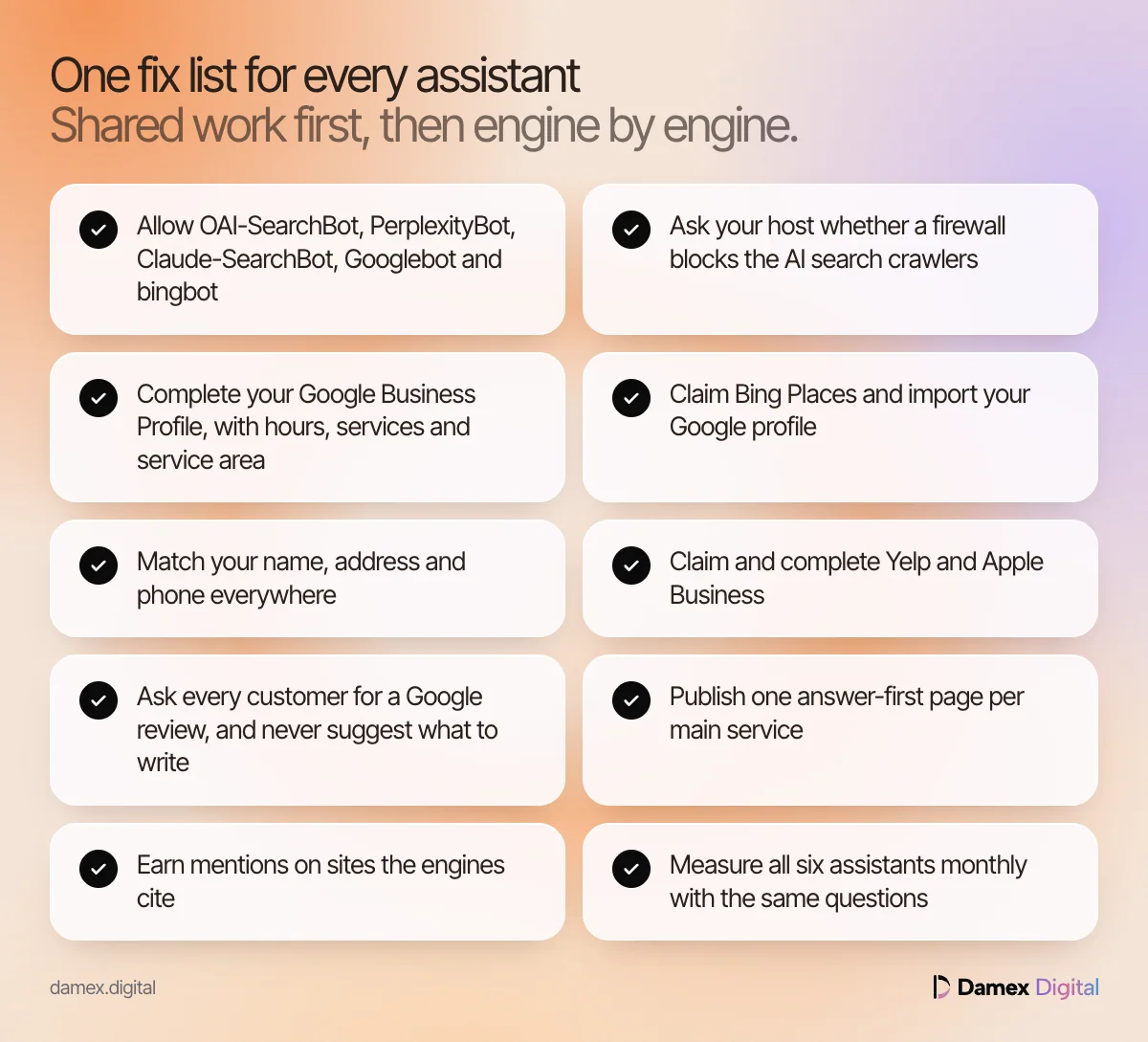
- Allow every AI search crawler. Check robots.txt for OAI-SearchBot, PerplexityBot, Claude-SearchBot, Googlebot and bingbot, and ask your host whether a firewall blocks them. Our AI crawler checker tests the documented ones at once.
- Complete your Google Business Profile. Hours, special hours, categories, services, service area, photos and website. Google says complete, accurate profiles are more likely to show in local results.
- Claim Bing Places. Import your Google profile to save time. Bing says it helps keep your details eligible for inclusion in AI-generated responses.
- Match your name, address and phone everywhere. One exact version on your website and every listing. A mismatch gives every engine a reason to skip you.
Month one onward: give every engine the same strong facts
Month one onward
- Claim and complete Yelp and Apple Business. Claude and ChatGPT both lean on Yelp in the studies above, and an Apple Business place card covers iPhone users. Don’t ask customers for Yelp reviews, because Yelp asks businesses not to.
- Ask every customer for a Google review. Ask after every job, not only the happy ones, and never suggest what to write. Google’s review policy says businesses shouldn’t request that specific content be included. Our guide to getting more Google reviews has messages that follow the rules.
- Publish one answer-first page per main service. Open with a direct answer, then give price ranges, areas, hours and licence numbers in plain text.
- Earn mentions on sites the engines cite. Local roundups, news and trade association directories give every engine a second source.
- Measure all six monthly. Ask the same questions on each assistant and log who gets named and which sources are cited.
Does Google Business Profile help with ChatGPT and other assistants?
Yes, but unevenly. Google Business Profile is the main source for Google’s AI tools and the record Gemini reads through Maps. For ChatGPT and Claude it matters less directly: in 8ight’s study, Google was named in the text of 23% of ChatGPT answers but linked in under 1%.
So what is Google Business Profile used for now? It’s your listing on Search and Maps, ranked mainly on relevance, distance and popularity (Google’s help page still uses a “Prominence” heading), and it feeds what Google’s AI tools repeat. Complete it first, then make everything else match. Our local SEO service does that matching across the directories AI engines and maps read for your trade.
Can you pay to advertise your business on ChatGPT or other assistants?
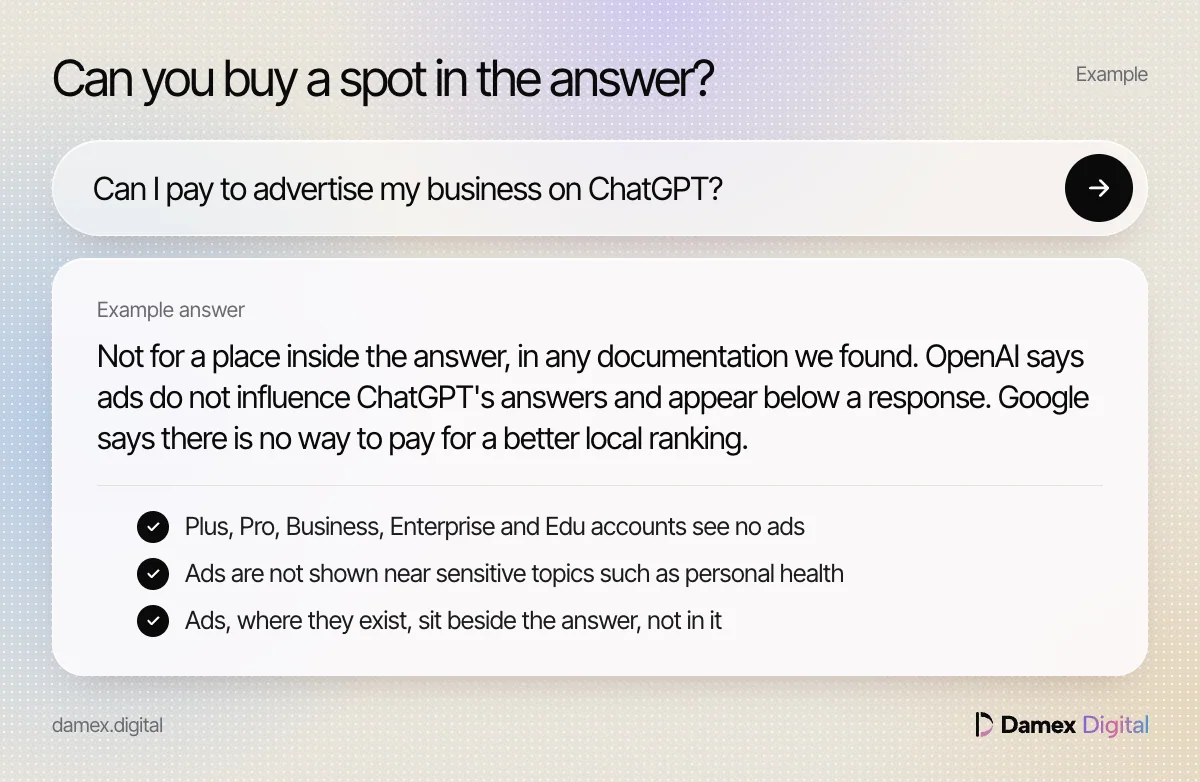
You can’t pay for a place inside an assistant’s answer in any documentation we found. OpenAI says ads “do not influence ChatGPT’s answers” and appear below a response, and Google says there’s no way to pay for a better local ranking. Ads, where they exist, sit beside the answer, not in it.
Per OpenAI’s ads help page, Plus, Pro, Business, Enterprise and Edu accounts see no ads, and ads aren’t shown near sensitive topics such as personal health. Our ChatGPT guide covers how its ads are chosen.
How does this work for each trade?
The engines treat every trade the same way, but customers in each trade ask different questions and get checked against different records. Home services are often checked against licence records and review sites. Health practices are judged on hours, insurance and reviews, under stricter rules on what they can say.
Home services
For HVAC companies
HVAC questions spike with the weather, and assistants that read Google Maps answer “who’s open now” from your listed hours. Update special hours before holidays and heat waves. In 8ight’s study, ChatGPT named at least one of the HVAC contractors checked in only 45.0% of places. Our HVAC guide to ChatGPT covers certifications and dealer locators.
More for HVAC companies: HVAC marketing and AI visibility
For plumbing companies
Plumbing calls come at bad hours. ChatGPT works from a rough IP location and Gemini can use device location, so name your service area plainly on your site and on Bing Places, not only on Google. ChatGPT named at least one checked plumber in 47.4% of places in 8ight’s sample. For the map side, read how to show up for emergency plumber near me searches.
More for plumbing companies: Plumbing marketing and AI visibility
For roofing companies
Roofing shows the split between engines most clearly. In 8ight’s study, ChatGPT cited government sites, mostly licensing pages, in about one answer in four, while Claude cited none and leaned on Yelp. A roofer needs both: a current state licence record under the same business name, and a claimed, complete Yelp page. Our guide to how roofers get found after a storm covers storm timing.
More for roofing companies: Roofing marketing and AI visibility
Health practices
For dental practices
Patients ask about Saturday hours, new-patient openings and insurance. Gemini reads hours and ratings from Maps, so your Business Profile hours and services must match the website exactly. List accepted insurance plans in plain text, not a PDF, because Microsoft warns PDFs often lack the structure AI systems use. Keep review replies general and never confirm that someone is a patient. Our guide for dental practices covers health directories.
More for dental practices: Dental marketing and AI visibility
For med spas
Med spas were the only health care category in 8ight’s local study, so there’s little published data on how assistants treat health practices. Any assistant can quote your treatment pages, so describe each treatment, who performs it and their credentials accurately, without outcome promises. OpenAI doesn’t show ads near personal health topics, so don’t plan on ChatGPT ads. Rules vary by state; check with your attorney. Read our med spa advertising rules guide.
More for med spas: Med spa marketing and AI visibility
Example: one plumber, six assistants, two months
Here’s how a cross-engine score works and how to read it before acting on it, in round numbers. Real results vary by engine, city and trade.
5 of 48
A three-van plumber in Columbus, Ohio is named in 5 of 48 answers when it starts, from 8 questions asked on 6 assistants.
Worked example
The starting score. 8 questions × 6 assistants = 48 answers. The plumber is named in 5, all from Google’s tools: 3 in AI Overviews and 2 in Gemini. That’s 5 ÷ 48 = 10.4%.
The diagnosis. Its Google profile is strong. But its robots.txt blocks every bot except Googlebot, so ChatGPT, Perplexity and Claude can’t read its pages. Bing Places is unclaimed with a 2022 phone number, and Yelp is unclaimed.
Week one. It opens robots.txt to the AI search crawlers, imports its Google profile into Bing Places and claims Yelp with matching details.
Month two. The same 48 answers now name it 14 times: AI Overviews 3, Gemini 3, Copilot 3, Perplexity 2, ChatGPT 2 and Claude 1. That’s 14 ÷ 48 = 29.2%, up from 10.4%.
Reading it honestly. Answers vary run to run, so part of the jump could be noise, and asking each question twice gives a steadier number. But the gains sit where the fixes were: Copilot after Bing Places, and ChatGPT, Perplexity and Claude after the crawler change.
What are the most common mistakes owners make with AI search?
The most common mistake is fixing for one engine and assuming the rest follow. A strong Google profile does little for Claude, and a perfect robots.txt does nothing if Bing Places shows an old phone number. These are the mistakes we see most.
- Blocking AI crawlers by accident. A blanket robots.txt rule or a firewall can shut out every AI search crawler.
- Mixing up training and search crawlers. Blocking ClaudeBot opts you out of training. Blocking Claude-SearchBot can cost you search visibility.
- Fixing only Google. Copilot reads Bing, and Claude leans on Yelp. An unclaimed Bing Places or Yelp page is an open gap.
- Asking for reviews the wrong way. Asking only happy customers, telling them what to write, or asking for Yelp reviews breaks the platforms’ rules.
- Hiding key facts. Prices, hours and service areas inside images, PDFs or tabs are harder for every engine to read.
- Copying one page for every suburb. Near-identical pages give an engine nothing new to quote.
- Judging from one answer. ChatGPT’s repeat answers shared a median 29% of names in 8ight’s data, so one screenshot proves little.
- Paying for promised placement. No engine documents a paid spot in its answer, so a placement guarantee is a promise nobody can keep.
For why a rival gets picked, read why ChatGPT recommends your competitor.
How do you check what each assistant says about you?
Ask each assistant the questions your customers ask, with your trade and city included, and note who is named and which sources are cited. Use a fresh chat, ask the same set every month and repeat each question twice. Then fix any cited source that disagrees with your listings.
I need a [trade] in [city] for [job] this week. Recommend three businesses, say why you picked each one, and list the sources you used.
Where did you find the phone number and opening hours for [business name]? Link the exact pages.
Cross-engine AI visibility check
- robots.txt allows OAI-SearchBot, PerplexityBot, Claude-SearchBot, Googlebot and bingbot
- Firewall or CDN doesn’t block AI search crawlers
- Google Business Profile complete, with current special hours
- Bing Places, Apple Business and Yelp claimed and matching Google
- Name, address and phone identical on your website and every listing
- One answer-first page per main service, in plain text
- Review request sent to every customer after every job
- Same questions asked on all six assistants this month, twice each
Our 30-minute AI visibility audit has the full scoring method.
How Damex does it
Our team does this work, and a senior marketer with 10+ years of experience owns each account. The AI Visibility service tracks your buyer questions every month across five engines: ChatGPT, Perplexity, Gemini, Google AI Overviews and Copilot.
- Audit. We ask those engines your customers’ questions and record who gets named.
- Listings. We fix your name, address and phone across the directories AI engines and maps read for your trade, including Bing Places.
- Profile. From Essentials up, we keep your Google Business Profile complete.
- Reviews. On Growth and Authority, we ask every customer for a review after the job, with their consent, and reply to every review.
- Pages. We write service and FAQ pages that open with a direct answer.
- Measure. You see your count, engine by engine, against the month you started.
We don’t promise placement, because no one can. We measure it and show you the trend. Prices are on the pricing page, and the free AI Visibility Check shows where you stand today.
Questions people ask
How does ChatGPT decide which local businesses to recommend?
OpenAI says ChatGPT search rewrites the question into targeted queries, adds a rough location from the IP address and sends them to search partners. It then ranks what it finds using multiple factors. OpenAI doesn't publish those factors and says placement is not guaranteed.
Can I pay to advertise my business on ChatGPT?
You can't pay for a place inside the answer. OpenAI says ads don't influence ChatGPT's answers and appear below a response, for some plans only. Google also says there's no way to pay for a better local ranking. Being named still depends on what each engine finds about you.
Does Google Business Profile help with AI assistants?
Yes, most of all with Google's own. Google's guidance for AI Overviews and AI Mode names keeping Business Profile information up to date, and Gemini reads public Google Maps details such as hours and ratings. BrightLocal found Google's AI tools used Business Profile for virtually every location it tracked.
How does Google Business Profile work with AI search?
Your profile feeds Google's local listings, which Google says also draw on crawled websites, user contributions and licensed third-party data. Google's AI Overviews, AI Mode and Gemini read from those listings, so the hours, categories and reviews on your profile become what they repeat.
Is Google Business Profile still important if customers use ChatGPT?
Yes. It's the main source for Google's AI tools, and Google's own help page says complete and accurate profiles are more likely to show in local results. ChatGPT links to Google pages rarely in the studies we read, so it needs Yelp, Bing and your website as well, not instead.
Does ChatGPT recommend businesses to others the same way it recommends them to me?
Not exactly. OpenAI says ChatGPT uses each person's rough location and may use saved memories when it rewrites a search. The same question can also return different names a few minutes later. Judge your visibility across many questions and runs, not one screenshot.
Why do ChatGPT and Perplexity name different businesses?
They search different places. ChatGPT uses partner search providers it doesn't fully name, and Perplexity searches the web in real time with its own crawler. Each picks and cites different pages, so the same question can produce different shortlists.
Does Claude recommend local businesses?
Yes, when web search is on. Anthropic says Claude grounds answers in the live web and every search response includes citations. In one study of local trade questions, Claude cited Yelp in 202 of 218 answers, so a claimed, complete Yelp page matters for Claude.
Which AI assistant matters most for a local business?
The one your customers use, which you can't see directly. Google's AI tools reach people already searching Google, and ChatGPT reaches people who skip search. Because the work overlaps so much, it's safer to be ready for all of them than to bet on one.
How long does it take to show up in AI answers?
It depends on the engine and on how much needs fixing. Perplexity says robots.txt changes can take up to 24 hours to reach its systems, while reviews and outside mentions build over months. That's why we measure monthly instead of promising a date.
Do I need a separate strategy for each AI engine?
Mostly not. Most of the work is shared, such as crawlable pages, matching listings and steady reviews. The engine-specific part is small: the right crawler allowed, Bing Places for Copilot, Google Business Profile for Google's tools and Yelp for the engines that lean on it.
Sources
- OpenAI Help: Searching the web with ChatGPT
- OpenAI Help: Ads in ChatGPT
- Perplexity Help Center: How does Perplexity work?
- Perplexity: Perplexity crawlers
- Google Search Central: AI features and your website
- Google Local Listings Help: How Google sources and uses information in local listings
- Google Business Profile Help: Tips to improve your local ranking on Google
- Google Maps user contributed content policy: Fake engagement
- Gemini Apps Help: Find places and get directions in Gemini Apps
- Microsoft Advertising: Optimizing your content for inclusion in AI search answers
- Bing Webmaster Blog: Introducing AI Performance in Bing Webmaster Tools
- Claude Help Center: Enable and use web search
- Claude Help Center: Does Anthropic crawl data from the web?
- PPC Land: ChatGPT names 3.4% of tested local firms with under 25 reviews, 8ight finds
- BrightLocal: Top sources and directories for local AI search
Cite this post
Badhon, S. U. (2026, October 31). How ChatGPT and other AI assistants recommend local businesses. Damex Digital Blog. https://damex.digital/blog/how-ai-assistants-choose-local-businesses/
Founder, Damex Digital
Led product marketing and go-to-market at weDevs, led marketing at Damex and managed a marketing team at Genex. Founded Damex Digital so local service businesses get the daily work of a good marketing team, measured in calls and booked jobs.