SEO vs AEO vs GEO explained for local business owners
SEO, AEO and GEO in plain English for local service businesses. What each one means, what Google and the AI tools say, and what to fix first.
The short answer
SEO helps your business show up in Google's normal results and map. AEO, answer engine optimization, aims to get you named in direct answers such as Google's AI Overviews. GEO, generative engine optimization, means the same for AI chat tools like ChatGPT. For a local business, all three rest on the same groundwork of a complete Google profile, matching listings, real reviews and clear pages.
- SEO, AEO and GEO are three names for getting found in search results, AI answers and AI chat.
- Google says normal SEO best practices still apply to its AI features, with no extra requirements.
- AEO doesn't replace SEO. It sits on top of it, and the work underneath is mostly the same.
- ChatGPT, Perplexity and Copilot each publish how their search crawlers work, and blocking the wrong one can hide you.
- What's new is measurement, since you also need to check what AI tools say about you every month.
- Who this is for
- US local service businesses in fifteen trades: home services, health practices and auto repair
- What to do first
- Ask the AI tools your customers' questions, then fix your Google profile and listings
- What's actually new
- Checking what AI tools say about you every month
On this page 14 sections
- 01What do SEO, AEO and GEO mean in plain English?
- 02What do AI SEO, LLM SEO and AIO mean?
- 03Why does the difference matter now?
- 04What’s the difference between AEO vs SEO vs GEO?
- 05How does each search surface work, according to the platforms?
- 06What did the GEO research actually find?
- 07Does AI SEO work, and can AI replace SEO?
- 08What should a local service business do first?
- 09How does this work for each trade?
- 10How does it work for dental and med spa practices?
- 11Example: one owner, three proposals, one plan
- 12What are the most common SEO, AEO and GEO mistakes?
- 13What should you ask before you buy SEO, AEO or GEO?
- 14How does Damex handle SEO, AEO and GEO?
A plumber gets three sales emails in one week. The first sells SEO. The second sells AEO. The third sells GEO, “the future of search”. Each one wants a monthly fee, and they all sound like the same thing in a different hat.
Mostly, they are. This guide sorts out AEO vs SEO vs GEO in plain English, along with AI SEO, LLM SEO and AIO. It covers what each word means, how Google, ChatGPT, Perplexity and Copilot say their search works, what the original GEO research found, and what a local service business should do first. It’s written for owners of US local service businesses in fifteen trades: home services, health practices and auto repair.
Key takeaways
- SEO, AEO and GEO are three names for getting found. The difference is where the customer is looking, not the work underneath.
- Google says SEO best practices remain relevant for AI Overviews and AI Mode, and that there are no additional requirements to appear in them.
- ChatGPT and Perplexity each run a search crawler. Block it and you drop out of their search answers.
- The GEO paper found citing sources, adding quotations and adding statistics lifted one visibility measure by 30 to 40% on its benchmark, while keyword stuffing did little.
- Don't buy AEO or GEO as a separate product. Buy the groundwork once and measure it in every place customers ask.
What do SEO, AEO and GEO mean in plain English?
They’re three names for getting your business in front of people who are looking for it. SEO targets search results and the map. AEO targets direct answers such as Google’s AI Overviews. GEO targets written answers from AI chat tools like ChatGPT. The difference is where people are looking, not what you fix.
What is search engine optimization (SEO)?
SEO is about showing up in Google’s and Bing’s normal results and on the map. Google’s SEO Starter Guide describes it as helping search engines understand your content and helping people find your site. For a local business, the map matters as much as the blue links. That means your Google Business Profile, your listings and your reviews are SEO too.
What is answer engine optimization (AEO)?
Answer engine optimization is about being the business named in a direct answer, such as a Google AI Overview, instead of one link among ten. The customer reads a short paragraph and may never scroll. If your name is in that paragraph, you’re in the running. If it isn’t, the links below it may not get the click.
What is generative engine optimization (GEO)?
Generative engine optimization is about being mentioned in answers written by AI chat tools such as ChatGPT, Perplexity, Gemini and Copilot. The term comes from a 2023 research paper by Aggarwal and colleagues about engines that pull from several sources and summarise them. AEO and GEO overlap so much that many people use the two terms interchangeably.
What do AI SEO, LLM SEO and AIO mean?
They’re more labels for the same goal. AI SEO, LLM SEO and AIO (AI optimization) all mean getting found and cited by AI tools as well as by search engines. None of them names a new technique. Each one is an umbrella over AEO and GEO, built on normal SEO.
The LLM SEO meaning is the narrowest. An LLM is a large language model, the engine inside ChatGPT, Gemini and Claude, so LLM SEO means optimizing for the answers those models write. AIO is the slipperiest, because some people use it as short for Google’s AI Overviews. When a proposal says AIO, ask which one they mean.
The quotable rule is simple. When a new acronym appears, ask the seller exactly what they’ll change on your profile, listings, reviews and pages, and how they’ll show you it worked. If the answer is the same list a local SEO would give you, you’re looking at the same product with a new label.
Why does the difference matter now?
It matters because customers now get answers in more places, and each place reads your business slightly differently. Google has AI Overviews and AI Mode on top of the map. ChatGPT, Perplexity and Copilot each run their own search. The groundwork is shared, but you can only see the result by checking each place.
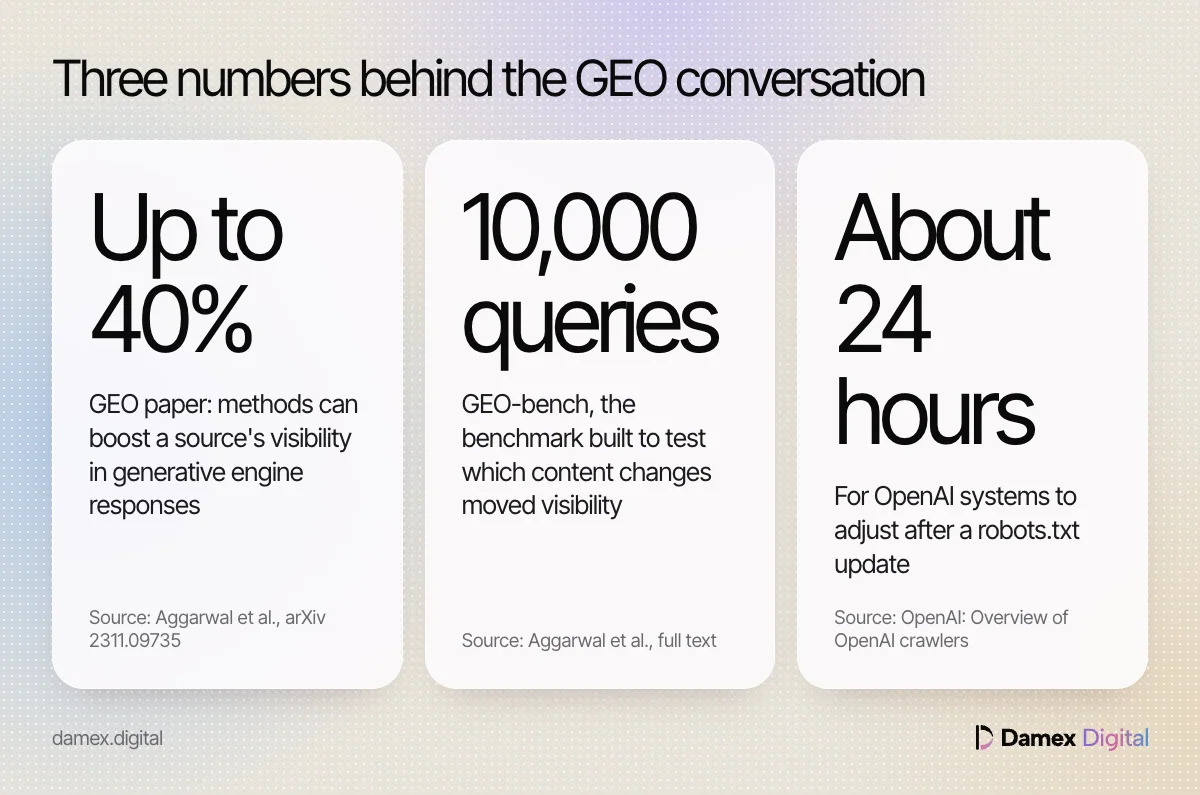
Here’s what the platforms and the research say, in numbers.
Up to 40%
The GEO paper reported that its methods can boost a source's visibility in generative engine responses by up to 40%.
10,000 queries
The researchers built GEO-bench, a benchmark of 10K queries from multiple sources, to test which content changes moved visibility.
Source: Aggarwal et al., full text
About 24 hours
OpenAI says it can take about 24 hours from a robots.txt update for its systems to adjust which sites ChatGPT search can show.
0 extra requirements
Google says there are no additional requirements to appear in AI Overviews or AI Mode beyond being indexed and eligible to show with a snippet.
Microsoft now reports AI citations too. In February 2026 Bing Webmaster Tools added an AI Performance report showing how content appears across Microsoft Copilot, AI-generated summaries in Bing and select partner integrations. When the platforms start reporting on AI answers, it’s a sign those answers are worth measuring.
What’s the difference between AEO vs SEO vs GEO?
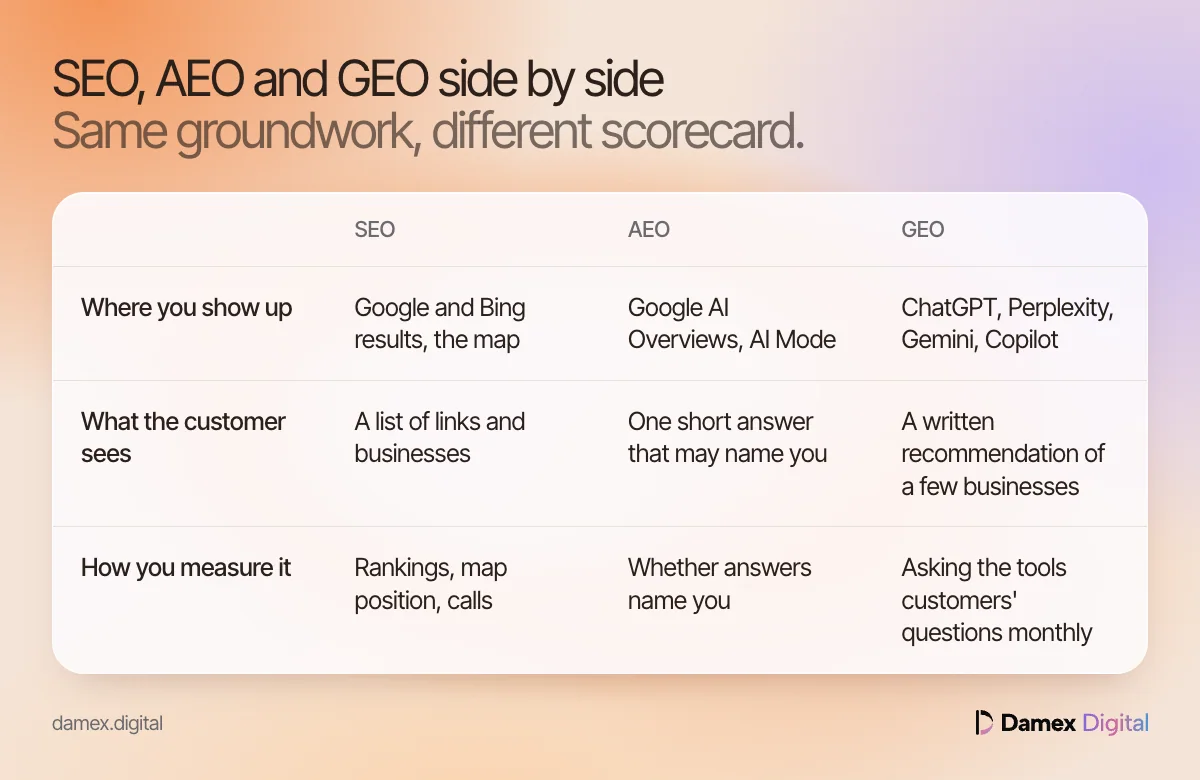
The difference is the surface and the scorecard, not the groundwork. SEO is judged by rankings and map position. AEO is judged by whether a direct answer names you. GEO is judged by whether an AI chat tool recommends you. All three draw on your profile, listings, reviews, pages and mentions.
| SEO | AEO | GEO | |
|---|---|---|---|
| Where you show up | Google and Bing results, the map | Google AI Overviews, AI Mode, other direct answers | ChatGPT, Perplexity, Gemini, Copilot |
| What the customer sees | A list of links and businesses | One short answer that may name you | A written recommendation naming a few businesses |
| Main inputs | Profile, listings, reviews, pages, links | The same, plus pages that answer follow-up questions | The same, plus mentions on sites the tools read |
| How you measure it | Rankings, map position, calls | Whether answers name you, Search Console | Asking the tools your customers’ questions monthly |
| Official guidance | Google SEO Starter Guide | Google’s AI features page | OpenAI, Perplexity and Bing crawler and webmaster docs |
AEO vs SEO: what’s the difference?
SEO wins a place in a list. AEO wins a mention inside an answer. Google says the best practices for SEO remain relevant for AI Overviews and AI Mode, so AEO isn’t a separate discipline. It’s SEO aimed at a different result.
GEO vs SEO: what’s the difference?
GEO aims at tools that write a whole answer and often name only two or three businesses. A ranking report can’t tell you whether you’re one of them. That makes the local SEO vs GEO question mostly about measurement, since the listings and reviews that help on the map are the same ones AI tools read.
Answer engine optimization vs generative engine optimization
In practice they’re the same work. AEO is the older term and usually means Google’s answers. GEO comes from the research paper and usually means chat tools. Pick whichever word your provider uses, then hold them to the measurement.
How does each search surface work, according to the platforms?
Each platform publishes the basics. Google says SEO best practices still apply to its AI features. ChatGPT and Perplexity run their own search crawlers and cite sources. Microsoft reports Copilot citations in Bing Webmaster Tools. None of them publishes a separate AI ranking formula for local businesses, so we stick to what they do say.
Google Search and the map
Google says local results are mainly based on relevance, distance and popularity, and that there’s no way to request or pay for a better local ranking. Relevance is how well your profile matches the search. Distance you can’t change. Popularity is about how well known your business is, and reviews feed into it. Google’s help page says more reviews and positive ratings can help your local ranking.
Google AI Overviews and AI Mode
To be shown as a supporting link, Google says a page must be indexed and eligible to be shown in Google Search with a snippet. It names checking that your Business Profile information is up to date as one of the SEO best practices that apply. It also describes query fan-out, issuing multiple related searches across subtopics and data sources. Traffic from these features is counted in Search Console’s Performance report under the Web search type. Our guide to how Google AI Overviews choose local businesses goes deeper.
ChatGPT search
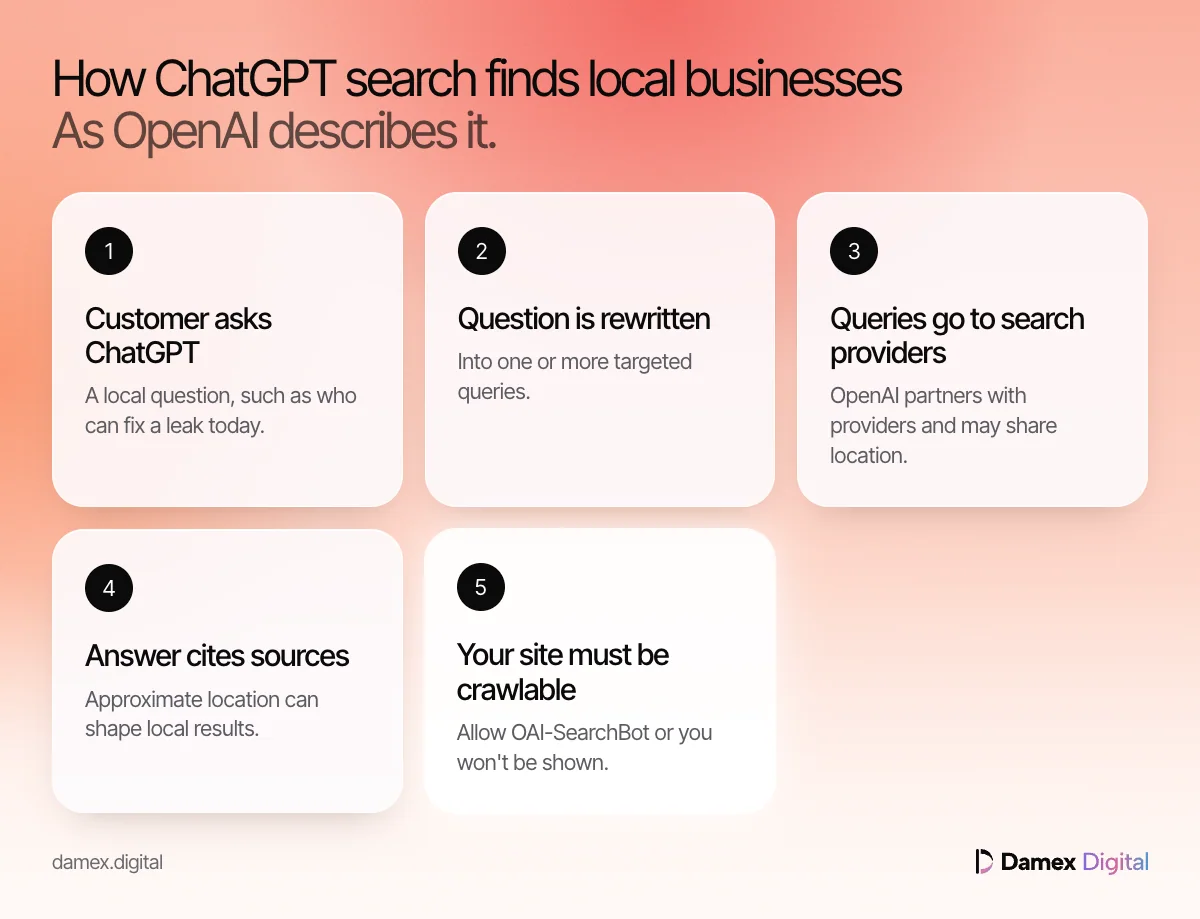
OpenAI’s help page says ChatGPT search typically rewrites your question into one or more targeted queries and sends them to search providers it partners with. It can use an approximate location from your IP address for local results, and may share location with providers of nearby business listings. To be eligible, OpenAI says to allow OAI-SearchBot to crawl your site. Its crawler documentation says sites that opt out of OAI-SearchBot won’t be shown in ChatGPT search answers. For the full checklist, read how to get recommended by ChatGPT.
Perplexity
Perplexity says PerplexityBot is designed to surface and link websites in search results on Perplexity, and that it isn’t used to crawl content for AI foundation models. So blocking it costs you visibility without protecting you from model training. Our guide to getting your business on Perplexity covers where it gets local information and how to check it.
Microsoft Copilot and Bing
Bing’s AI Performance report shows how often pages are cited as sources in AI-generated answers, plus the grounding queries, which Bing describes as the key phrases the AI used when retrieving content. Bing notes the data represents a sample of overall citation activity. The same post says IndexNow helps keep information fresh across search and AI experiences. See our Microsoft Copilot guide for the local details.
What did the GEO research actually find?
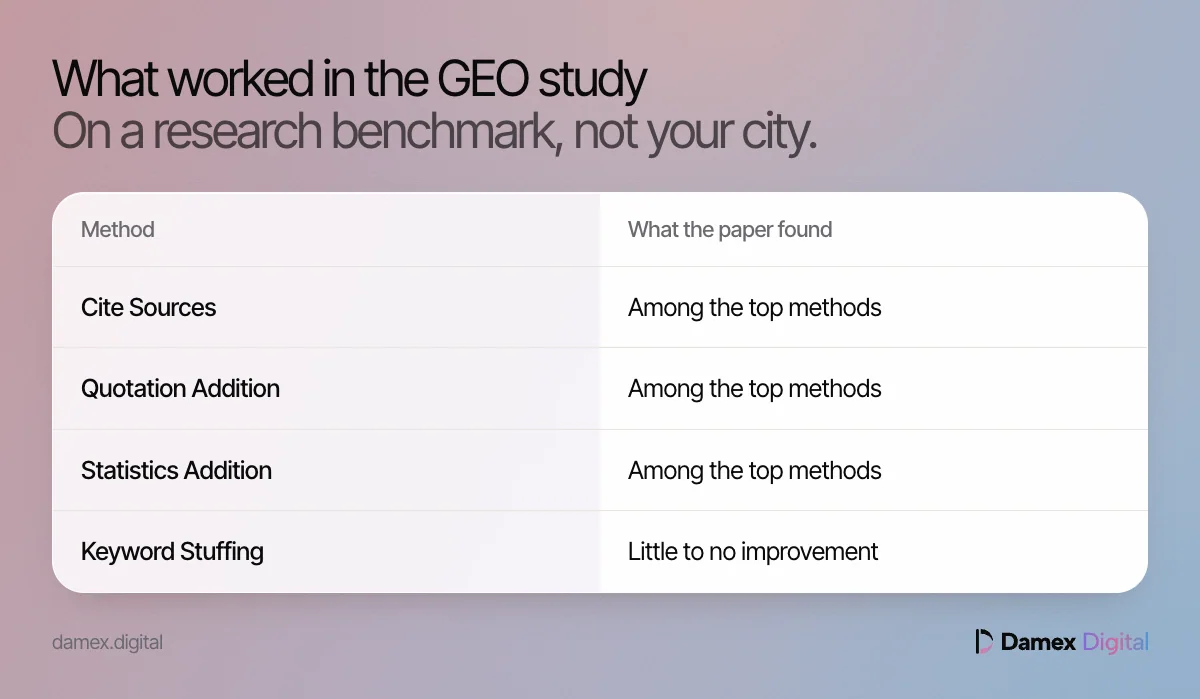
The GEO paper found that some simple content changes made a source more visible in AI answers, and that classic keyword stuffing didn’t. Its best methods were citing sources, adding quotations and adding statistics. It also found that the effect varied by subject, and that lower-ranked sites gained the most.
How does generative engine optimization work in the study?
The authors, Aggarwal and colleagues, tested nine ways of rewriting a web page, including Cite Sources, Quotation Addition, Statistics Addition, Fluency Optimization and Keyword Stuffing. They measured visibility with two metrics, one based on how many words of the answer came from a source and where they appeared, and one based on a subjective impression score. The paper was published at KDD 2024 and also tested its methods on Perplexity.
What worked and what didn’t
According to the full text, the top methods achieved a relative improvement of 30 to 40% on the word-count metric and 15 to 30% on the impression metric. Keyword stuffing, the old SEO habit, offered little to no improvement. The abstract adds that the efficacy of these strategies varies across domains.
What it means for a local business
The most useful line for a small business is that lower-ranked websites, which typically struggle for visibility, benefit significantly more. That’s encouraging, but it’s a result on a research benchmark of general questions, run on engines as they worked in 2023 and 2024. It promises nothing for an emergency plumber in your city. Read it as a reason to write clear, specific, sourced pages and to measure your own visibility before paying anyone for a tactic.
Does AI SEO work, and can AI replace SEO?
AI SEO works in the sense that what AI tools say about you can change when what they read changes. It doesn’t replace SEO, because the AI tools still depend on search crawlers, indexes and the same public information about your business. AI search vs SEO isn’t a choice. One sits on top of the other.
Does AI SEO work?
The research says yes on its benchmark, and the platforms tell you what makes a page eligible. What nobody can tell you is how often you’ll be named next month, because AI answers vary from run to run. So the honest answer is that it works when it’s measured, and that a one-off screenshot proves nothing.
Can AI replace SEO?
No. Google says a page must be indexed in Search to appear in its AI features, and both ChatGPT and Perplexity run search crawlers. If your site isn’t crawlable or your listings disagree, AI tools have less to work with. The AI SEO vs traditional SEO debate is mostly about reporting. Traditional SEO reports rankings. AI SEO adds a check on what the answers say.
Is generative engine optimization the future of digital marketing?
It’s part of it. More customers will ask a chat tool before they search, and the tools will keep changing. The businesses that do well will be the ones whose details are accurate and consistent everywhere, so whichever tool comes next finds the same story. That’s been good marketing since before AI.
What should a local service business do first?
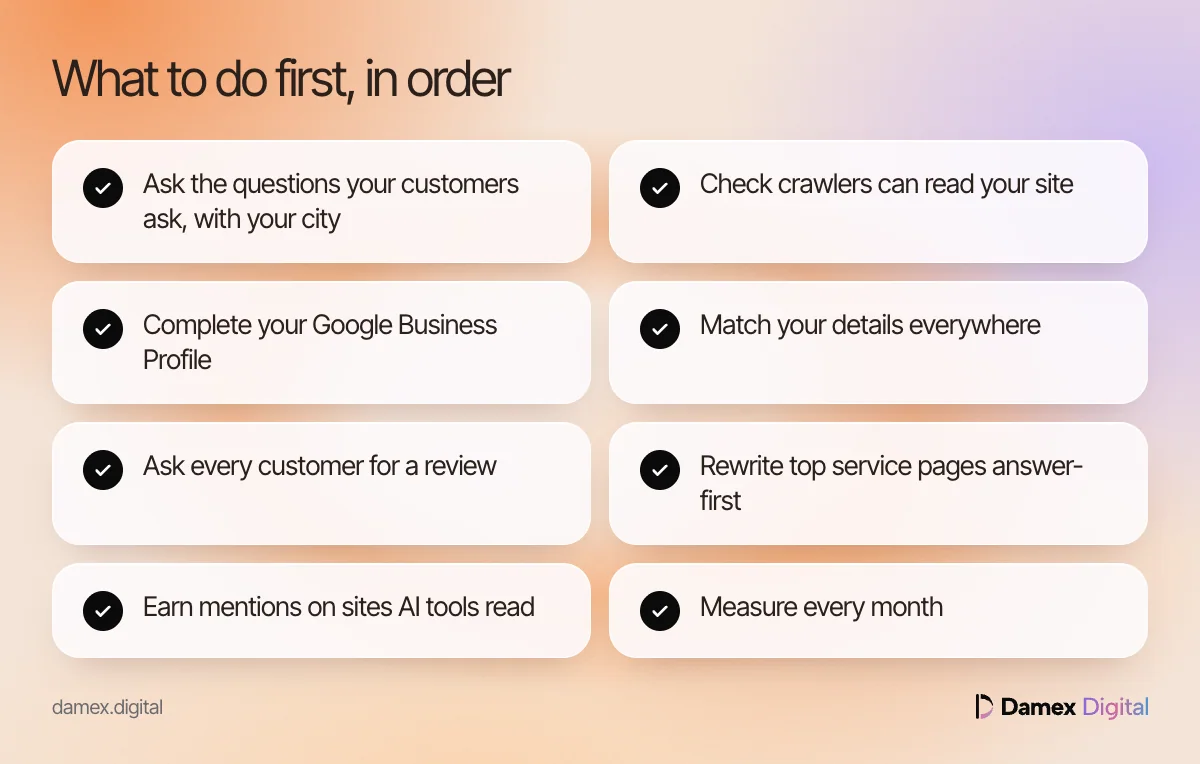
Start with a check you can run in an afternoon, then fix the groundwork in order. Answer engine optimization for small businesses isn’t a separate project. It’s the same profile, listings, reviews and pages, done properly and checked every month in each place your customers ask.
- Ask the questions your customers ask. Put three or four real questions, with your city, into each AI tool and Google. Write down who gets named. Our AI visibility self-audit shows how to score it.
- Check that the crawlers can read your site. Make sure robots.txt allows Googlebot, Bingbot, OAI-SearchBot and PerplexityBot. Our free AI crawler checker tests each one. Blocking GPTBot, OpenAI’s training crawler, is a separate choice.
- Complete your Google Business Profile. Set categories, service area, hours, services and photos. Google lists an up-to-date Business Profile as a best practice for its AI features as well as for the map.
- Match your details everywhere. Use the same name, address, phone and hours on Bing Places, Apple Business Connect, Yelp and your trade directories. A different phone number on one site gives every engine a reason to doubt the others.
- Ask every customer for a review. Don’t pick only the happy ones and don’t tell them what to write. Our guide to getting more Google reviews covers the rules.
- Rewrite your top service pages answer-first. Open each page with one sentence that answers the main question, then cover the follow-ups customers ask, such as price range, hours and areas served. That’s how a page serves query fan-out.
- Earn mentions on sites AI tools read. Trade associations, local news and best-of lists all count. You can’t edit an AI answer, but you can add to what it reads.
- Measure every month. Ask the same questions again and compare. Check Search Console and Bing’s AI Performance report too.
My water heater is leaking. Who can fix it today in Plano, Texas? Recommend a company and say why.
How does this work for each trade?
The groundwork is shared, but the questions differ by trade, and so does what an answer needs to know before it names you. Home service customers ask urgent, local questions. Health practice patients ask about trust, insurance and fit. Here’s where SEO, AEO and GEO meet for each.
For HVAC companies
HVAC questions change with the season, and so do the answers. “Who can fix my AC tonight” in July and “furnace won’t turn on” in January fan out into different follow-ups about hours, price and brands serviced. Make sure your profile categories and service pages cover both seasons, so the AC page isn’t the only one an AI tool can find in December. Our guide to HVAC companies in ChatGPT covers the AC repair questions in detail.
More for HVAC companies: HVAC marketing and AI visibility
For plumbing companies
Plumbing searches are often emergencies, so the map does most of the work and distance matters. Google says distance is one of the three main local factors, and you can’t change where the customer is. What you can control is whether your profile and site say plainly that you handle burst pipes and leaks after hours, and in which areas. Read how to show up for emergency plumber near me searches next.
More for plumbing companies: Plumbing marketing and AI visibility
For roofing companies
Roofing customers ask AI tools to check legitimacy, especially after a storm, when out-of-town crews arrive. A consistent local address, licence details where your state issues them, and reviews that mention real local jobs give an answer something to trust. A GEO proposal that skips those basics for content alone misses the point. See how roofers get found after a storm.
More for roofing companies: Roofing marketing and AI visibility
How does it work for dental and med spa practices?
Health practices face the same three surfaces, with stricter rules on what they can say. Patients ask AI tools about insurance, new-patient availability and whether a practice is right for them. The GEO tactics of adding statistics and quotations only help if the claims are accurate and allowed.
For dental practices
Patients ask questions like “dentist near me that takes Delta Dental” or “emergency dentist open Saturday”. An answer can only name you if your insurance list, hours and services are published in plain text and match your profile. Replies to reviews need care, because patient privacy rules apply. Our guide to how dental practices get named in ChatGPT and AI Overviews covers both. Privacy rules can vary by state as well; check with your attorney.
More for dental practices: Dental marketing and AI visibility
For med spas
Med spa content has to follow advertising rules before it can follow any GEO tactic. Adding statistics to a treatment page only helps if each claim can be backed up, and testimonials and before-and-after photos carry their own rules. Write clear pages about who performs each treatment and what it involves, and keep the numbers you can support. Our guide to med spa advertising rules explains the limits. Rules vary by state; check with your attorney.
More for med spas: Med spa marketing and AI visibility
The same pattern holds for the other trades we work with, from electrical and pest control to auto repair shops. The shared groundwork comes first, then the trade’s own proof, such as licences, certifications and warranties.
Example: one owner, three proposals, one plan
Here’s how to compare SEO, AEO and GEO proposals line by line, and how to read a monthly visibility score, with round numbers chosen to keep the arithmetic easy.
Comparing the proposals
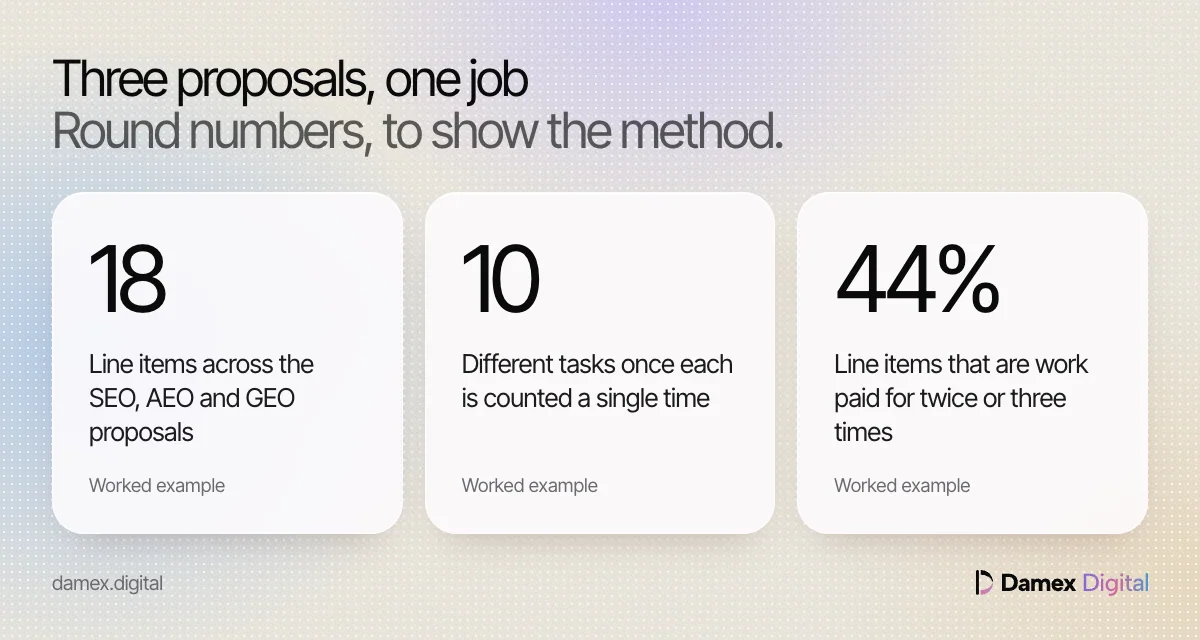
Example: an HVAC owner receives three monthly proposals. The SEO one lists six tasks: Google profile, listings, service pages, two articles a month, review requests and a ranking report. The AEO one lists six: FAQ pages, schema, Google profile, review requests, articles and a report. The GEO one lists six: listings, articles, brand mentions, an llms.txt file, AI answer tracking and a report.
That’s 18 line items. Counted once each, there are only 10 different tasks: profile, listings, service and FAQ pages, articles, reviews, schema, mentions, llms.txt, AI tracking and reporting. So 8 of the 18 line items, or 44%, are work the owner would pay for twice or three times. Example: at $600, $700 and $800 a month, that’s $2,100 for roughly one job done by three vendors.
Reading the score
Example: the owner instead tracks 20 questions across 5 AI engines, which is 20 × 5 = 100 answers a month. In month one the business is named in 4 ChatGPT answers, 6 Perplexity, 3 Gemini, 7 AI Overviews and 2 Copilot, a total of 22 of 100. After the listings and profile fixes, month three shows 31 of 100. That’s 9 more answers naming the business, a rise of 9 ÷ 22, or about 41%. One month’s change can be noise. Three months in the same direction is a trend.
What are the most common SEO, AEO and GEO mistakes?
The most common mistake is paying for the same work under three names. The others come from treating AI search as a trick rather than a reader. Each one below either wastes money or quietly hides you from the tools you’re trying to reach.
- Buying AEO or GEO as a separate product. If the task list matches local SEO, it is local SEO. Ask for one plan that covers every surface and one report that shows each.
- Treating llms.txt as a ranking factor. llms.txt is, in its own authors’ words, a proposal. Google says you don’t need AI text files for its AI features. It’s cheap to publish, but it isn’t a secret lever.
- Blocking the wrong crawler. OpenAI’s GPTBot collects training data, while OAI-SearchBot powers search answers, and each setting is independent. Blocking every AI bot to stop training can also drop you from ChatGPT and Perplexity search.
- Stuffing keywords for AI. The GEO paper found keyword stuffing offered little to no improvement. Clear answers, sources and real numbers did better.
- Judging by one screenshot. AI answers change from run to run. A single answer naming you, or missing you, tells you little. Track the same questions monthly.
- Believing a ranking guarantee. Google says no secrets automatically rank a site first and that local ranking can’t be bought. Nobody can promise an AI answer either.
- Forgetting Bing. Bing now reports how often your pages are cited in Copilot and in AI summaries in Bing. A missing or wrong Bing Places listing is one more inconsistency for every engine to find.
What should you ask before you buy SEO, AEO or GEO?
Ask what will change, where it will be measured and who answers for it. A good provider can name the surfaces, the questions they’ll track and the fixes they’ll make in plain English. Copy this list into your notes before your next sales call.
Questions to ask any SEO, AEO or GEO provider
- Which surfaces will you track: Google results, the map, AI Overviews, ChatGPT, Perplexity, Gemini or Copilot?
- Which customer questions will you test, and will they stay the same every month?
- What exactly will you change on my profile, listings, reviews and pages?
- Which tasks in this proposal would a local SEO provider also do?
- How will you check that search crawlers can read my site?
- Will you ask every customer for a review, without filtering for happy ones?
- Who do I talk to when a number goes the wrong way?
- Do you promise placement or rankings? If yes, why?
How does Damex handle SEO, AEO and GEO?
We don’t sell SEO, AEO and GEO as three products. One team does the groundwork once and measures it in every place customers ask. A senior marketer with 10+ years of experience owns your account, and every piece of work is checked before it goes out under your name.
Every month we ask five AI engines (ChatGPT, Perplexity, Gemini, Google AI Overviews and Copilot) the questions your customers ask and record who gets named. A specialist fixes your name, address and phone across the directories AI engines and maps read for your trade, including Bing Places and Apple Business Connect. From Essentials up, we keep your Google Business Profile complete and post weekly. We write service and FAQ pages that open with a direct answer. On Growth and Authority, we ask customers for a review after each job, with their consent, reply to every review and pitch local best-of lists. Then we count the AI answers that name you against your starting point.
Our Local SEO work covers listings and pages, AI Visibility tracks 10 to 50 buyer questions across five AI engines each month, depending on your package, and Content adds answer-first articles. All three come inside every package. The free two weeks show whether the count of answers naming you goes up before you pay anything. You can run your free check now, and see every package on our pricing page.
Questions people ask
What is answer engine optimization (AEO)?
Answer engine optimization is the work of making your business easy for AI assistants and search features to understand, trust and quote in a direct answer, such as a Google AI Overview. For a local business it means consistent listings, specific reviews and pages that answer common questions in the first sentence.
What does generative engine optimization mean?
Generative engine optimization (GEO) means shaping the sources that AI chat tools such as ChatGPT and Perplexity draw on, so they mention your business accurately. The term comes from a 2023 research paper by Aggarwal and colleagues, later published at KDD 2024.
What is the difference between AEO and SEO?
SEO aims for a ranked link or a spot on the map. AEO aims to be the business an answer names. Google says SEO best practices remain relevant for its AI features, so AEO is a goal built on SEO work, not a separate discipline.
GEO vs SEO: what's the difference?
SEO targets a list of results that the customer clicks through. GEO targets a written answer from an AI chat tool that may name a few businesses and nothing else. The inputs overlap heavily, but GEO is measured by asking the tools questions, not by checking rankings.
Is AEO just a new name for SEO?
Partly. It aims at a different result, being quoted in an answer instead of listed as a link, but the work underneath is mostly SEO.
Does AI SEO work?
The research says visibility in AI answers can be changed. The GEO paper reported gains of up to 40% on its benchmark. No one can promise a result for your trade and city, so measure before and after any work.
Can AI replace SEO?
No. AI search tools still read the web, and Google says a page must be indexed in Search to show in its AI features. SEO is what makes your business readable to them. What AI changes is where customers see the answer.
Do I need a special file or code to show up in Google's AI answers?
No. Google says you don't need new machine-readable files, AI text files or special schema markup to appear in AI Overviews or AI Mode. llms.txt is a proposal, not a confirmed ranking factor.
If I block ChatGPT's crawler, can I still show up in ChatGPT?
Not in its search answers. OpenAI says sites that opt out of OAI-SearchBot won't be shown in ChatGPT search answers, though they can still appear as navigational links. Blocking GPTBot, its training crawler, is a separate setting.
Is answer engine optimization worth it for small businesses?
The groundwork is worth doing for any local business because it helps in Google, the map and AI answers at once. Paying extra for AEO as a separate product rarely is, because most of the tasks repeat what good local SEO already covers.
Why do Reddit threads on AEO vs SEO disagree so much?
Mostly because people use the words differently. Some mean Google's AI Overviews by AEO, others mean every AI tool. Ask anyone selling it which surfaces they mean and how they'll measure them.
Can anyone guarantee I'll show up in AI answers?
No. Google itself says there are no secrets that automatically rank a site first, and there's no way to pay for a better local ranking. A good provider measures how often you're named and improves what the engines read.
Sources
- Google Search Central: AI features and your website
- Google Search Central: SEO Starter Guide
- Google Business Profile Help: Tips to improve your local ranking on Google
- Aggarwal et al., GEO: Generative Engine Optimization (arXiv 2311.09735)
- Aggarwal et al., GEO: Generative Engine Optimization, full text (KDD 2024)
- OpenAI: Overview of OpenAI crawlers
- OpenAI Help Center: Searching the web with ChatGPT
- Perplexity: Perplexity crawlers
- Bing Webmaster Blog: Introducing AI Performance in Bing Webmaster Tools
- llmstxt.org: The /llms.txt file proposal
Cite this post
Badhon, S. U. (2026, October 31). SEO vs AEO vs GEO explained for local business owners. Damex Digital Blog. https://damex.digital/blog/seo-vs-aeo-vs-geo/
Founder, Damex Digital
Led product marketing and go-to-market at weDevs, led marketing at Damex and managed a marketing team at Genex. Founded Damex Digital so local service businesses get the daily work of a good marketing team, measured in calls and booked jobs.