Med spa advertising rules in the US, in plain English
Med spa advertising rules from the FTC, FDA, HHS, Google and Meta: claims, before-and-after photos, influencers, HIPAA releases and a pre-publish checklist.
The short answer
Med spa ads in the US must be truthful and backed by evidence. The FTC says health claims need competent and reliable scientific evidence, that before-and-after photos showing better results than clients generally get are likely deceptive, and that free treatments for influencers must be disclosed. Say FDA approved only where it's true, get written permission for patient photos, and check your state board. Rules vary by state.
- Every health claim, stated or implied, needs competent and reliable scientific evidence, and a client testimonial isn't that evidence.
- Before-and-after photos should show results clients can generally expect, or the ad should clearly say what they can expect.
- Free or discounted treatments given to influencers or reviewers must be disclosed clearly, in the post itself.
- Say approved, cleared or compounded accurately, and get signed, written permission before using any client's photo or story.
- Google, Meta and your state board add their own rules. Rules vary by state; check with your attorney.
- Who this is for
- Med spa owners, medical directors and whoever runs their social media and ads
- Federal rules covered
- FTC Act, Endorsement Guides and reviews rule, FDA approval status, HIPAA
- Platform rules covered
- Google Ads restricted drug terms and Meta's Health and Wellness policy
- Not covered
- Your state's full rules, which vary. This is not legal advice.
On this page 17 sections
- 01What are the med spa advertising rules in the US?
- 02What do the key terms mean?
- 03Why do these rules matter more for med spas now?
- 04What proof do you need for a treatment claim?
- 05Can you post before-and-after photos?
- 06Do you need patient permission to use photos and testimonials?
- 07Do influencers and reviewers have to disclose free treatments?
- 08FDA approved, cleared or compounded: how should you word each?
- 09What do Google Ads and Meta allow for med spa ads?
- 10Do state rules change what you can say?
- 11How do you check a med spa post before it goes live?
- 12Wording do’s and don’ts for med spa ads
- 13Example: fixing a lip filler caption
- 14How do the rules apply to each med spa service?
- 15What do the rules mean for med spa marketing, SEO and Google reviews?
- 16What are the most common med spa advertising mistakes?
- 17How does Damex handle med spa marketing?
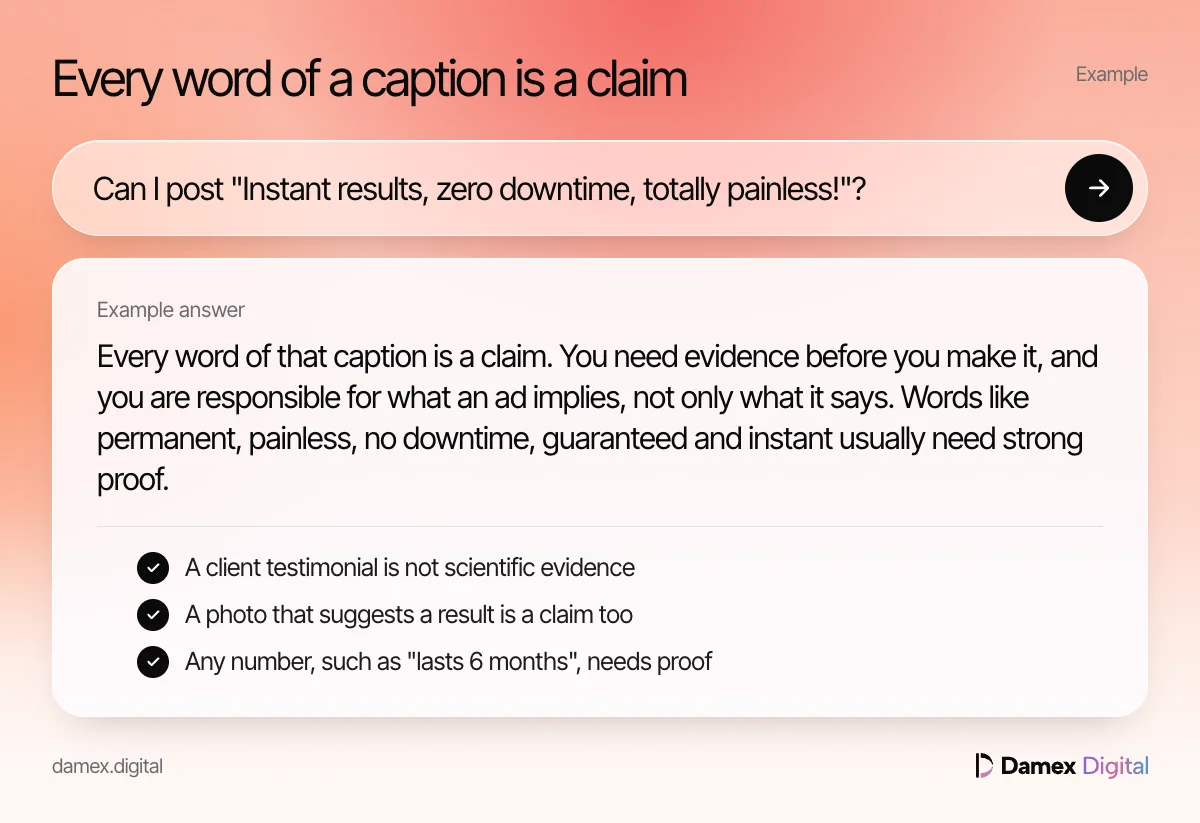
It’s Friday afternoon. Your injector sends a lip filler before-and-after to the person who runs your Instagram. The caption comes back as “Instant results, zero downtime, totally painless!” It looks great, and it’s ready to post.
Every word of that caption is a claim. This guide sets out the med spa advertising rules and regulations in the USA in plain English, from the FTC, FDA, HHS, Google, Meta and two state boards. Rules vary by state, and this isn’t legal advice; check with your attorney.
Key takeaways
- Every health claim a med spa makes, stated or implied, needs competent and reliable scientific evidence before it runs. A client testimonial is not that evidence.
- Before-and-after photos must show results clients can generally expect, or clearly say what they can expect. A results not typical line doesn't fix a misleading photo.
- Free or discounted treatments given to influencers or reviewers must be disclosed clearly, in the post itself.
- If HIPAA covers your practice, using a client's photo or story in marketing needs their signed written authorization. Get a signed release either way.
- Say FDA approved only for the approved product and use. Many devices are cleared, compounded drugs are not approved, and the FDA doesn't approve cosmetics.
- Google, Meta and your state board each add rules on top. Rules vary by state; check with your attorney.
What are the med spa advertising rules in the US?
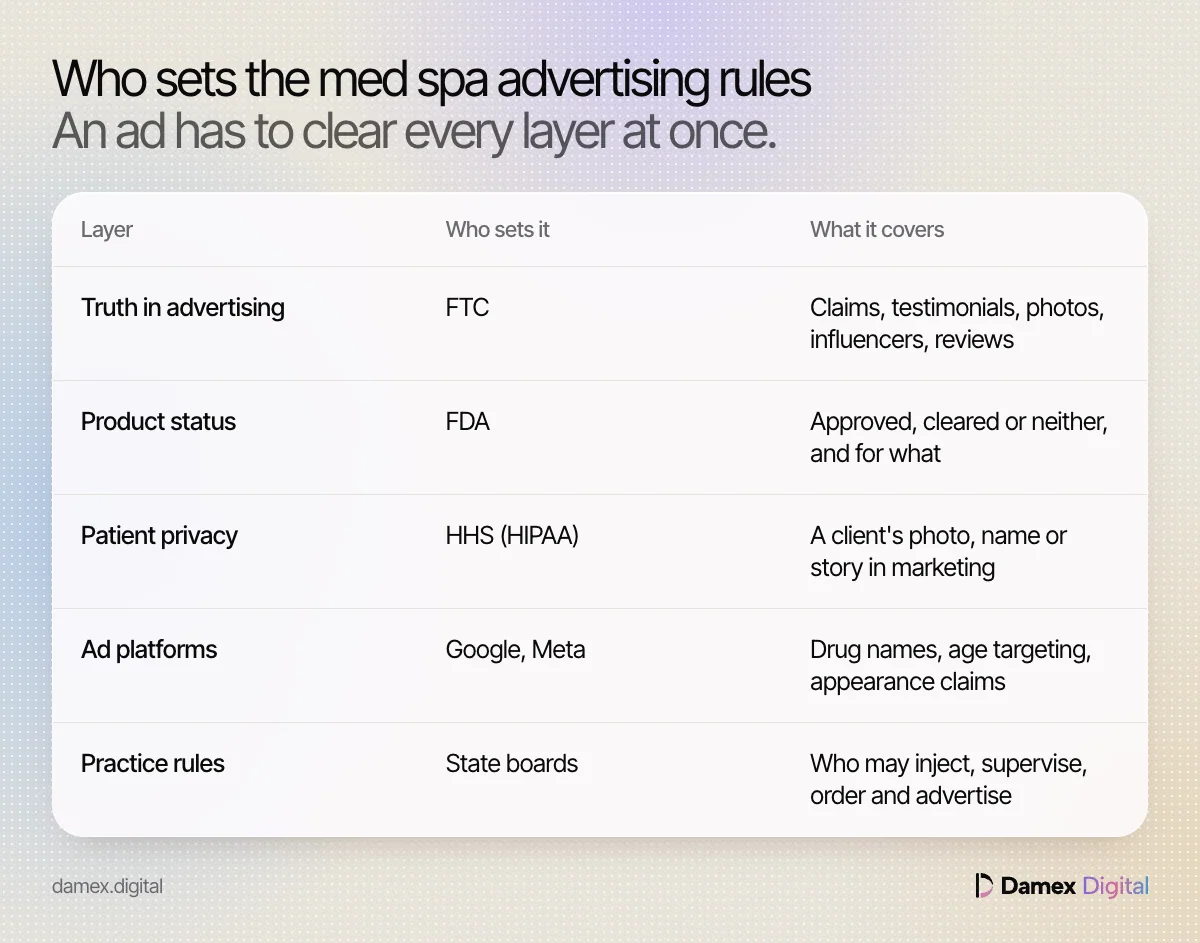
Med spa advertising rules in the US come in layers. The FTC polices truthful claims, endorsements and reviews. The FDA decides what drugs and devices are approved or cleared for. HIPAA covers patient photos and stories if your practice is a covered entity. Google and Meta add ad policies, and state boards add their own rules.
| Layer | Who sets it | What it covers for a med spa |
|---|---|---|
| Truth in advertising | FTC | Treatment claims, testimonials, before-and-after photos, influencers, reviews |
| Product status | FDA | Whether a filler, device or drug is approved, cleared or neither, and for what |
| Patient privacy | HHS (HIPAA) | Using a client’s photo, name or story in marketing |
| Ad platforms | Google, Meta | Drug names in ads, age targeting, appearance claims |
| Practice rules | State medical and nursing boards | Who may inject, supervise, order and advertise treatments |
A med spa ad has to clear every layer at once, and passing one doesn’t mean passing the others.
What do the key terms mean?
Five terms come up again and again in the official sources.
- Substantiation. The evidence you hold before you make a claim. For health claims, the FTC asks for competent and reliable scientific evidence.
- Endorsement. A message people are likely to read as someone else’s honest opinion. The FTC says even “tags in social media posts” can be endorsements.
- Material connection. A link between you and an endorser that people wouldn’t expect, such as a free treatment or a family tie.
- Covered entity. Under HIPAA, a health care provider that transmits health information electronically in a standard transaction, among others.
- Authorization. A patient’s signed written permission to use their information, including photos, for a stated purpose.
Why do these rules matter more for med spas now?
Enforcement tools and official warnings have both grown. The FTC’s reviews rule allows civil penalties, the FDA keeps counting adverse events from compounded GLP-1 drugs, and platforms gate cosmetic ads by age. These five figures come straight from the official pages.
Oct 21, 2024
The FTC's rule on consumer reviews and testimonials went into effect, and it authorizes courts to impose civil penalties for knowing violations.
990
As of May 31, 2026, the FDA had received 990 reports of adverse events associated with compounded semaglutide, and more than 730 for compounded tirzepatide.
Source: FDA: Concerns with unapproved GLP-1 drugs used for weight loss
18
HIPAA's de-identification rule lists 18 types of identifiers, and full face photographic images are one of them.
Source: eCFR: 45 CFR 164.514
22+
The FDA has approved dermal fillers for use in adults 22 years of age or older, and only for specific uses.
18+
Meta says ads promoting cosmetic procedures, and weight loss products and services, must be targeted to people at least 18 years old.
What proof do you need for a treatment claim?
You need evidence before you make the claim. The FTC’s Health Products Compliance Guidance says health claims “require substantiation in the form of competent and reliable scientific evidence,” and that the same principles apply to “the marketing of any health-related product.”
Two details catch owners out. First, you’re responsible for what an ad implies, not only what it says. “Melts fat in one session” and a photo that suggests it are both claims. Second, the FTC says advertisers “should not make claims through consumer testimonials or expert endorsements” that they couldn’t support directly. The Endorsement Guides put it plainly: “Consumer endorsements themselves are not competent and reliable scientific evidence.”
Words like permanent, painless, no downtime, guaranteed and instant usually need strong proof, and so does any number, such as “lasts 6 months”.
What about your own staff’s claims?
The same rules cover your injector or medical director in an ad. The Guides say an expert endorser’s “qualifications must in fact give the endorser the expertise” claimed.
Can you post before-and-after photos?
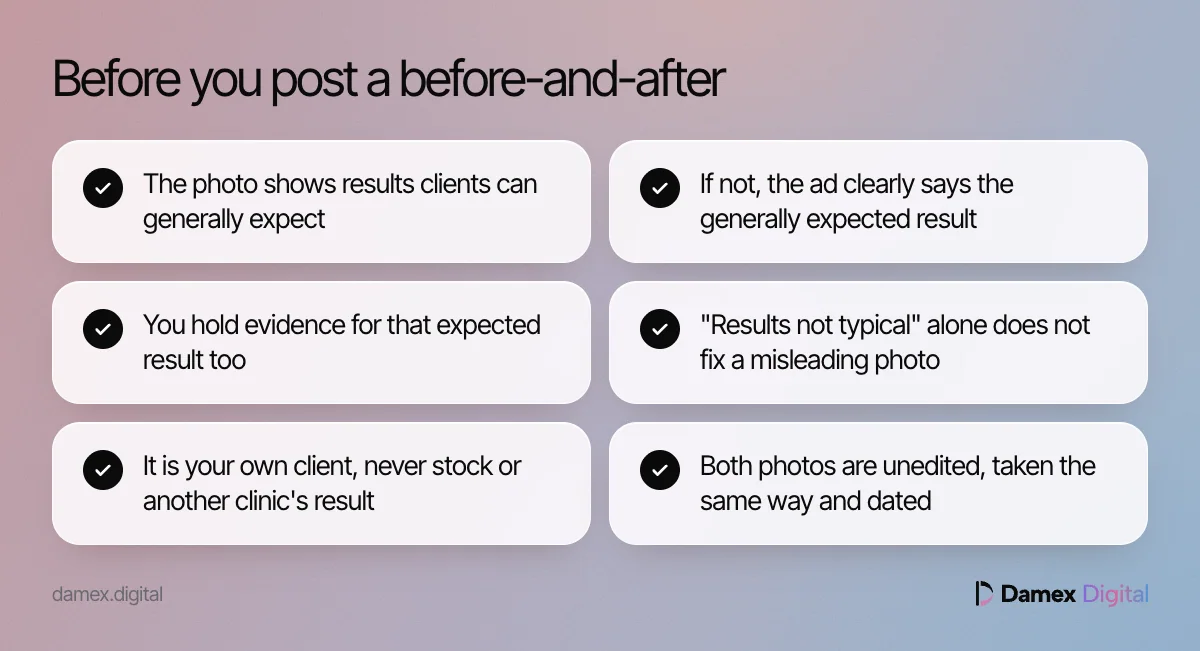
Yes, if they show results clients can generally expect, or the ad clearly discloses what clients can expect. The FTC’s health guidance says “Testimonials that report results more dramatic than users can generally expect are likely to be deceptive.” It uses before-and-after photos among its examples, and says “results not typical” disclaimers don’t cure the deception.
The Endorsement Guides add that if a client’s result isn’t representative, the ad should clearly disclose the generally expected result, and you need evidence for that too. They also say using the image of someone other than the actual endorser is deceptive if it misrepresents something material. Never post stock photos or another clinic’s results as yours.
Do you need patient permission to use photos and testimonials?
Get written permission every time. Under HIPAA, a covered entity includes a health care provider that transmits health information electronically in connection with certain standard transactions. HHS says that, with limited exceptions, the Privacy Rule requires “an individual’s written authorization” before their information is used for marketing.
HHS’s marketing guidance defines marketing as “a communication about a product or service that encourages recipients of the communication to purchase or use” it. A testimonial post promoting your lip filler fits. The exceptions are narrow: a face-to-face communication, or a promotional gift of nominal value.
Photos count: HIPAA’s de-identification rule lists “full face photographic images and any comparable images” as identifiers.
What goes in a photo and testimonial release?
Under 45 CFR 164.508, a valid authorization “must be written in plain language” and includes at least:
- A description of the information, such as specific photos or a quote.
- Who may use it and who may receive it.
- The purpose, such as your Instagram, website and ads.
- An expiration date or event.
- The patient’s signature and date, and their right to revoke it in writing.
A covered entity may not condition treatment on signing, and must give the patient a copy. If you’re not sure HIPAA covers your practice, ask your attorney. A signed release is good practice either way.
Do influencers and reviewers have to disclose free treatments?
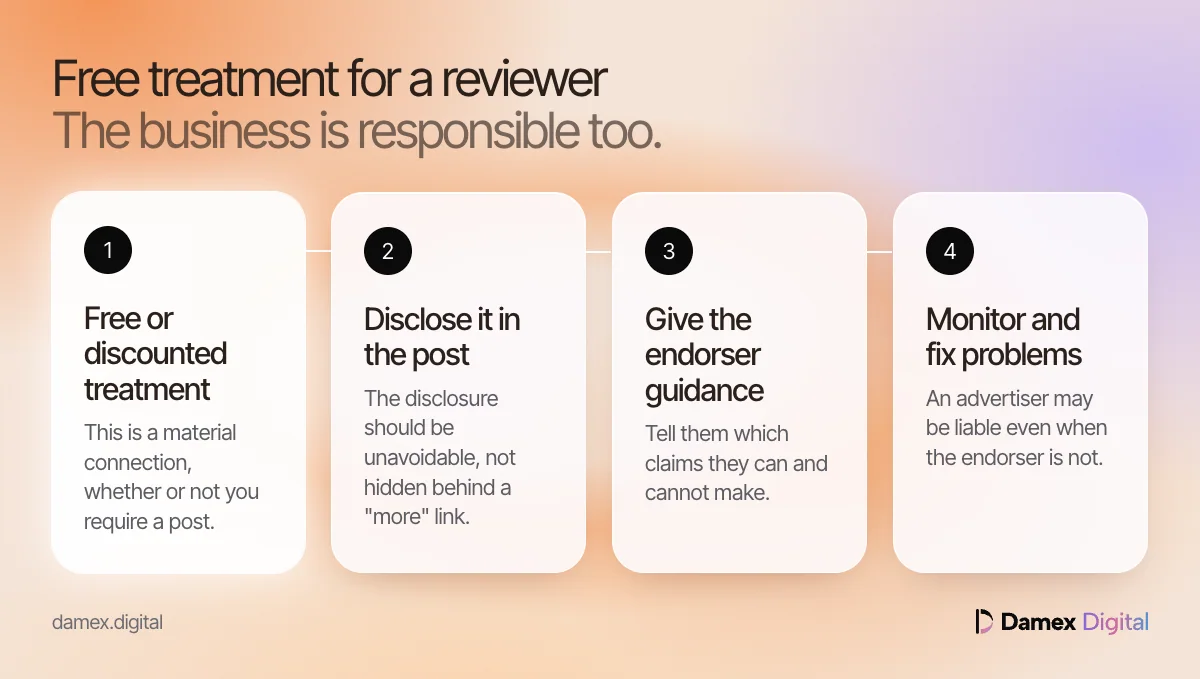
Yes. The Endorsement Guides say material connections include “free or discounted products” given to an endorser, whether or not you require a post. On social media, the Guides say “the disclosure should be unavoidable.” In their own examples, a disclosure hidden behind a “more” link, or a platform label that’s easy to miss, falls short.
You’re responsible too. The Guides say “an advertiser may be liable for a deceptive endorsement even when the endorser is not liable.” Give endorsers guidance, monitor what they post and fix problems. If a creator gets a free facial and calls it “a facelift without surgery”, that claim is yours to correct.
What does the fake reviews rule add?
The FTC’s rule on fake reviews and testimonials took effect on October 21, 2024. Its Q&A says a business that posts testimonials on its own website is disseminating them, not just hosting them. It bans incentives that require a particular sentiment, and says relatives who review you should “clearly and conspicuously disclose their relationship” to your business. See our glossary entry on the FTC fake review rule.
Google goes further and bans review incentives outright. Our guide on how to get more Google reviews covers its rules. Ask every client, and don’t suggest what to write.
FDA approved, cleared or compounded: how should you word each?
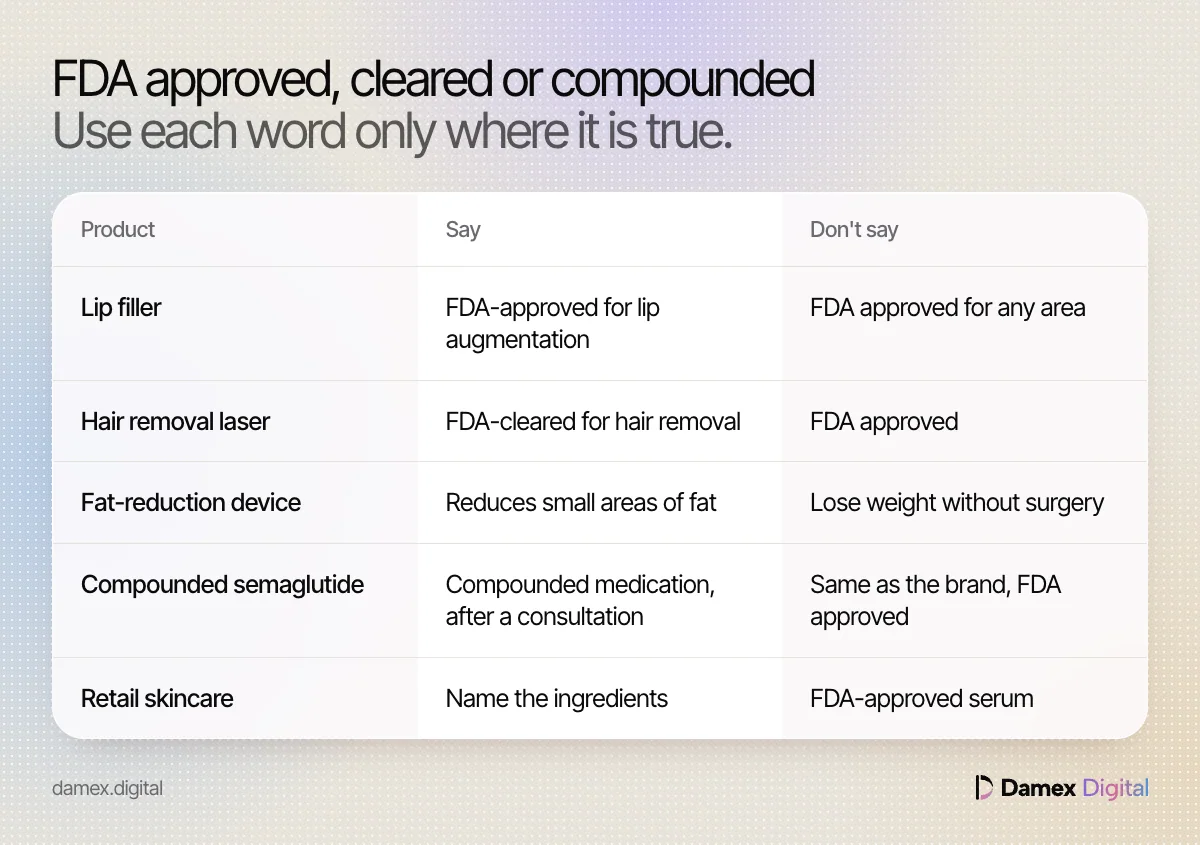
Use the word that matches the product and the use. The FDA approves some fillers and drugs for specific uses, clears many devices through 510(k), doesn’t approve compounded drugs and doesn’t approve cosmetics. Saying FDA approved about the wrong product, or the wrong use, is a false claim.
Dermal fillers
The FDA’s dermal fillers page says fillers are approved for adults 22 or older for specific uses, such as moderate to severe facial wrinkles and augmenting the lips, cheeks, chin and back of the hand. It recommends against filler for body contouring and in the glabella, nose, area around the eyes, forehead or neck, saying “these uses for dermal fillers are not approved by the FDA.”
So a non-surgical nose job with filler is a use the FDA lists as not approved. The FDA also says needle-free devices are not approved for injecting fillers.
Lasers and body contouring devices
The FDA’s explainer on approval says the highest-risk devices generally need premarket approval, while many moderate-risk devices reach the market through “510(k) clearance.” Call a cleared laser cleared, for the use it’s cleared for. The FDA also says its logo shouldn’t be used to suggest it endorses any product or service.
The FDA’s body contouring page says non-invasive body contouring “does not treat obesity or improve your health” and “will not result in weight loss.”
Compounded GLP-1s and skincare
The FDA says “compounded drugs are not FDA approved” and that it doesn’t review them for safety, effectiveness or quality before they’re marketed. Its GLP-1 page lists a company that “makes claims such as the compounded drug is the same as an FDA-approved drug” as a red flag. Skincare is simpler: “The FDA doesn’t approve cosmetics.”
| Product | What the FDA says | Say | Don’t say |
|---|---|---|---|
| Lip filler | Approved for lip augmentation in adults 22+ | FDA-approved for lip augmentation | FDA approved for any area |
| Filler in the nose | Listed as not approved | Describe the treatment, with no FDA claim | FDA-approved liquid nose job |
| Hair removal laser | Often 510(k) cleared | FDA-cleared for hair removal | FDA approved |
| Fat-reduction device | Won’t result in weight loss | Reduces small areas of fat | Lose weight without surgery |
| Compounded semaglutide | Not FDA approved | Compounded medication, prescribed after a consultation | Same as the brand, FDA approved |
| Retail skincare | FDA doesn’t approve cosmetics | Name the ingredients | FDA-approved serum |
What do Google Ads and Meta allow for med spa ads?
Both platforms let med spas advertise, with limits. Google restricts prescription drug terms and requires certification to target them as keywords. Meta requires cosmetic procedure and weight loss ads to target adults and blocks ads that attack people’s appearance. Neither platform’s approval makes a claim legal.
Google Ads
Google’s restricted drug terms policy says US campaigns “may use prescription drug terms for promotional purposes, in accordance with local laws and regulations.” You don’t need certification to use those terms in ads and landing pages, but “you must be certified in order to keyword-target these terms.” Google’s list of those terms includes neurotoxin brands and GLP-1 ingredients such as semaglutide.
So an ad can mention a neurotoxin brand, but bidding on the brand as a keyword needs certification. Google also requires certification for business types like telehealth providers, which matters if you prescribe weight loss medicine online.
Meta (Facebook and Instagram)
Meta’s Health and Wellness policy says ads for cosmetic procedures and weight loss products and services “must be targeted to people at least 18 years or older.” It lists cosmetic procedures such as dermal fillers, and cosmetic ads “depicting before and after transformation”, among what’s allowed for adults.
The same policy bans “statements of inferiority about physical appearance” and clickbait in a health or weight loss context. Prescription weight loss products fall under Meta’s Drugs and Pharmaceuticals policy, with its own targeting and written permission rules. A hook like “Hate your saggy jawline?” is the kind of line to rewrite.
Do state rules change what you can say?
Yes, and they vary a lot. State medical and nursing boards decide who may inject, supervise, order and advertise treatments. An ad that suggests the wrong person does the work can be a problem even when every federal rule is met.
California
The Medical Board of California’s FAQs say “no unlicensed persons, such as medical assistants, may inject Botox.” They also say a lay-owned business can’t legally offer these services, and that the Board can direct a business to change or clarify a misleading ad.
Texas
The Texas Medical Board’s March 2026 bulletin describes House Bill 3749, known as Jenifer’s Law. It limits who may order elective IV therapy and “restricts the administration of elective IV therapy to a physician” or a physician assistant, advanced practice registered nurse or registered nurse under adequate physician supervision. Ads for IV drips should match who actually gives them.
Rules vary by state, so check your medical and nursing boards, and your attorney, before you launch a campaign or a new treatment.
How do you check a med spa post before it goes live?
Run every post and ad through the same eight checks before it’s published. Once it’s a habit it takes minutes, and it catches problems before a client or a regulator does.
Checking a med spa post or ad
- List every claim. Include what the photo suggests.
- Match each claim to evidence. No evidence on file means cut the claim.
- Check the results are typical. If most clients don’t get this result, say clearly what they can generally expect.
- Check the photo. Your own client, unedited, same lighting and angle.
- Find the signed release. Confirm it covers this photo, this channel and this purpose, and hasn’t been revoked.
- Disclose any connection. Free treatment, discount or staff member? Say so in the post itself.
- Fix FDA wording and platform settings. Use approved, cleared or neither correctly, and target adults on Meta.
- Check your state. Confirm who performs the treatment fits your board’s rules. This step needs you or your attorney.
Med spa pre-publish checklist
- Every claim has evidence on file
- Results shown are typical, or the expected result is disclosed
- Photos are our own clients, unedited, taken the same way
- A signed release covers this photo, channel and purpose
- Any free or discounted treatment is disclosed in the post
- FDA approved appears only where true for that product and use
- No weight loss claims for body contouring
- The post names who performs the treatment
- Prices match the website and booking tool
- Someone has checked it against our state’s rules
Wording do’s and don’ts for med spa ads
Most problems sit in a handful of familiar phrases. The versions on the right are starting points, and they still need to be true for your clinic.
| Don’t write | Write instead | Why |
|---|---|---|
| Painless | Most clients describe mild discomfort | Absolute claims need proof |
| Zero downtime | Some swelling for a day or two is common | Recovery claims need evidence |
| Results guaranteed | Results vary; we’ll talk through what to expect | Guarantees are claims too |
| Lasts forever | Some fillers are absorbed over time | The FDA says some fillers are naturally absorbed |
| Loved by @creator! | @creator received this treatment free | Material connections must be disclosed |
| Hate your wrinkles? | Smooth the look of forehead lines | Meta bans attacks on appearance |
Example: fixing a lip filler caption
Here’s the Friday caption, rewritten. Swap in your own creator, injector and price.
The draft read: “Instant results, zero downtime, totally painless! Our FDA-approved filler gives you the perfect pout, guaranteed. Loved by @lauren.glows! Lip special $399 this week only.”
| Line in the draft | Problem | Fix |
|---|---|---|
| Instant results | Implies the final result shows straight away | Say when results usually settle, as your injector confirms |
| Zero downtime | Recovery claim without evidence | Some swelling for a day or two is common |
| Totally painless | Absolute claim | Most clients describe mild discomfort |
| FDA-approved filler | True only for the approved use | FDA-approved for lip augmentation in adults |
| Perfect pout, guaranteed | Promised result | Results vary; we’ll plan yours together |
| Loved by @lauren.glows | Free treatment not disclosed | Lauren received this treatment free |
| $399 this week only | Fine if true and the price matches everywhere | Keep it, and update the booking tool |
The tally: 7 claims. 1 stays, 5 are reworded and 1 gets a disclosure, so 6 of 7 lines change before anyone checks the release or the state rules.
The fixed caption: “Soft, natural lip filler by Maria Lopez, RN, our nurse injector. FDA-approved for lip augmentation in adults. Some swelling for a day or two is common, and results vary, so we’ll plan yours together. Lip filler from $399 this week. Lauren received this treatment free.”
How do the rules apply to each med spa service?
Each service on a med spa menu meets a different mix of these rules, but every one meets the FTC’s evidence and photo rules.
Neurotoxins and Botox near me specials
People search phrases like botox near me specials and botox near me prices, so promotions get clicks. Keep the price true, the same everywhere, and clear about whether it’s per unit or per area. Name who injects, since California says medical assistants may not inject Botox.
Body contouring, weight loss, IV therapy and skincare
Keep fat-reduction devices away from weight loss language. Never compare compounded GLP-1s to approved brands, and check Google’s and Meta’s prescription drug rules first. In Texas, IV drip ads should match Jenifer’s Law. Keep membership perks separate from reviews. Our med spa industry page covers the wider marketing picture.
What do the rules mean for med spa marketing, SEO and Google reviews?
The same rules apply to your website, Google Business Profile and reviews, not only to ads. Careful, supported treatment pages serve search engines, AI assistants and regulators alike.
Med spa marketing ideas that stay inside the rules
The best med spa marketing ideas are usually the honest ones: explain a treatment start to finish, introduce your injector with real credentials, answer consultation questions, and post consented, unedited results. Our social media service and short-form video service build posts from that material.
Med spa SEO and local SEO for med spas
Med spa SEO starts with one page per treatment that says what it is, who performs it and a starting price that matches your booking tool. Local SEO for med spas adds an accurate Google Business Profile. Our med spa Google Business Profile playbook walks through the setup.
AI SEO for a med spa business
AI SEO for a med spa business means making those pages easy for assistants to quote. An unsupported claim can travel into an AI answer without its context. Our guides to getting recommended by ChatGPT and SEO vs AEO vs GEO go further. Nobody can promise placement in an AI answer.
Med spa Google reviews
Ask every client after the visit, with the same message, and don’t suggest what to write or offer rewards. Keep replies general and never confirm someone is a client. For Yelp, claim and complete your page without asking for reviews. Our med spa review request templates follow those rules.
What are the most common med spa advertising mistakes?
Most med spa advertising problems come from a few repeated habits: claims you can’t support, client images used without permission, and connections left undisclosed.
- Posting your best result as typical. A results not typical line doesn’t fix it.
- Editing before-and-after photos. Filters and changed lighting change the claim.
- Using photos without a signed release. Full-face photos are HIPAA identifiers.
- Gifting treatments without a disclosure. You share responsibility for the post.
- Calling everything FDA approved. Many devices are cleared, and compounded drugs and cosmetics aren’t approved.
- Using weight loss language for body contouring. The FDA says it won’t result in weight loss.
- Asking only happy clients for reviews. Google doesn’t allow it. Ask every client the same way.
- Skipping the state check. A board can ask you to change an ad.
How does Damex handle med spa marketing?
Our team runs med spa marketing, and a senior marketer owns your account. Every draft is checked for promised results and unsupported medical claims before anything goes out under your name. Anything we can’t confirm goes back to you, including every state question.
- AI visibility. Every package tracks the questions clients ask AI engines about treatments in your city, and we work on the sources those engines read.
- Social. On the social media add-on, we turn the client photos you send into posts for two platforms.
- Ads. On the Paid ads add-on, we build Google Search and Meta campaigns inside the budget cap you set. See our Paid ads service.
- Reviews. On Growth and Authority, we ask every client for a review, with their consent, and reply in general terms. See our Reviews service.
Prices are on the pricing page, with context in our guide to local marketing costs. To see how your med spa looks to AI assistants first, run the free AI Visibility Check. Rules vary by state and none of this is legal advice; check with your attorney.
Questions people ask
What are the advertising rules for med spas in the US?
Several layers apply at once. The FTC requires truthful, evidence-backed claims and honest endorsements and reviews. The FDA decides what drugs and devices are approved or cleared for. HIPAA covers patient photos and stories if your practice is a covered entity. Google and Meta add ad policies, and state medical and nursing boards add their own rules. Rules vary by state; check with your attorney.
Is a results not typical disclaimer enough under a dramatic before-and-after photo?
No. The FTC's health products guidance says disclaimers like results not typical don't cure the deception. If the result isn't what clients generally get, the ad should clearly say what they can generally expect, and you need evidence for that too.
Can I give an influencer a free treatment in exchange for a post?
You can, but the connection must be disclosed clearly in the post. The FTC's Endorsement Guides list free or discounted products as a material connection, and the advertiser can be liable for what the influencer claims, even when the influencer isn't.
Does HIPAA apply to my med spa?
It applies to health care providers who transmit health information electronically in connection with certain standard transactions. Many owners aren't sure whether that includes them, so ask your attorney, and get a signed written release for any client photo or testimonial either way.
Can I advertise compounded semaglutide as FDA approved?
No. The FDA says compounded drugs are not FDA approved and that it doesn't review them for safety, effectiveness or quality before they're marketed. It also lists claiming a compounded drug is the same as an FDA-approved drug as a red flag for consumers.
Can I run Google Ads for Botox?
Google's restricted drug terms policy says campaigns targeting the United States may use prescription drug terms in ads and landing pages without certification, but you must be certified to keyword-target those terms. Your claims still have to meet FTC rules and your state's rules.
Can I use before-and-after photos in Facebook and Instagram ads?
Meta's Health and Wellness policy lists cosmetic procedure ads depicting before and after transformation among what it allows, if the ad targets people 18 or older. Meta's approval doesn't make a photo truthful, so the FTC's typical-results rules still apply.
Does my med spa medical director have to be named in ads?
None of the federal sources in this guide require it. Some states have their own rules on naming or supervising physicians, so check your state medical board and your attorney. Naming who performs each treatment and their credentials is good practice anyway.
What should a med spa post on social and Google?
Real work from your own clients with signed releases, unedited photos taken the same way, plain explanations of each treatment, who performs it and their credentials, and prices that match your website and booking tool. Leave out promised results and any claim you can't support.
How do I get my med spa recommended when someone asks AI for botox near me?
No one can guarantee it. Assistants draw on your website, your Google Business Profile and reviews, so publish a clear page for each treatment that names who performs it, keep your listings consistent and ask every client for a Google review without suggesting what to write.
Where do I find my state's med spa advertising rules?
Start with your state medical board and nursing board, then confirm with a healthcare attorney. Rules on who can perform, supervise and advertise treatments differ by state. California and Texas, for example, publish board guidance on Botox and elective IV therapy.
Sources
- FTC: Health Products Compliance Guidance
- eCFR: 16 CFR Part 255, FTC Guides Concerning Use of Endorsements and Testimonials in Advertising
- FTC: The Consumer Reviews and Testimonials Rule, Questions and Answers
- HHS: HIPAA Privacy Rule guidance on marketing
- eCFR: 45 CFR 164.508, Uses and disclosures for which an authorization is required
- eCFR: 45 CFR 164.514, De-identification of protected health information
- eCFR: 45 CFR 160.103, Definitions (covered entity)
- FDA: Dermal Fillers (Soft Tissue Fillers)
- FDA: Non-Invasive Body Contouring Technologies
- FDA: Is It Really FDA Approved?
- FDA: Concerns with unapproved GLP-1 drugs used for weight loss
- Google Ads Policy Help: Restricted drug terms
- Meta Advertising Standards: Health and Wellness
- Medical Board of California: FAQs on cosmetic treatments
- Texas Medical Board: Bulletin, March 2026 (House Bill 3749, Jenifer's Law)
Cite this post
Badhon, S. U. (2026, October 31). Med spa advertising rules in the US, in plain English. Damex Digital Blog. https://damex.digital/blog/med-spa-advertising-rules/
Founder, Damex Digital
Led product marketing and go-to-market at weDevs, led marketing at Damex and managed a marketing team at Genex. Founded Damex Digital so local service businesses get the daily work of a good marketing team, measured in calls and booked jobs.