Roofing marketing after a storm: how to get found and trusted
After a storm, homeowners are told to check every roofer. How a local roofer gets found and chosen: license, Google profile, storm page, ads and texting rules.
The short answer
After a storm, the FTC, FEMA and state attorneys general tell homeowners to check a roofer's license, insurance and reviews and to be wary of door-to-door offers. The local roofer who gets the call is the one they can verify fast: license and insurance in text, an accurate Google profile, recent reviews, an honest storm page and every call answered.
- Homeowners are told by the FTC, FEMA and state officials to verify license, insurance, reviews and complaints before they hire.
- Make each check take seconds by putting those facts in text on your website and Google profile.
- Write one honest storm page that explains what happens next and promises nothing about insurance.
- Ads help only if every call is answered, so set a budget your crews and phones can handle.
- Text only people who gave written consent, and treat door knocking as the weakest way to be trusted.
- Who this is for
- Owners of local roofing companies in storm-prone areas of the US
- What to do first
- Put your license or registration number and insurance line in text on your homepage and Google profile
- What homeowners are told
- Confirm the license, get more than one estimate, never sign over the insurance check
- What never to promise
- That insurance will pay. The insurer and its adjuster decide coverage
On this page 17 sections
- 01What does roofing marketing after a storm involve?
- 02Why does being easy to verify matter after a storm?
- 03What do homeowners check before hiring a roofer after a storm?
- 04What is considered storm damage to a roof?
- 05How do you get found and trusted after a storm?
- 06What should a storm damage page say?
- 07How should you update your Google Business Profile in storm season?
- 08Should you run Local Services Ads or search ads after a storm?
- 09What are the rules on texting and door knocking after a storm?
- 10Do manufacturer certifications help a roofer get chosen?
- 11How should a roofer talk about insurance claims?
- 12Example: what storm week puts at stake
- 13Which roofing marketing ideas work best in storm week?
- 14What should you do in storm week?
- 15What are the common mistakes roofers make after a storm?
- 16How do AI assistants pick a roofer after a storm?
- 17How Damex does it
Hail came through on Tuesday night. On Wednesday morning a homeowner stands in the driveway looking at a dented gutter, phone in hand. A truck she’s never seen is parked two doors down, and a man with a clipboard is offering free inspections.
She doesn’t call him. She searches for a roofer, opens three profiles and starts checking. Whoever passes her checks fastest gets the call.
That is what roofing marketing after a storm comes down to: being the roofer a worried homeowner can find, check and trust in a minute or two. This guide, written for owners of local roofing companies in the US, shows how to pass those checks before and during storm week.
Key takeaways
- The FTC, FEMA and state attorneys general tell homeowners to verify a roofer's license, insurance and reviews, and to be wary of door-to-door offers.
- Put your license or registration number and insurance line in text on your website and Google profile, so each check takes seconds.
- Write one honest storm page. Explain what happens next and never promise what insurance will pay.
- Size ads to the calls you can answer. Local Services Ads began moving into Performance Max in August 2026, and you still pay only for valid leads.
- Text only people who gave written consent. Federal rules also limit telephone solicitations to 8 a.m. to 9 p.m. local time.
- Ask every customer for a review, including repair and insurance jobs, so storm-week searchers see recent local work.
What does roofing marketing after a storm involve?
Roofing marketing after a storm is the work that makes a local roofer easy to find, check and call after hail or high wind: your Google Business Profile, a storm page, reviews, ads, phones and how you contact homeowners. Most of it is set up before the storm, so a careful homeowner picks you after checking three roofers.
The terms in this guide
- Storm chaser is the term officials such as the Illinois Attorney General use for contractors who turn up after storms and go door to door offering repairs.
- Local Services Ads are Google’s pay-per-lead ads for home service businesses, now moving into Performance Max campaigns.
- Prior express written consent is the signed agreement, which can be given electronically, that federal rules require before you send marketing texts with an autodialer.
Why does being easy to verify matter after a storm?
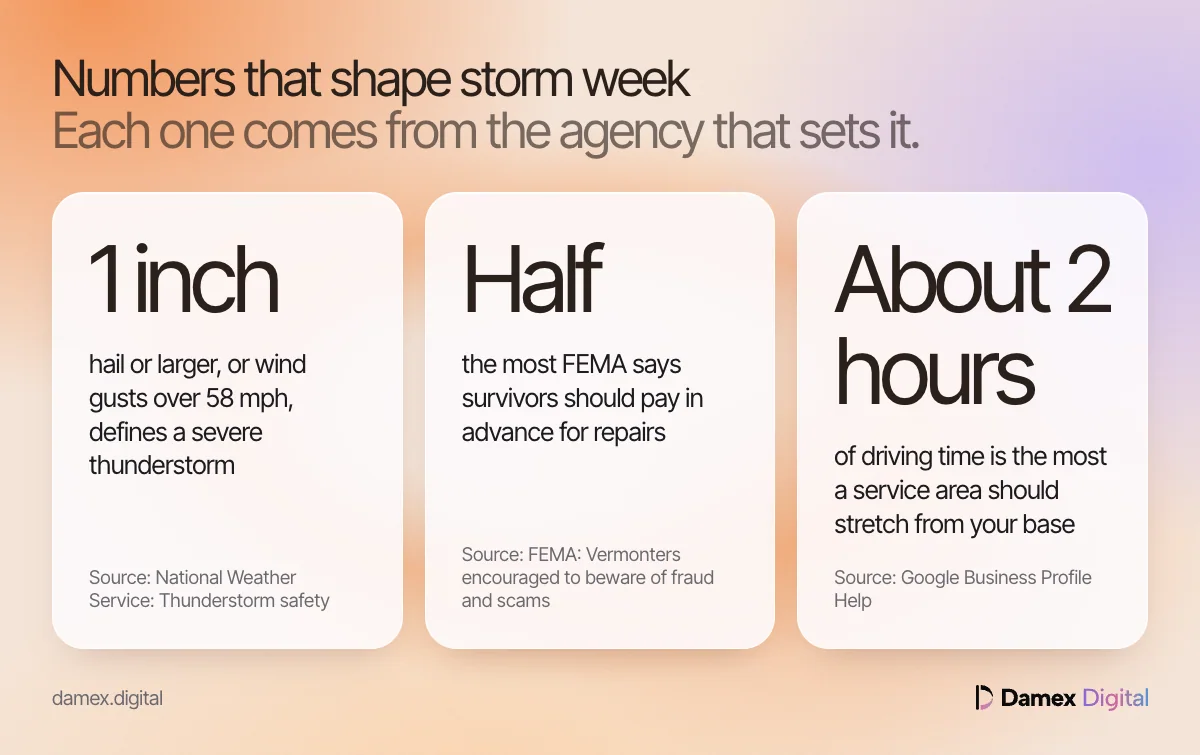
Being easy to verify matters because federal and state officials tell homeowners to check every contractor before they sign, and after a storm they’re checking several of you at once. These are the rules and thresholds that shape storm week, each from the agency or platform that sets it.
1 inch
The National Weather Service defines severe thunderstorms as storms capable of producing hail an inch or larger, or wind gusts over 58 mph.
Half
FEMA tells disaster survivors not to pay more than half the costs of repairs in advance, and to use licensed or verified local contractors backed by reliable references.
Source: FEMA: Vermonters encouraged to beware of fraud and scams
3 business days
The FTC's Cooling-Off Rule gives buyers until midnight of the third business day to cancel many sales made at their home, with a few exceptions.
Source: FTC: Buyer's Remorse: The FTC's Cooling-Off Rule May Help
About 2 hours
Google's guidelines say a business's service area shouldn't extend farther than about 2 hours of driving time from where it's based.
Source: Google Business Profile Help: Guidelines for representing your business
8 a.m. to 9 p.m.
Federal rules bar telephone solicitations to residential subscribers before 8 a.m. or after 9 p.m., local time at the called party's location.
Source: eCFR: 47 CFR 64.1200
What do homeowners check before hiring a roofer after a storm?
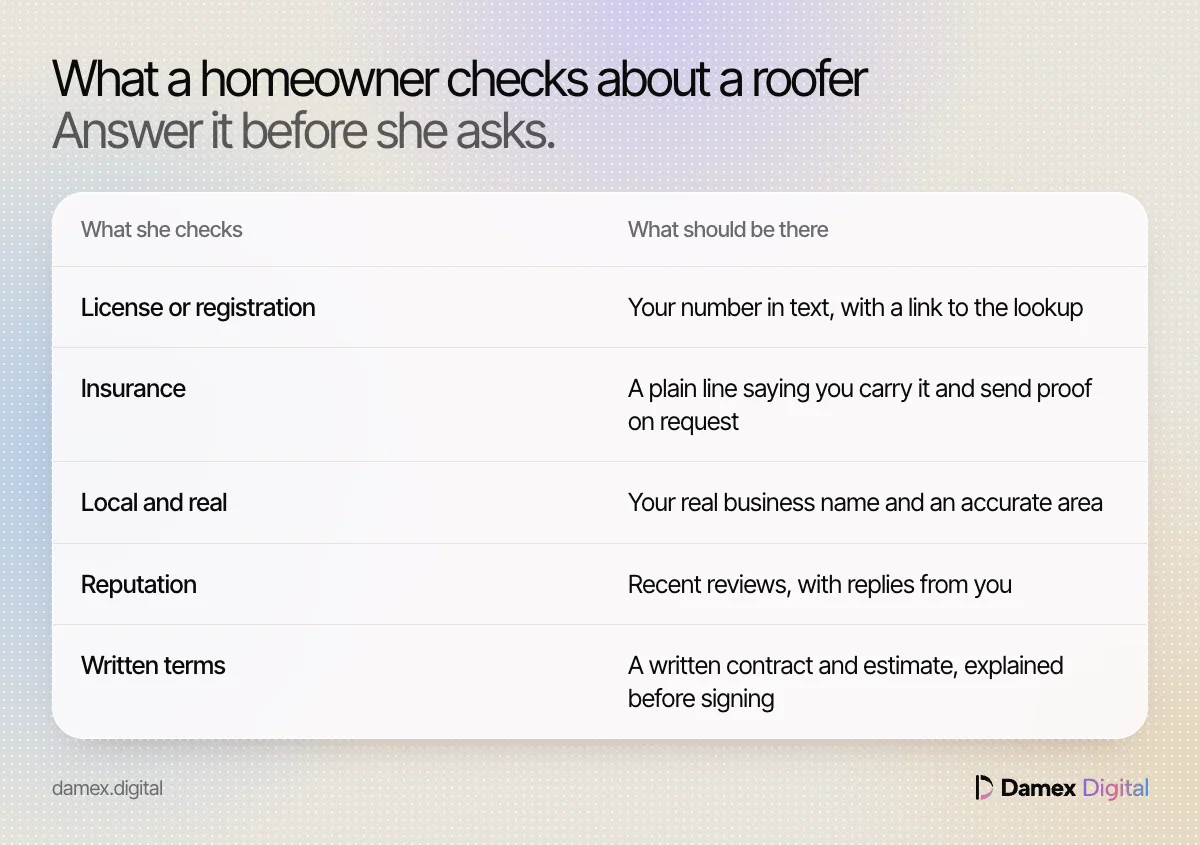
Homeowners check license, insurance, reviews, complaints and written terms, because that is what consumer protection officials tell them to check. The FTC, FEMA and state attorneys general publish nearly the same list, so your marketing should answer it before she asks.
The FTC’s storm scam advice says to “confirm your contractor’s license and insurance”, get estimates from more than one contractor, and search a contractor’s name with words like scam, review or complaint. FEMA’s fraud warning adds that FEMA does not endorse any specific commercial businesses.
The Illinois Attorney General warns about “storm chasers”, tells residents to be wary of contractors who go door to door offering free inspections, and says to use established local contractors where possible. In Kansas, the Attorney General’s roofing page says roofers must hold a state registration certificate, keeps a public registry, and tells homeowners to get at least three written estimates and check Better Business Bureau complaint records. Licensing rules vary by state, so check what yours requires.
| What she checks | Where she looks | What should be there |
|---|---|---|
| License or registration | Your website, then the state or county lookup | Your number in text, with a link to the lookup |
| Insurance | Your website, then she asks you | A plain line saying you carry insurance and will send proof on request |
| Local and real | Google profile, Maps | Your real business name and an accurate address or service area |
| Reputation | Google reviews, BBB, a search for scam or complaint | Recent reviews, with replies from you |
| Written terms | Your website or the estimate | A written contract and estimate, explained before anyone signs |
What is considered storm damage to a roof?
Officially, a severe thunderstorm is one that can produce hail an inch or larger or wind gusts over 58 mph, according to the National Weather Service. Damage is confirmed by inspection, and coverage is decided by the insurer, so your marketing should explain the signs, not diagnose them.
GAF’s storm damage guide lists three signs worth a professional check: stains on ceilings and walls, which may mean a leak; signs of hail on gutters and downspouts; and blown-off shingles, which point to wind. Use those words on your storm page; they’re how homeowners search for storm damage roof repair near me.
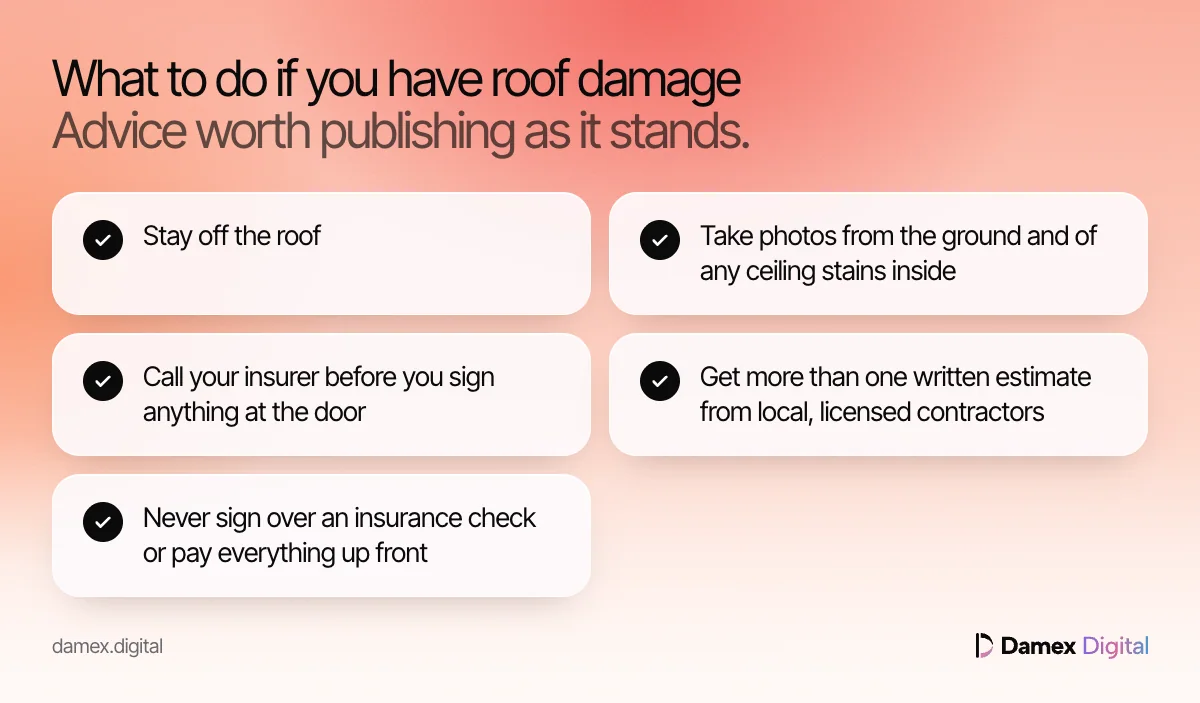
What to do if you have roof damage
Publish this advice as it stands. A roofer who says “get other estimates” reads as the opposite of a storm chaser.
- Stay off the roof. Take photos from the ground and of any ceiling stains inside.
- Call your insurer before you sign anything at the door. The Illinois Attorney General notes the insurer will likely send an adjuster at no additional cost.
- Get more than one written estimate from local, licensed contractors.
- Never sign over an insurance check or pay everything up front. The FTC lists both as warning signs.
How do you get found and trusted after a storm?
You get found by being complete and consistent where homeowners search, and trusted by making every check quick to pass. The first five steps belong in a calm month and the rest in storm week. This is the core of local SEO for roofing contractors.
Before storm season
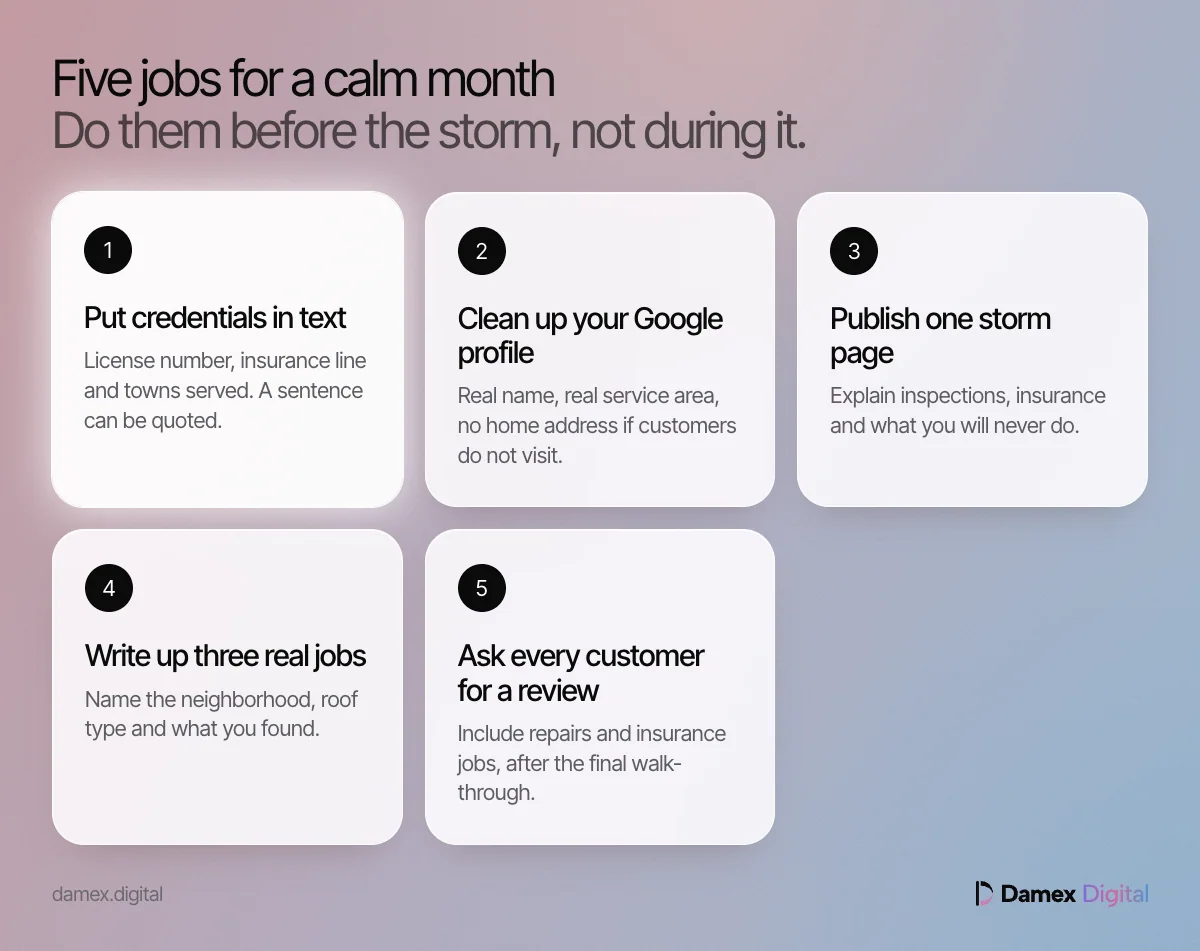
- Put your credentials in text. Add your license or registration number, insurance line and towns served to your homepage, storm page and Google profile description. A badge image can’t be searched or quoted; a sentence can.
- Clean up your Google profile. Use your real business name, hide a home address if customers don’t visit, and set a service area you really cover. Google says it shouldn’t extend beyond about 2 hours of driving time. Our roofing Google Business Profile playbook lists the categories, services and photos to add.
- Publish one storm page. Explain inspections, insurance and what you’ll never do, in plain words.
- Write up three real jobs. Name the neighborhood, the roof type and what you found, so homeowners and AI assistants have concrete detail to repeat.
- Ask every customer for a review. Ask after the final walk-through, including repairs and insurance jobs. Our guide to getting more Google reviews covers Google’s rules, and our review request texts for roofers are ready to adapt.
In storm week
- Answer every call. A voicemail sends the homeowner to the next roofer. A missed-call text-back replies within moments, answers common questions and books inspections.
- Post to your Google profile. Share what to do after the storm, with a real photo, and keep your hours honest.
- Turn on ads you can serve. Raise Local Services Ads or search budgets only as far as your crews and phones can handle.
- Follow up in writing. Send every inspected homeowner photos, a written estimate and your license number.
What should a storm damage page say?
A storm damage page should say what happens next, plainly, and promise nothing about insurance. The FTC tells homeowners “don’t rely on a contractor to tell you what’s covered”, so a page that promises a free roof works against you. Write it once, keep it current, and link to it from your Google profile.
Storm page outline
- Who you are. License or registration number, insurance, where you’re based and how long you’ve worked locally (only if true).
- What an inspection involves. Who comes, how long it takes and that there’s no obligation.
- How insurance works with you. The insurer decides coverage and will likely send an adjuster, and you can show the adjuster the damage you found.
- What you will never do. Ask for full payment up front, ask for cash only, or ask anyone to sign over an insurance check. The FTC lists all three as warning signs.
- Their rights. The FTC says a contract signed at home should include a written statement of the right to cancel within three business days.
- Real photos and questions. Your crew, your trucks and nearby jobs, then the questions homeowners ask, each answered in its first sentence.
Don’t copy the page for every nearby town with only the name changed. It’s one of the mistakes listed on our roofing industry page.
Starter copy
Storm damage? Here's what happens next. We're a licensed and insured roofer based in [town], license number [number]. Book a free inspection and we'll photograph any damage and explain it. Your insurer decides what's covered, and we're happy to show the adjuster what we found. We never ask for full payment up front, for cash only or for your insurance check.
By checking this box, I agree that [Business] may text me about my inspection and roofing services at the number above. Consent isn't required to buy anything. Reply STOP to opt out.
The consent line is a starting point, not legal advice. Rules vary by state; check the wording with your attorney.
How should you update your Google Business Profile in storm season?
Update your Google Business Profile with posts that tell homeowners what to do, real photos of your work, and hours that match when you answer. Google says posts can show text, photos or videos. Keep the name, categories and service area as they are; storm week is the wrong time to stretch them.
Posts
Google’s posts help lists three types: updates, offers and events. In storm week, post an update: “Hail last night? Stay off the roof, photograph damage from the ground and call your insurer before you sign anything.” Google notes that posts with a phone number in the description might get rejected, and that posts older than six months are archived unless a date range is set. Our Google Business Profile post templates give you a year of ideas.
Hours
Google’s guidelines ask for your regular customer-facing hours and allow special hours for particular days. If you extend phone hours in storm week, set special hours rather than changing your regular ones.
Photos and service area
Post finished roofs, crews at work and storm damage you documented, without the homeowner’s details. Don’t add towns the storm hit unless you really serve them.
Should you run Local Services Ads or search ads after a storm?
Run them only if you can answer every call they bring. Ads reach people searching right now, but a homeowner who clicks an ad still runs her checklist. Set a budget your phones and crews can serve, and raise it in steps.
Local Services Ads and the Performance Max move
Google began moving Local Services Ads into Performance Max in August 2026 for select US home and storefront service advertisers, and roofing is one of the listed categories, according to Google Ads Help. You still pay only for valid, qualified leads such as calls, messages and bookings. Businesses that pass Google’s checks can show the Google Verified badge, and an existing badge transfers automatically.
Budgets change shape. Google divides your historical weekly budget by 7 to set a daily average, and caps monthly spend at that daily average multiplied by 30.4. Review your service areas and ad schedule in Google Ads settings before storm season.
Search ads
Point search ads at your storm page, not your homepage, and schedule them for hours someone answers. For the trade-offs of paying per lead against building calls you own, read buying leads vs owning your calls. Typical costs are in our local marketing costs guide, and our paid ads service runs both inside a budget cap you set.
What are the rules on texting and door knocking after a storm?
Text only people who have agreed to hear from you, and treat door knocking as the weakest way to earn trust. The FCC says commercial texts require written consent, federal rules limit telephone solicitation hours, and homeowners have been told to be wary of door-to-door offers. Rules vary by state and city; check with your attorney.
Texting
The FCC says its rules ban autodialed texts to mobile phones without prior consent, and that “commercial texts require written consent.” Under the federal rule, written consent is a signed agreement authorizing marketing messages to a specific number, and the FCC notes it can be given through website forms. The rule also bars telephone solicitations before 8 a.m. or after 9 p.m. local time and to numbers on the national Do Not Call registry, and applies those limits to texts to wireless numbers as the FCC’s order describes. A bought list of storm-zone numbers carries no consent. Use the checkbox on your storm page instead. A reply to someone who called you first is different from a cold marketing text; our missed-call texts for roofers keep that first reply informational.
Door knocking
If your crew knocks, have them leave a card with your license number and website, and let the homeowner check you on her own time. The FTC’s Cooling-Off Rule gives buyers three days to cancel many sales made at home. It has exceptions, including sales needed to meet an emergency and repairs the homeowner asked you to come and do. Local rules on door-to-door selling and permits vary, so check with your city and your attorney before anyone knocks.
Do manufacturer certifications help a roofer get chosen?
Manufacturer certifications can help, if the homeowner can confirm them on the manufacturer’s own site. A logo can’t be checked, but a listing in the manufacturer’s directory can, and it gives the homeowner one more independent source that says you’re real.
GAF’s contractor pages list three certifications, Master Elite, Certified Plus and Certified, each tied to the warranties a contractor can offer, and the site has a page for homeowners to verify a contractor’s certification. GAF also says certified contractors are independent businesses, not its representatives. Other shingle makers run their own programs; check yours on the manufacturer’s own site.
If you hold one, name the level in text exactly as the manufacturer does and link to your listing. Don’t imply the manufacturer endorses your work or will pay a claim.
How should a roofer talk about insurance claims?
Explain the process and never promise the outcome. The insurer decides coverage, the adjuster inspects, and the homeowner pays the deductible; your job is to document the damage and explain the steps. Some states regulate what contractors may say on claims, so check yours with your attorney.
Texas is a clear example. The Texas Department of Insurance says it’s illegal for a contractor to offer to waive, rebate or absorb a policyholder’s deductible. A roofer also can’t act as a public adjuster on a property it’s working on or advertise that it would, and a website counts as advertising. Safe: “We’ll photograph the damage and can meet your adjuster.” Unsafe: “We’ll get your roof paid for” or “We’ll cover your deductible.”
Roof replacement cost vs actual cash value
Homeowners often ask why two neighbors got different checks. The NAIC explains that replacement cost coverage pays to repair or replace without deducting depreciation, while actual cash value pays the depreciated cost. In its example, two families each have $15,000 of roof damage and a $1,000 deductible: one receives $14,000, the other $4,000 after $10,000 of depreciation. Their policy says which applies.
Example: what storm week puts at stake
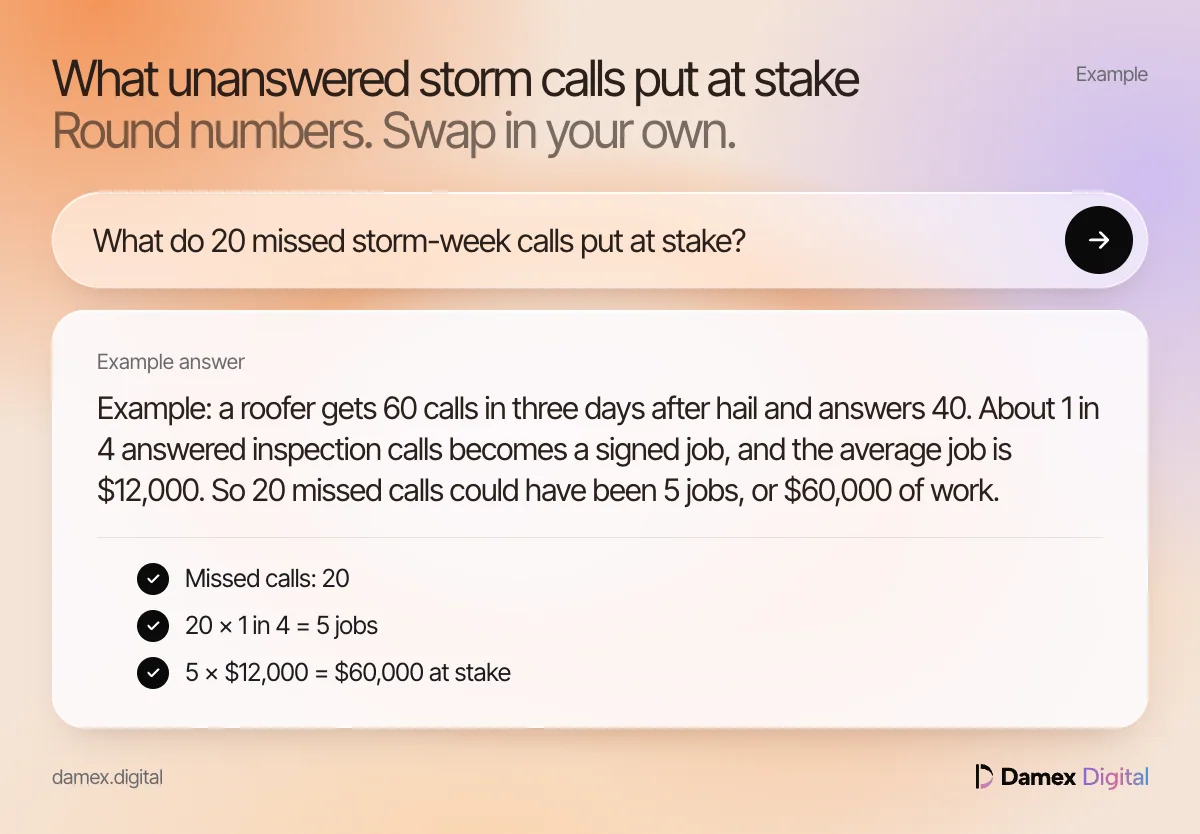
Swap in your own numbers. Say a roofer gets 60 calls in the three days after a hailstorm. The office answers 40, and 20 go to voicemail. About 1 in 4 answered inspection calls becomes a signed job, and the average job is $12,000.
- Missed calls: 20
- Jobs those calls might have become: 20 × 1 in 4 = 5
- Work at stake: 5 × $12,000 = $60,000
$60,000
In this example, 20 unanswered storm-week calls, a 1 in 4 close rate and a $12,000 average job put $60,000 of work at stake.
Worked example
The ad budget math works the same way. If the roofer’s Local Services Ads budget was $1,400 a week before the move to Performance Max, Google sets a daily average of $1,400 ÷ 7 = $200, and monthly spend is capped at $200 × 30.4 = $6,080. Doubling it only helps if the phones can take double the calls. Our missed-call calculator runs the first sum with your numbers, and missed calls are the cheapest leads you’re losing explains why.
Which roofing marketing ideas work best in storm week?
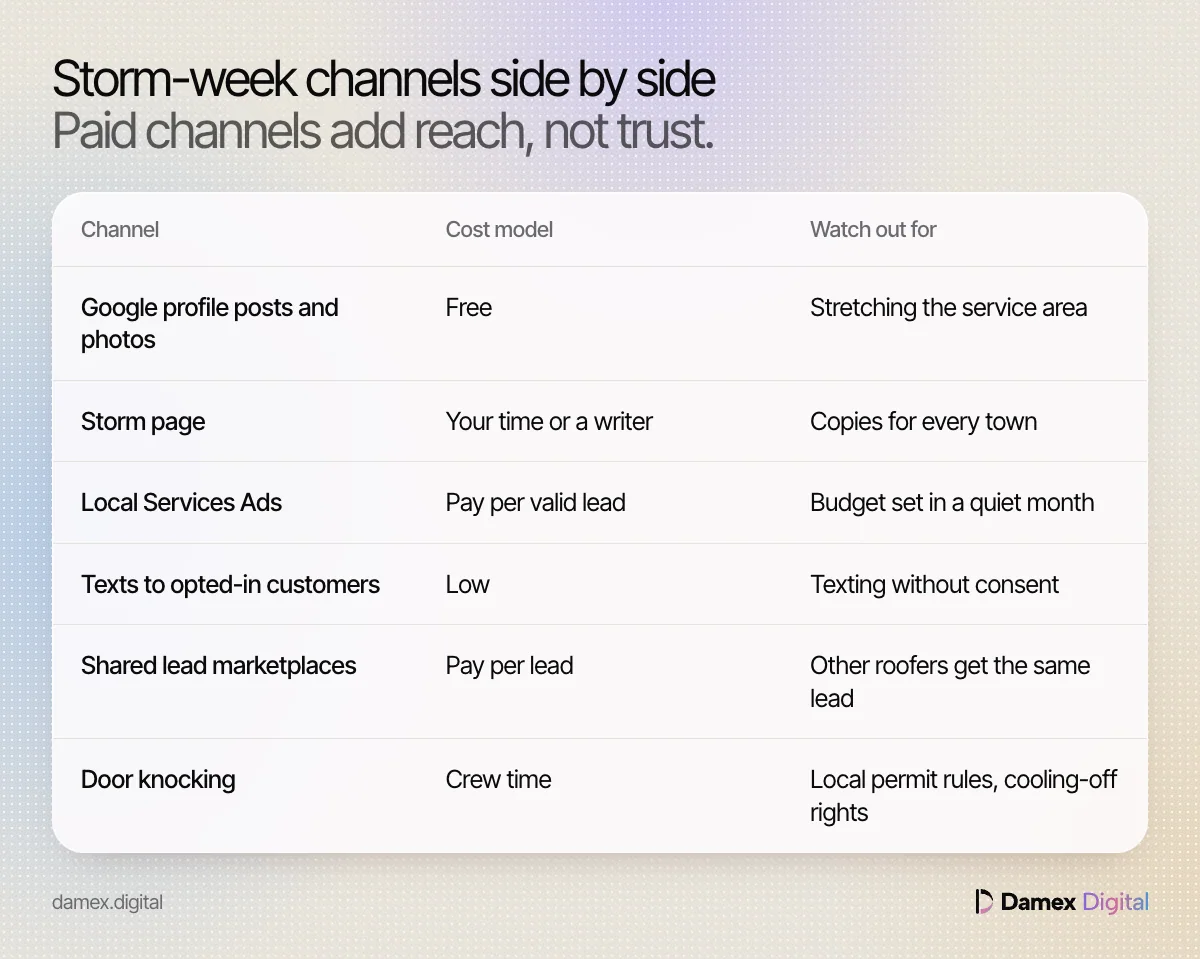
The ideas that work best in storm week are the ones homeowners can verify: your Google profile, your storm page, reviews and fast answers. Paid channels add reach but not trust. The table compares the main options by cost, trust signal and risk.
| Channel | Cost model | Trust signal | Watch out for |
|---|---|---|---|
| Google profile posts and photos | Free | Real photos, reviews, accurate area | Stretching the service area |
| Storm page | Your time or a writer | License, insurance, plain terms | Copies for every town |
| Local Services Ads | Pay per valid lead | Google Verified badge | Budget set in a quiet month |
| Texts to opted-in customers | Low | They already know you | Texting without consent |
| Shared lead marketplaces | Pay per lead | The platform’s own checks | Other roofers get the same lead |
| Door knocking | Crew time | A card with your license number | Local permit rules, cooling-off rights |
What should you do in storm week?
Work through a short list the morning after the storm, before the phones peak. It covers your Google profile, storm page, phones, ads and follow-up. Copy it into your team chat so the office and the crews work from the same list.
Storm-week checklist for roofers
- Confirm the storm hit your service area before you post about it.
- Post a Google update with what to do now and a real photo.
- Set special hours on Google for any extra days you’ll answer.
- Turn on missed-call text-back and test it from a mobile phone.
- Raise ad budgets only to the number of calls you can answer.
- Text only customers who gave written consent, between 8 a.m. and 9 p.m. their time.
- Ask every finished customer for a review, including repairs and insurance jobs.
- Log which channel each call came from.
What are the common mistakes roofers make after a storm?
The common mistakes are promises you can’t keep, shortcuts that break platform rules, and phones nobody answers. Each one makes a careful homeowner, or Google, trust you less, and each is easy to avoid if you set your rules before the storm.
- Promising insurance will pay. The insurer decides, and in some states the law limits what you may promise.
- Stuffing the business name. Google says your name “should reflect your business’s real-world name”. So “Smith Roofing”, not “Smith Roofing Storm Damage Hail Repair”.
- Stretching the service area. Google’s guidance is about 2 hours’ drive, not every town the storm hit.
- Copying storm pages by town. Near-copies tell homeowners nothing new.
- Texting bought lists. A purchased list of storm-zone numbers carries no consent.
- Asking only happy customers for reviews. Ask every customer the same way, and never suggest what to write.
- Raising budgets nobody can answer. Paid leads that hit voicemail hand the job to a competitor.
How do AI assistants pick a roofer after a storm?
No one can guarantee that an AI assistant will name your company, but you can make the facts it finds consistent. Assistants that search the web draw on much the same public pages homeowners check, so the work above does double duty. That’s AI SEO for a roofer’s website in practice.
Keep your Yelp page claimed and complete, and your name and number identical everywhere. See how AI assistants choose local businesses and how to get recommended by ChatGPT. Roofing SEO and AI visibility share one base: accurate facts, repeated where people check.
How Damex does it
Our team does storm-season work for roofing companies, and a senior marketer with 10+ years of experience owns the result. Most of it happens before the storm, so storm week is about answering calls and following up, not scrambling.
- Profile. From Essentials up, we keep your Google Business Profile accurate and post every week, including storm advice in season.
- Pages. We write your storm page and service pages, each opening with a direct answer.
- Reviews. On Growth and Authority, we ask every customer after the job, with their consent, and reply to every review through our reviews program.
- Calls. The AI receptionist add-on answers calls, handles common questions, books inspections and texts back any call it still misses.
- Ads. On the Paid ads add-on, we run Google Search and Local Services Ads inside your budget cap, tracked to calls.
- Checks. Every post, page and reply is reviewed before anything goes out under your name.
See what we do for roofing companies, and compare packages on our pricing page.
Questions people ask
How do I prove I'm not a storm chaser?
Make yourself easy to check. Show your license or registration number, proof of insurance on request, an accurate address or service area, and recent reviews with your replies. The FTC tells homeowners to confirm a contractor's license and insurance, so answer those questions before they're asked.
Can I promise homeowners that insurance will cover their roof?
No. Coverage is decided by the insurer. The FTC tells homeowners not to rely on a contractor to tell them what's covered, so explain the steps instead and let the adjuster decide. Rules on how contractors may talk about claims vary by state; check with your attorney.
Can I text homeowners in a storm-hit neighborhood?
Only if they gave consent. The FCC says commercial texts require written consent, and its rules ban autodialed texts to mobile phones without prior consent. Buying a list of numbers in the storm zone doesn't give you that consent.
Should I put storm damage in my Google business name?
No. Google's guidelines say your name should reflect your real-world business name and that adding unnecessary information isn't permitted. Put storm work in your services, posts and website instead.
How do roofers get more jobs without door-knocking?
Be easy to find and easy to verify before the storm, then answer fast after it. That means a complete Google profile, a storm page, reviews from every customer, ads sized to your capacity and a reply to every missed call. Homeowners have been told to be wary of door-to-door offers, so inbound calls start with more trust.
What is considered storm damage to a roof?
The National Weather Service defines a severe thunderstorm as one that can produce hail an inch or larger or wind gusts over 58 mph. GAF lists ceiling stains, hail marks on gutters and downspouts, and blown-off shingles as signs worth an inspection. Whether damage is covered is the insurer's decision.
What's the difference between roof replacement cost and actual cash value?
The NAIC says replacement cost coverage pays to repair or replace without deducting depreciation, while actual cash value pays the depreciated cost. In its example, a $15,000 roof claim with a $1,000 deductible pays $14,000 under replacement cost and $4,000 under actual cash value after $10,000 of depreciation.
Should my storm page list roof replacement cost per square foot?
Only if you publish your own real prices and keep them current. Prices depend on the roof, the materials and the area, so many roofers explain how they quote instead. Never quote a figure as what insurance will pay.
How do I get my roofing company recommended by AI assistants after a storm?
No one can guarantee it. AI assistants read the same public sources homeowners check, so make sure your license, insurance, service area and reviews say the same thing on your website, Google profile and directories. A storm page that answers questions in its first sentence gives them something to quote.
Can I add more towns to my Google profile after a storm?
Only towns you really serve. Google's guidelines say a service area shouldn't extend farther than about 2 hours of driving time from your base. Stretching it to every town the storm hit risks your profile.
How do I get more commercial roofing jobs after a storm?
Give property managers their own route in: a separate page for commercial and flat roofs, a form that asks for the building address and a contact on site, and project write-ups of commercial work you've done. The trust checks are the same, with more weight on insurance documents and written terms.
Sources
- FTC: How To Avoid Scams After Weather Emergencies and Natural Disasters
- FTC: Buyer's Remorse: The FTC's Cooling-Off Rule May Help
- Illinois Attorney General: Raoul warns residents to be on alert for storm-related repair scams
- Kansas Attorney General: Roofing information for consumers
- FEMA: Vermonters encouraged to beware of fraud and scams
- Texas Department of Insurance: Roofing and insurance, know the law
- NAIC: Rebuilding after a storm, replacement cost vs actual cash value
- National Weather Service: Thunderstorm safety
- GAF: Storm damage roof repairs resources guide
- GAF: Residential roofing contractors and certifications
- Google Business Profile Help: Guidelines for representing your business on Google
- Google Business Profile Help: Create and manage posts
- Google Ads Help: Local Services Ads transition to Performance Max
- FCC: Stop Unwanted Robocalls and Texts
- eCFR: 47 CFR 64.1200, Delivery restrictions
Cite this post
Badhon, S. U. (2026, October 31). Roofing marketing after a storm: how to get found and trusted. Damex Digital Blog. https://damex.digital/blog/roofers-found-after-storm/
Founder, Damex Digital
Led product marketing and go-to-market at weDevs, led marketing at Damex and managed a marketing team at Genex. Founded Damex Digital so local service businesses get the daily work of a good marketing team, measured in calls and booked jobs.