Pay per lead vs owning your calls: roofing, HVAC and plumbing leads
How Angi, Thumbtack, HomeAdvisor and Google Local Services Ads charge per lead, how credits work, and when to buy leads or build calls you own.
The short answer
Pay-per-lead platforms charge for a customer contact, not a booked job. Angi matches each request with no more than five pros, Thumbtack lets a customer contact five pros in the first four hours, and Google Local Services Ads charges per valid lead, now inside Performance Max for many home services. Buy leads to fill gaps. Build owned calls, through your profile, reviews and fast answers, for the long run.
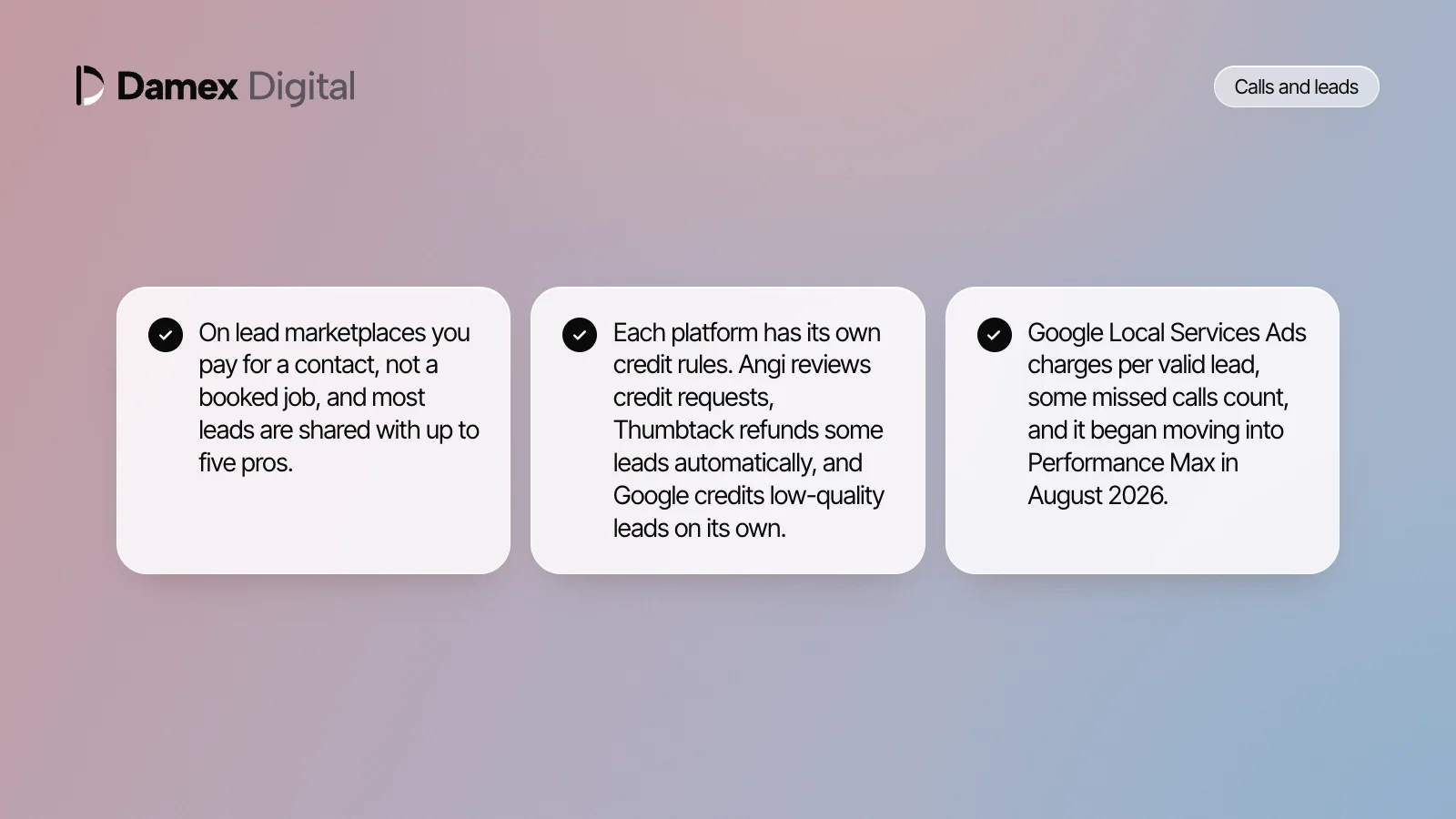
- On lead marketplaces you pay for a contact, not a booked job, and most leads are shared with up to five pros.
- Each platform has its own credit rules. Angi reviews credit requests, Thumbtack refunds some leads automatically, and Google credits low-quality leads on its own.
- Google Local Services Ads charges per valid lead, some missed calls count, and it began moving into Performance Max in August 2026.
- Owned calls come from your Google profile, reviews, website, ads in your own account and answering every call fast.
- Compare every channel on cost per booked job. Buy leads to fill gaps while owned calls grow.
- Who this is for
- Roofing, HVAC and plumbing owners weighing lead sites against their own marketing
- What to do first
- Work out last month's cost per booked job for every channel
- Last reviewed
- November 1, 2026, against each platform's own help pages
On this page 12 sections
- 01What do lead terms like pay per lead and shared leads mean?
- 02Why does the choice matter more in 2026?
- 03How do roofing leads work on pay per lead sites?
- 04What’s the difference between shared and exclusive leads?
- 05How do lead credits and refunds work on each platform?
- 06What does owning your calls take?
- 07How does this work for each trade?
- 08What does cost per booked job look like? A worked example
- 09Should you buy roofing leads or build your own?
- 10What are the common mistakes with bought leads?
- 11How Damex does it
- 12Sources and how we researched this
A hailstorm rolls through on Tuesday. By Wednesday morning your phone is buzzing with lead alerts. You call the first one back from the top of a ladder, and the homeowner tells you, politely, that three other roofers have already called.
That’s the trade-off with roofing leads you pay per lead for. You get volume fast, but you’re often not the only one who got the lead, and you pay for the contact whether or not it becomes a job. This guide sets out how Angi, Thumbtack, HomeAdvisor and Google Local Services Ads charge, in their own words, how each handles bad leads, and what it takes to build calls you own. It’s written for roofing, HVAC and plumbing owners, and the math works for any home service trade.
Key takeaways
- Lead marketplaces charge for a contact, not a booked job. Angi says leads are not guaranteed jobs.
- Most marketplace leads are shared. Angi matches each request with no more than five pros, and Thumbtack lets customers contact five pros in the first four hours.
- Credit rules differ by platform, so read them before you buy, not after a bad week.
- Google Local Services Ads charges per valid lead, counts some missed calls, and began moving into Performance Max in August 2026.
- Owned calls come from your Google profile, reviews, website, ads in your own account and answering fast.
- Judge every channel on cost per booked job, then blend paid and owned by business stage.
What do lead terms like pay per lead and shared leads mean?
A lead is a customer who has asked to be contacted about a job. Pay per lead means you’re billed for each of those contacts, whatever happens next. So when an owner asks what HVAC leads mean, the honest answer is a phone number and a job description, not a booked install.
Here are the terms used in the rest of this guide.
- Pay per lead. You pay for each enquiry, such as a call or message, rather than for clicks or a flat listing.
- Shared leads. The same enquiry goes to several businesses, so each one competes to reply first.
- Exclusive leads. The enquiry goes to one business only. A call from someone who found your own profile or website is exclusive by nature.
- Opportunity. Angi’s word for a project you can review, with its lead fee, before you show interest. It becomes a charged lead when you and the homeowner both show interest.
- Lead credit. Money returned to your account, usually as credit toward future leads, when a platform agrees a lead was invalid.
- Owned call. A customer who finds you by name or through your own channels and dials you directly, with no per-lead fee.
- Cost per booked job. What a channel cost you in a month divided by the jobs it actually booked. It’s the only number that compares a marketplace, an ad and your own profile fairly.
Why does the choice matter more in 2026?
The rules behind bought leads are specific and they keep changing. Shared caps, missed-call charges, credit windows and the Performance Max move all change what a lead really costs you. Each figure below links to the platform’s own help page.
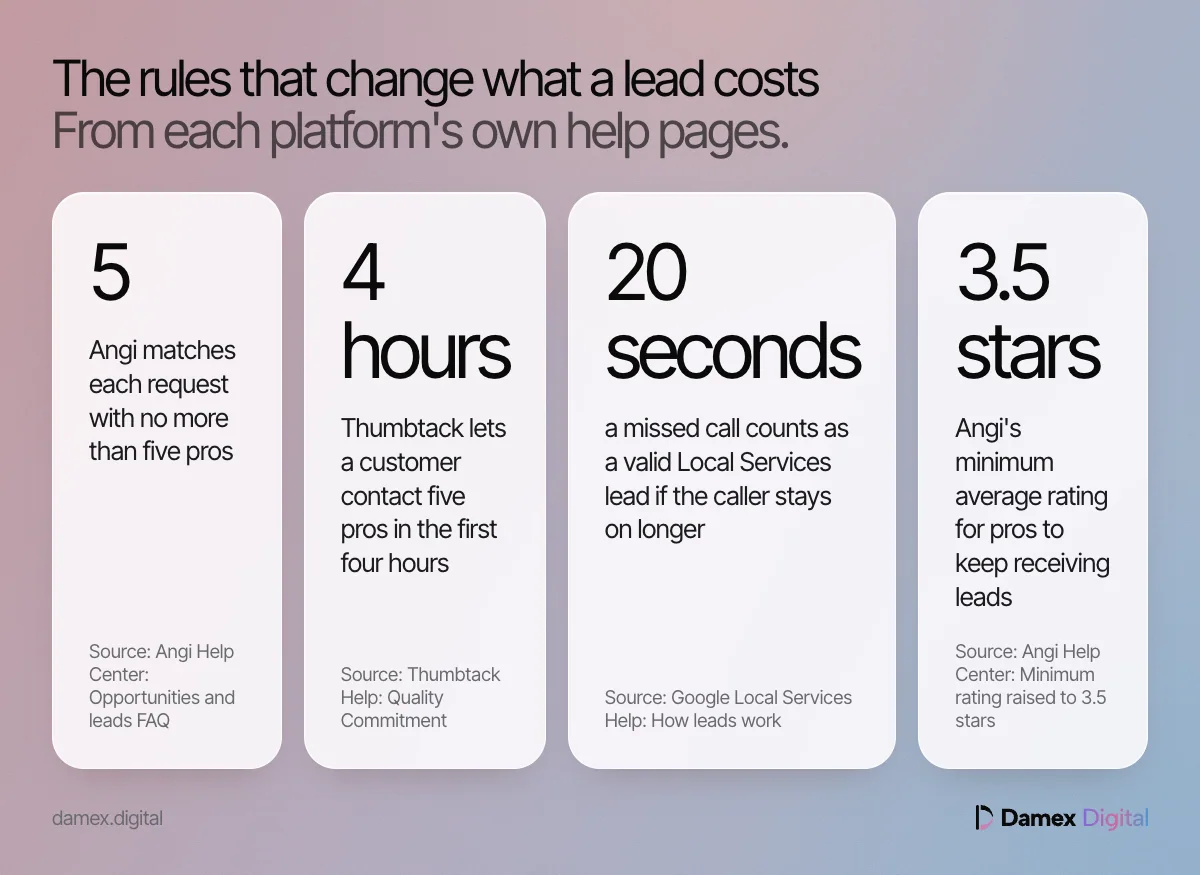
5
Angi says each time a homeowner submits a project request, it will match them with no more than five pros.
4 hours
Thumbtack limits the number of pros a customer can contact to five in the first four hours, with more allowed after that.
20 seconds
On Google Local Services Ads, a missed call during business hours counts as a valid lead when the caller stays on the line for more than 20 seconds.
30.4
After the move to Performance Max, Google caps monthly Local Services spend at your daily average budget multiplied by 30.4.
Source: Google Ads Help: Local Services Ads moving to Performance Max
What do the quality rules add?
Every platform also ties your lead flow to how well you treat customers. Angi raised its minimum average rating for pros from 3.0 to 3.5 stars in March 2025, per its policy update, and says its data shows homeowners are more likely to pick pros with multiple reviews and a high rating.
3.5 stars
Angi's minimum average rating for pros to keep receiving leads, raised from 3.0 stars in March 2025.
Source: Angi Help Center: Minimum rating raised to 3.5 stars (Wayback copy)
30 days
Google says it reassesses charged Local Services leads and, in most cases, applies credits for low-quality ones within 30 days.
Google’s ad rankings page says the same thing in its own way. Your rating, number of reviews and average response time affect where your ad shows, and “Missed calls may negatively affect your responsiveness.” Reviews and answering speed pay off on bought leads and owned calls alike.
How do roofing leads work on pay per lead sites?
Roofing leads on pay per lead sites work the same way for HVAC and plumbing. A homeowner describes a job, the platform matches it to a few pros, and each pro pays a fee for the contact. None of the four platforms below publishes a flat roofing, HVAC or plumbing lead price, so we won’t guess one.
How does Angi charge?
Angi says lead fees “change based on task, homeowner location, and demand for the work.” You’re charged once both you and the homeowner show interest in connecting, and Angi says you’re charged “whether or not you open or respond to them.” You set a monthly budget for leads you receive automatically, and some pros pay through an annual subscription instead.
Angi also offers Opportunities. Its leads FAQ says you see the project details and the lead fee before showing interest, and you pay only when both sides show interest. Opportunities are charged on top of your monthly budget. Leads arrive in the Angi for Pros app and on the website. More in our Angi profile guide.
How does Thumbtack charge?
On Thumbtack you set your own lead prices, and the price you set is “the exact amount you’ll pay for each lead.” Thumbtack says prices vary with the type and size of the job, how many pros are available and your market. With its Opportunities, you contact the customer first and pay only if they respond, per its pricing help page. See our Thumbtack guide for setting up the profile.
How does HomeAdvisor charge?
HomeAdvisor’s pro FAQ says the price of a lead “varies by the type of work you do” and by region, and you hear the current price for your area when you call to join. You set a spend target, but HomeAdvisor says it “is not a hard cap” and you can exceed it. You’re charged for each lead “whether or not you ultimately win the job.” More in our HomeAdvisor guide.
How does Google Local Services Ads charge?
Google charges for each valid lead from your ad. Valid leads include a call you answer or return, a message, a voicemail, a booking request, and a missed call during business hours where the caller stays on for more than 20 seconds. Google says prices vary by location, job type, lead type and bidding mode, and that “When similar local businesses bid on the same lead, those bids determine how much the lead is worth.” Roofers, HVAC companies and plumbers are all eligible categories.
Two details help owners. Follow-up calls or messages from the same customer aren’t charged again if there’s contact within 15 days. And message leads are “typically priced lower than the corresponding phone lead price,” though not always. For a plumbing-specific walkthrough, read whether Local Services Ads are worth it for plumbers, and see our glossary entry on Local Services Ads.
What changes with the move to Performance Max?
Google began moving Local Services Ads into Performance Max in August 2026, for select US home service advertisers in categories including plumbing, HVAC and roofing. Google says “You still only pay for valid leads.” Weekly budgets are divided by 7 into a daily average, manual bidding such as a maximum cost per lead is no longer supported, and your Google Verified badge transfers automatically. Ads still show only on Google Search and Google Maps.
What’s the difference between shared and exclusive leads?
A shared lead goes to several businesses and an exclusive lead goes to one. On the marketplaces above, leads are shared within a limit, and the platforms say so openly. That makes speed part of the price, because the first pro to call back usually has the best shot at the job.
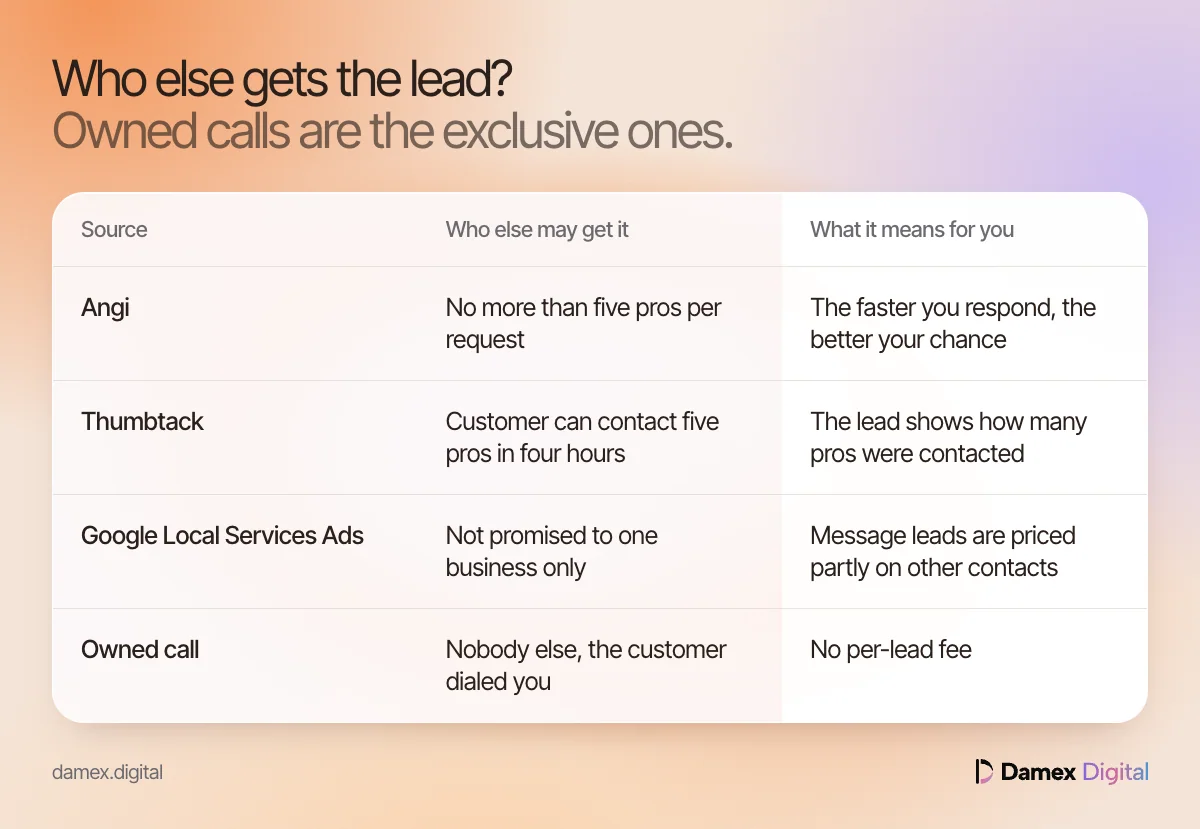
- Angi. It matches each request with “no more than five pros,” and adds that “The faster you respond, the better your chance of winning the job.”
- Thumbtack. Customers can contact five pros in the first four hours, and you can see on the lead how many pros the customer contacted.
- Google Local Services Ads. Google says customers “specifically selected your profile out of all the rest.” It doesn’t promise a lead goes to one business only, and it prices message leads partly on whether the customer contacted other advertisers.
The calls you own are the exclusive ones. Someone who searched your name, read your reviews or found your service page is calling you and nobody else. That’s why owning your calls is worth building even if you keep buying.
Before you buy plumbing leads for small business growth, or any roofing or HVAC leads for sale, ask the seller four things.
- How many businesses get the same lead?
- When exactly am I charged?
- What is the refund or credit policy, and how long do I have to ask?
- Can I pause or cap my spend, and is the cap a hard limit?
How do lead credits and refunds work on each platform?
Each platform handles bad leads differently. Angi reviews credit requests you file, Thumbtack refunds some leads automatically, and Google credits low-quality leads on its own. None of them credits a lead just because you didn’t win the job. Read the rules before your first bad week, because the deadlines are short.
Angi lead credits
Angi’s credit page, in the copy we could read (archived August 2025), lists reasons it may credit a lead: a phone number that isn’t in service or isn’t the customer’s, a location outside your ZIP codes, a job that isn’t one of your tasks, a duplicate lead, or leads sent while yours were turned off. The lead must be under 45 days old, you must have tried to call within 24 hours, and annual subscribers can’t request credits. Credits are store credit, expire after six months and are reviewed within 5 business days.
Angi is just as clear on what it won’t credit: a customer who doesn’t call back, already hired someone, changed their mind or was “just shopping,” or a job you didn’t win. It says those are already accounted for in lead pricing.
Thumbtack refunds
Thumbtack’s Quality Commitment says it automatically refunds a lead if the customer doesn’t reply to any pro they contacted within the first 72 hours. That covers the ghosted lead, which Angi treats as part of the price.
Google Local Services Ads credits
Google says charged leads “get reassessed by our models over time” and are credited if found to be low quality. It no longer credits leads marked job type not serviced or geo not serviced, so your settings are your protection, and credits aren’t available for health care categories. Rating your leads in the feedback survey can earn a bonus credit. Spam and duplicate contacts are filtered before you’re charged.
What does owning your calls take?
Owning your calls means customers find you by name and dial you directly, with no one taking a per-lead cut. It takes longer than buying, it needs steady work, and it keeps working when you stop paying. This is also the honest answer to how to get leads for roofing jobs without a marketplace.
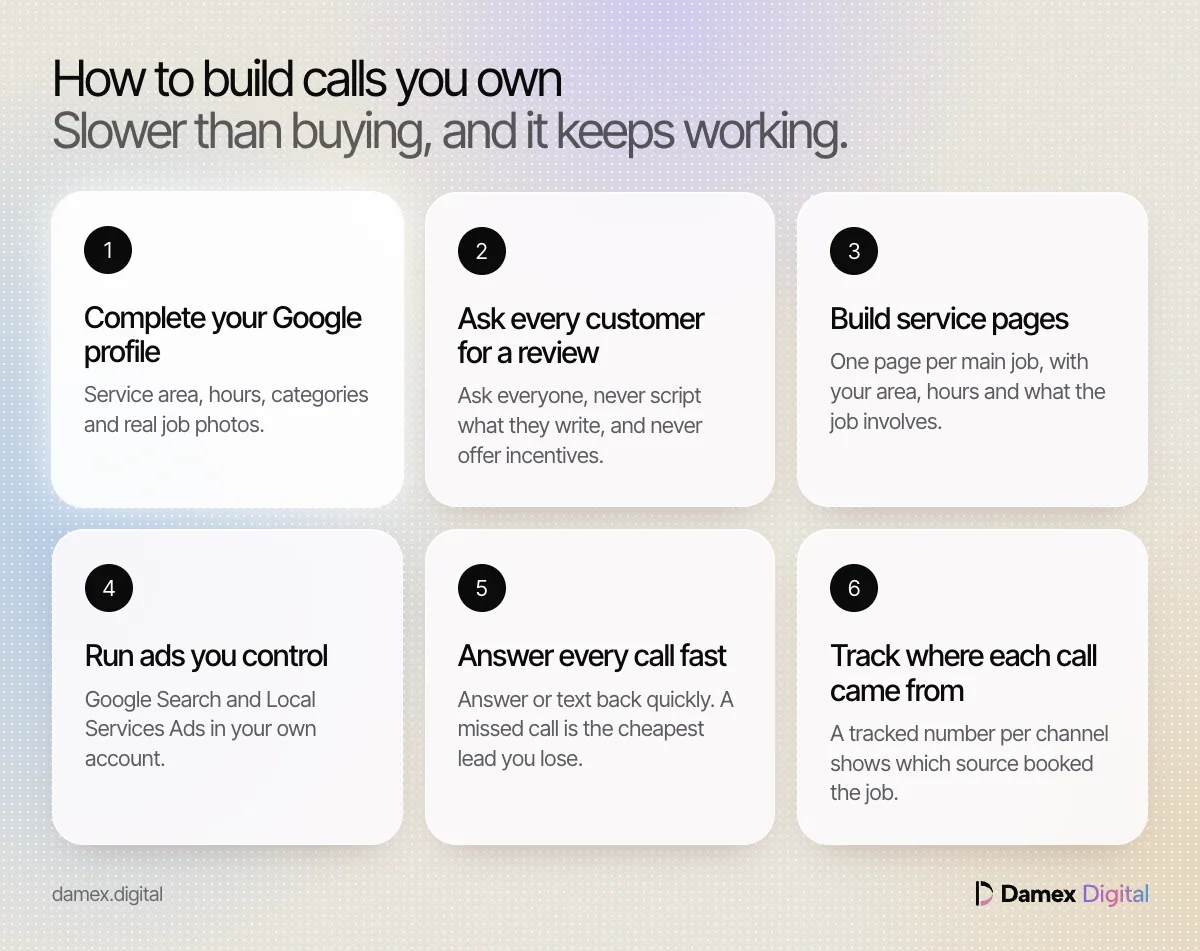
- Complete your Google Business Profile. Google says creating a profile is free, and that “Businesses with complete and accurate info are more likely to show up in local search results.” Add your service area, hours, categories and real job photos.
- Understand how local ranking works. Google’s ranking help page says local results are “mainly based on relevance, distance, and popularity,” and “There’s no way to request or pay for a better local ranking on Google.”
- Ask every customer for a review. Google says “More reviews and positive ratings can help your business’s local ranking.” Its policy bans incentives and bans selectively asking for positive reviews, so ask every customer and never script what they write. Our guide on how to get more Google reviews covers the wording.
- Build service pages that answer real questions. One page per main job, such as roof repair, AC repair or water heater replacement, with your area, hours and what the job involves.
- Run ads you control. Google Search ads and Local Services Ads in your own account still cost money, but a call from your own Search ad comes to you alone, and your profile reviews show on your Local Services ad.
- Answer every call or text back fast. A missed call is the cheapest lead you lose. Read why missed calls are the cheapest leads you are losing, and use our missed-call text template.
- Track where each call came from. A tracked number per channel shows which source booked the job, which is how you work out cost per booked job.
Do owned channels help with AI assistants too?
Yes. Owned channels also feed the AI assistants customers now ask. Our pillar on getting recommended by ChatGPT shows how the same profile and reviews carry over.
How does this work for each trade?
Each trade buys leads for different reasons. Roofers face storm surges, HVAC companies face seasonal peaks, and plumbers live on emergencies. The platforms’ rules are the same for all three, but which rule bites hardest isn’t.
Storm-driven work
For roofing companies
Storm damage roofing leads for sale flood in after hail, and so do your competitors. Because Angi and Thumbtack leads are shared, a roofer who calls back in an hour has often lost to one who called in ten minutes. Set a hard spend cap before storm season, since HomeAdvisor says its spend target can be exceeded. On Local Services Ads, Roofers is an eligible category and roofing is in Google’s first Performance Max phase, so check how your new daily budget handles a surge week. The owned side pays most here. A storm damage page and recent roof photos on your profile catch homeowners who search your name after a neighbor recommends you, as our guide on how roofers get found after a storm explains.
More for roofing companies: Roofing marketing and AI visibility
Seasonal and emergency work
For HVAC companies
Angi says lead fees change with demand for the work, so HVAC leads can cost the most when you can least use them, in the first heat wave or cold snap, when your techs are already booked. Lead marketplaces fill the shoulder months well, when crews have gaps. Use Angi’s short-term coverage or pause automatic leads when you’re full, and remember Angi Opportunities sit outside your monthly budget. Owned calls matter most for maintenance plans and repeat customers, who should never need a lead site to find you again. Answer the peak-week calls you already get before you buy more HVAC leads.
More for HVAC companies: HVAC marketing and AI visibility
For plumbing companies
Plumbing leads are urgent, so a missed call costs twice. On Local Services Ads, an unanswered call during business hours can be a charged lead, and Google says missed calls can hurt your responsiveness ranking. On marketplaces, a burst-pipe customer calls whoever answers first. Set your Local Services job types tightly, since Google no longer credits wrong job types or areas. For the after-hours side, our guide on emergency plumber near me searches covers hours, pages and answering.
More for plumbing companies: Plumbing marketing and AI visibility
What does cost per booked job look like? A worked example
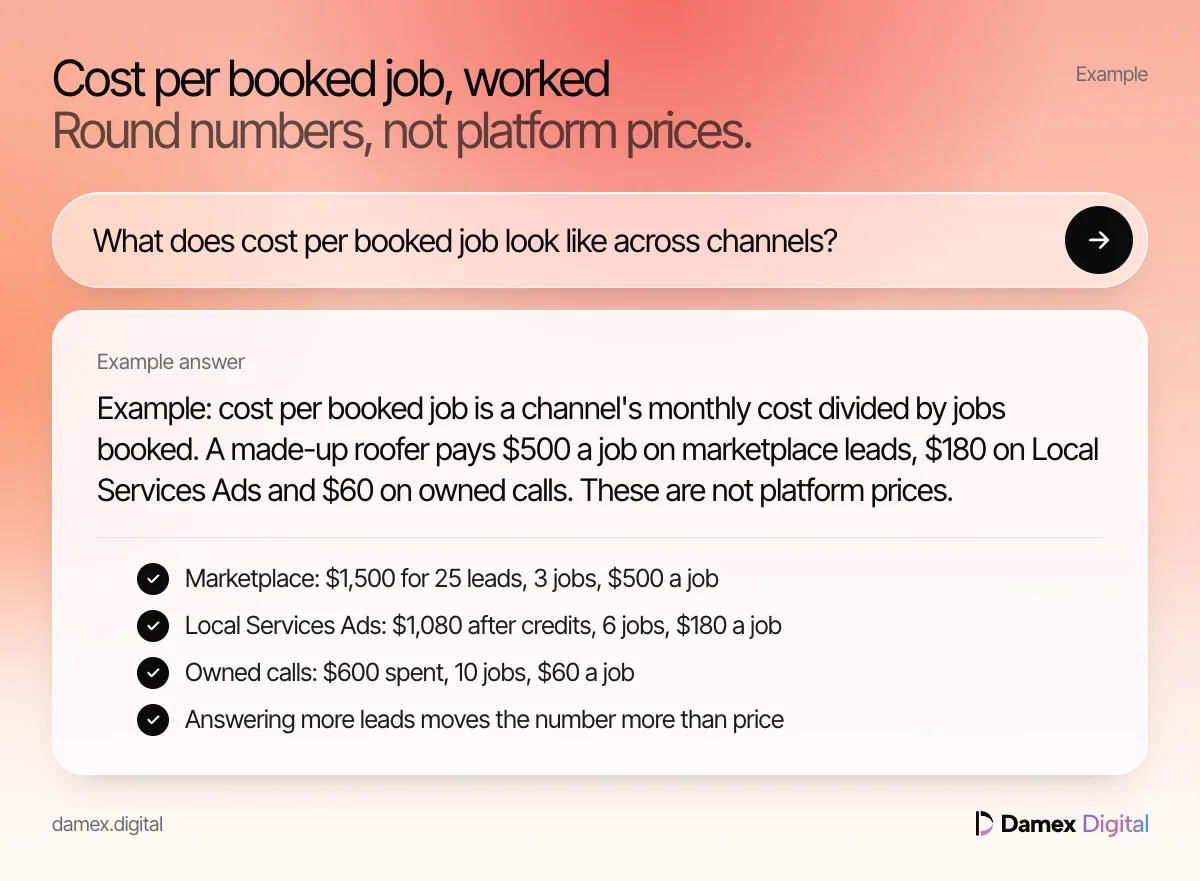
Cost per booked job is a channel’s monthly cost divided by the jobs it booked. Here’s one month for a roofing company running three channels at once, in round numbers you can swap for your own. None of these platforms publish roofing lead prices, so the costs below are estimates, not platform prices.
$500
A roofer spends $1,500 on 25 shared marketplace leads, reaches 20 and wins 3 jobs. Cost per booked job is $1,500 divided by 3.
Worked example
- Marketplace, Example. $1,500 for 25 leads. Three jobs booked. Cost per booked job is $500.
- Local Services Ads, Example. 20 charged leads at $60 is $1,200. Google credits 2, so you pay $1,080. You answer 16 and book 6. Cost per booked job is $1,080 divided by 6, or $180.
- Owned calls, Example. You spend $600 that month on profile, review and answering work. Your Google profile and website bring 30 calls, and you book 10. Cost per booked job is $60.
Two lessons sit in those sums. First, answering moves the number more than price does. Book two more of the Local Services leads you missed and cost per booked job falls from $180 to $135, with no extra spend. Second, the owned figure isn’t available in month one. A new business with few reviews might book two jobs from its profile, which puts that same $600 at $300 a job. Owned calls get cheaper as reviews and pages build up, while bought leads cost about the same every month.
Our line-by-line guide to local marketing costs shows how to put these channels in one budget, and the missed-call calculator shows what unanswered calls cost you.
Should you buy roofing leads or build your own?
Most owners should do both for a while. Buy roofing leads when you need jobs faster than owned channels can deliver, and build owned calls so you need fewer bought leads each year. The right mix depends on your reviews, your crew capacity and how fast you answer the phone.
| Your situation | Lean toward | Why |
|---|---|---|
| New business, few reviews | Marketplaces and Local Services Ads, plus profile and reviews from day one | Owned calls take months to build |
| Entering a new area or service | Bought leads as a test | Cheap way to check demand before building pages |
| Quiet season, crews idle | Marketplaces with a capped budget | Fills gaps you can switch off |
| Storm or peak week | Owned calls first, then paid within a hard cap | Shared leads go to whoever calls first |
| Many reviews and steady calls | Owned calls, with Local Services Ads for overflow | Cost per booked job usually favors owned |
| Missing many calls | Fix answering before buying anything | You pay for leads you don’t pick up |
A blended plan by business stage
- Starting out. Set up your Google profile, ask every customer for a review, and buy a capped number of leads so crews stay busy. Answer every lead within minutes.
- Growing. Get Google Verified for Local Services Ads, build service pages for your main jobs, and use marketplaces to fill gaps rather than as your main source.
- Established. Let owned calls carry the business. Keep paid ads for overflow, new areas and new services, and pause marketplaces in busy months.
What are the common mistakes with bought leads?
The costly mistakes come from judging leads on price instead of booked jobs, and from not reading the platform’s rules.
- Comparing cost per lead. A cheap lead that never books costs more than an expensive one that does. Compare cost per booked job.
- Calling back slowly. Shared leads go to the fastest reply, and Angi’s credit rules expect a call attempt within 24 hours.
- Missing the credit window. Angi wants reports within 45 days. Google won’t credit wrong job types or areas, so loose settings cost you.
- Treating a spend target as a cap. HomeAdvisor says its target can be exceeded. Check every invoice.
- Letting calls go to voicemail. On Local Services Ads, some missed calls are charged and can hurt your ranking.
- Never building owned calls. If every job comes through a lead site, you pay rent forever and your costs rise with demand.
- Asking only happy customers for reviews. Google bans selective asking. Ask every customer.
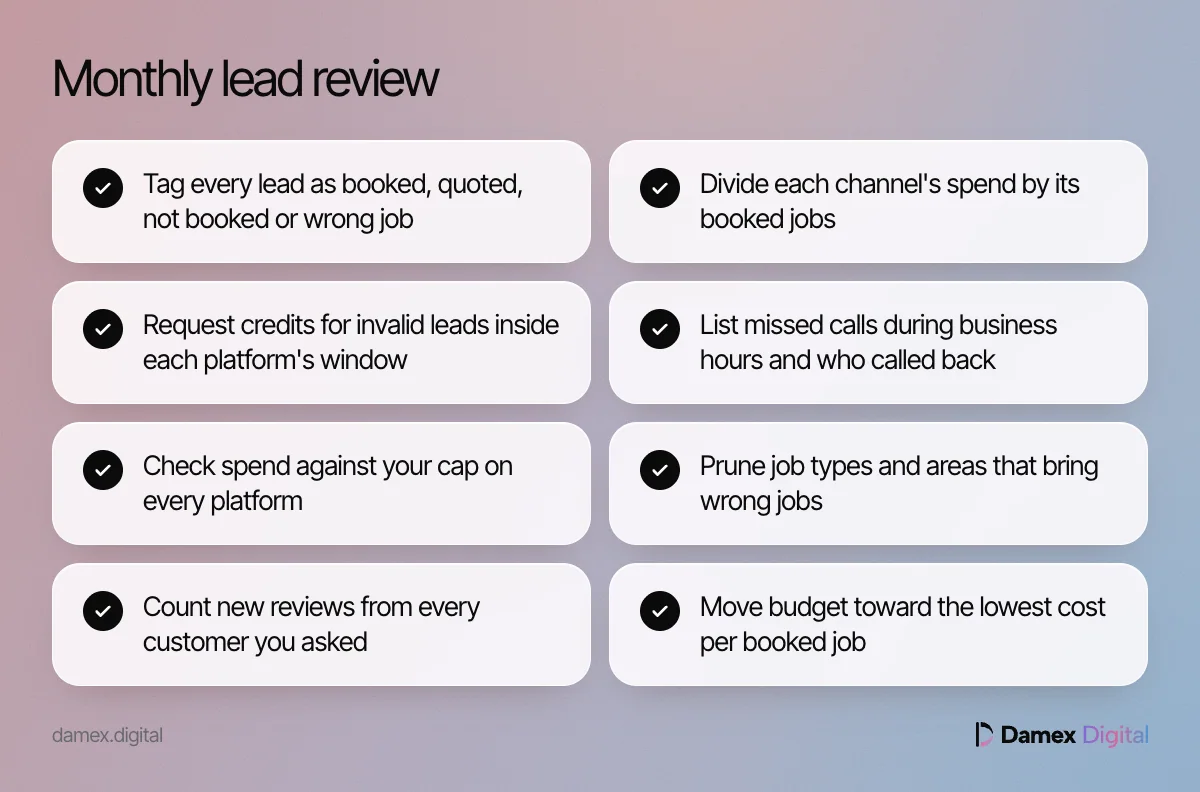
Monthly lead review
- Tag every lead as booked, quoted, not booked or wrong job
- Divide each channel’s spend by its booked jobs
- Request credits for invalid leads inside each platform’s window
- List missed calls during business hours and who called back
- Check spend against your cap on every platform
- Prune job types and areas that bring wrong jobs
- Count new reviews from every customer you asked
- Move budget toward the channel with the lowest cost per booked job
How Damex does it
Damex doesn’t sell leads. We build and run the channels that bring calls to you alone, and we track what each one books. Lead spend on marketplaces stays your decision, and we measure it against everything else.
On our Paid ads add-on, a specialist runs Google Search and Local Services Ads inside your own account, with spend billed by Google to you, no markup, and call tracking from ad to booked job. From Essentials up, our team keeps your Google Business Profile complete and active. On Growth and Authority, the reviews program asks every customer after each job, with their consent, and replies to every review. The Missed calls and AI receptionist add-on, $197 a month, answers calls, handles common questions, books jobs and texts back any call it still misses. Read how it compares in AI receptionist vs answering service. A senior marketer owns your account, and you see spend, calls and cost per call side by side. See every package and add-on on our pricing page, and what we do for roofing companies.
Sources and how we researched this
We read each platform’s own help pages on October 31 and November 1, 2026: Angi, Thumbtack, HomeAdvisor and Google. Where a page wouldn’t load on our network, we read the Internet Archive’s copy. The Angi credit page we could read is from August 2025 and the HomeAdvisor FAQ from February 2025, so check both for changes before you rely on them. All dollar figures here are Examples. Last reviewed November 1, 2026.
Questions people ask
Are roofing leads from lead sites exclusive?
Not on the platforms covered here. Angi says it matches each homeowner request with no more than five pros, and Thumbtack limits customers to contacting five pros in the first four hours. Ask any seller how many businesses get the same lead before you buy.
Do I pay for a lead if the customer never answers?
It depends on the platform. Angi says you're charged for leads whether or not you open or respond to them, and a homeowner who doesn't call back isn't a reason for credit. Thumbtack automatically refunds a lead if the customer doesn't reply to any pro within 72 hours.
Can I get credit for a bad Local Services Ads lead?
Often. Google reassesses charged leads and credits low-quality ones automatically, in most cases within 30 days. It no longer credits leads for job types or areas you don't serve, and credits aren't available for health care categories.
How much do HVAC leads cost?
None of the platforms publish a flat price. Angi says lead fees change with task, location and demand, Thumbtack lets you set your own lead prices, HomeAdvisor gives the price for your area when you call to join, and Google prices Local Services Ads leads by location, job type, lead type and bidding mode.
Is there an HVAC leads app like Thumbtack?
Yes. Angi runs its leads through the Angi for Pros app and its website. Whichever app you use, pick a platform on how it charges and credits leads, not on the app itself.
Can you get roofing, HVAC or plumbing leads free?
Yes, through channels you own. Google says creating a Business Profile is free and that there's no way to pay for a better local ranking. Reviews, a clear website and answering every call bring in leads with no per-lead fee, though they take time and work.
How do I get plumbing leads near me without buying them?
Show up in Google's local results. Google says local results are mainly based on relevance, distance and popularity, so a complete profile, steady reviews from every customer and fast answers do most of the work.
What do Reddit threads about roofing and HVAC leads tell you?
Treat them as one contractor's experience in one market. Lead quality changes with trade, area and season, so check each platform's own help pages and your own cost per booked job before you decide.
Do Local Services Ads still charge per lead after the move to Performance Max?
Yes. Google says you still only pay for valid leads, such as phone calls and messages, rather than clicks. Budgets become daily averages and manual bidding goes away.
Does Damex sell leads?
No. We work on the calls that come to you by name, through your Google profile, reviews, website and missed-call follow-up, plus ads run in your own Google account if you want them.
Sources
- Angi Help Center: Opportunities and Leads, Frequently Asked Questions
- Angi Help Center: How to request a lead credit for an invalid lead
- Angi Help Center: Policy update, minimum rating raised to 3.5 stars
- Thumbtack Help: How much do I pay for leads and opportunities?
- Thumbtack Help: What is Thumbtack's Quality Commitment?
- HomeAdvisor: How it works for pros
- Google Local Services Help: How leads work
- Google Local Services Help: How bidding works for Local Services Ads
- Google Local Services Help: About ad rankings
- Google Local Services Help: About Automated Local Services Ads lead credits
- Google Local Services Help: Getting started with Local Services Ads
- Google Local Services Help: Local Services Ads overview
- Google Ads Help: Local Services Ads moving to Performance Max
- Google Business Profile Help: Tips to improve your local ranking on Google
- Google Maps user contributed content policy: Fake engagement
Cite this post
Badhon, S. U. (2026, October 31). Pay per lead vs owning your calls: roofing, HVAC and plumbing leads. Damex Digital Blog. https://damex.digital/blog/buying-leads-vs-owning-calls/
Founder, Damex Digital
Led product marketing and go-to-market at weDevs, led marketing at Damex and managed a marketing team at Genex. Founded Damex Digital so local service businesses get the daily work of a good marketing team, measured in calls and booked jobs.