Does ChatGPT use Google reviews? How reviews feed AI answers
Does ChatGPT use Google reviews? What the research says about reviews in ChatGPT, Google's AI, Perplexity and Claude, and which review sites matter by trade.
The short answer
Rarely as a source it cites. BrightLocal found Google Business Profile isn't a top source for ChatGPT, which cited Yelp in 80% of its local answers, while Google's own AI tools cite your profile more than anything else. Your Google review count still seems to travel, though: in 8ight's study, ChatGPT named only 3.4% of tested firms with under 25 Google reviews.
- Google's AI Overviews and AI Mode cite your Google Business Profile more than any other source, and Google says reviews can help your local ranking.
- ChatGPT rarely links to Google. BrightLocal found Yelp in 80% of its local answers, and 8ight found the BBB and licensing pages instead.
- Your Google review count still tracked with being named by ChatGPT in 8ight's study. Star ratings didn't.
- Volume, recency and detail in customers' own words make reviews useful to every engine.
- Ask every customer for a Google review, claim your Yelp page without asking for Yelp reviews, and reply to every review.
On this page 14 sections
- 01What do the review terms in this guide mean?
- 02Why do reviews matter for AI answers now?
- 03Does Google use reviews in its own AI answers?
- 04Does ChatGPT use Google reviews for answers?
- 05How do Perplexity, Claude and other AI tools read reviews?
- 06What makes a review useful to AI?
- 07How do you make your reviews count across AI engines?
- 08Which review sites matter for AI recommendations in your trade?
- 09How does this work for each trade?
- 10Example: how review recency adds up for a roofer
- 11Should you reply to every review?
- 12How do you deal with fake negative Google reviews?
- 13What are the common mistakes with reviews and AI answers?
- 14How Damex does it
You’ve worked hard for your Google reviews. So it stings when ChatGPT recommends the company down the road, the one with half as many.
So does ChatGPT use Google reviews? Rarely as a source it links to, but the number you’ve collected still seems to travel with you. Google’s own AI tools read your Google Business Profile, reviews included, more than anything else. Your reviews count everywhere, just differently on each engine.
This guide covers what the research says about each engine, which review sites matter for which trade, and how to reply. It’s for US local service businesses in home services, health practices and auto repair. For how to ask customers, see our guide to getting more Google reviews.
Key takeaways
- Google's AI Overviews and AI Mode cite Google Business Profile more than any other source, so Google reviews matter most on Google.
- BrightLocal found Google Business Profile isn't a top source for ChatGPT. Yelp appeared in 80% of ChatGPT's local answers in that study.
- In 8ight's study, ChatGPT named 3.4% of firms with under 25 Google reviews and 22.2% of firms with 1,000 or more. Star ratings showed no such pattern.
- Volume, recency and detail in the customer's own words are what make a review useful to people and to AI.
- Ask every customer for a Google review. Claim and complete your Yelp page, but never ask for Yelp reviews.
- Reply to every review. Health practices keep replies general and never confirm someone is a patient.
What do the review terms in this guide mean?
Five terms help you read the research, because the studies measure different things: one counts the pages an engine links to, another counts the businesses it names.
- Google Business Profile reviews. The star ratings and written reviews on your free Google profile, shown in Google Maps and Search.
- Citation source. A page an AI engine links to as the place its answer came from. Being cited and being named are different: an engine can name your business while linking only to Yelp.
- AI review summary. A short paragraph, written by AI, that sums up many reviews at once. Google Maps shows them, written with Gemini.
- Review velocity. How often new reviews arrive. A steady flow reads as current; a burst then silence doesn’t.
- Review gating. Asking only the customers you expect to be happy. Google’s policy doesn’t allow it.
Why do reviews matter for AI answers now?
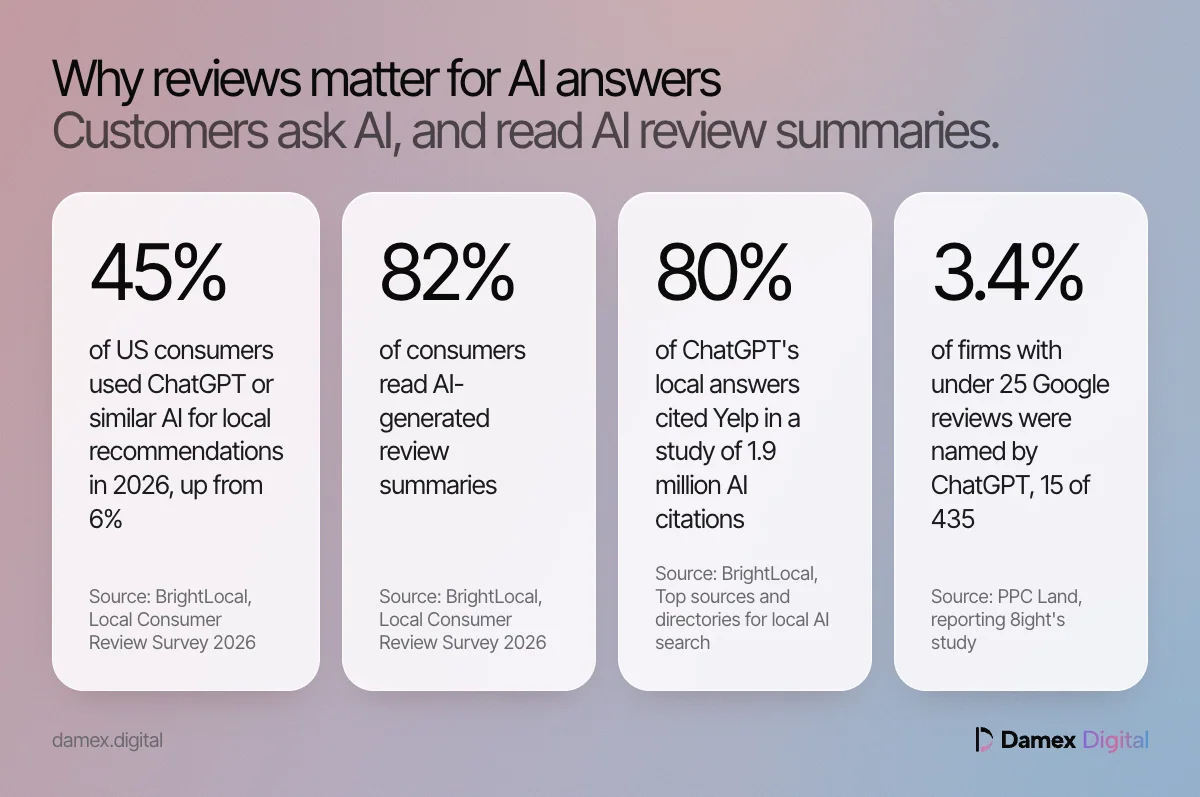
Because customers now ask AI who to call, and they read AI summaries of reviews before they ring anyone. In BrightLocal’s 2026 survey of 1,002 US adults, use of ChatGPT and similar tools for local recommendations jumped from 6% to 45% in a year.
45%
of US consumers used ChatGPT or another generative AI tool for local recommendations in 2026, up from 6% the year before.
82%
of consumers read AI-generated review summaries, and 23% would rely on the summary alone to decide.
80%
of ChatGPT's local answers cited Yelp as a source in BrightLocal's study of 1.9 million AI citations.
Source: BrightLocal, Top sources and directories for local AI search
3.4%
of tested local businesses with fewer than 25 Google reviews were named by ChatGPT in 8ight's September 2026 study, 15 of 435.
74%
of consumers look for reviews written in the last three months.
The local search experts agree on the direction. Whitespark’s 2026 Local Search Ranking Factors, in which 47 local SEO experts weigh in, reports “an increased importance of review signals” for the year. Reviews now shape what AI says about you, not just the map.
Does Google use reviews in its own AI answers?
Yes, more directly than any other engine. Google says reviews feed your local ranking, BrightLocal found Google Business Profile is the most-cited source in AI Overviews and AI Mode, and Google Maps uses Gemini to summarise reviews. On Google, reviews are among the most important things you control.
Google’s local ranking help page says local results are “mainly based on relevance, distance, and popularity.” The page still files reviews under its Prominence heading, which it says is “based on info like how many websites link to your business and how many reviews you have.” More reviews and positive ratings, it says, can help your local ranking.
In BrightLocal’s study, Google Business Profile was “the source of choice for Google’s own AIs”, cited for 94.17% of the businesses checked. Yelp came second for both AI Overviews and AI Mode.
Google also writes AI summaries of reviews. When it added Gemini to Maps in October 2024, it described people “reading the helpful review summarized with Gemini”. A summary can only repeat what customers wrote, so detailed reviews give it better material. More in our Google AI Overviews guide.
Does ChatGPT use Google reviews for answers?
Rarely as a source, in both major studies. BrightLocal found Google Business Profile isn’t a top ChatGPT source, and 8ight found ChatGPT linked to a Google page in no more than 1% of answers. Yet the number of Google reviews a business had still tracked with whether ChatGPT named it.
- BrightLocal counted 1.9 million citations across AI Overviews, AI Mode and ChatGPT in the US, UK and Australia. Its words: “While Google Business Profile isn’t a top source, Apple’s version is.” Yelp was “the most common source for ChatGPT in local search by some distance”, appearing in 80% of ChatGPT’s answers.
- 8ight, as reported by PPC Land, checked 2,976 businesses across 39 trades in 49 places. Google’s name appeared in 23% of ChatGPT answers, but ChatGPT cited the Better Business Bureau in 38.7% and government sites in 25.1%. About 7 in 10 of those government pages were licensing boards or licence look-ups.
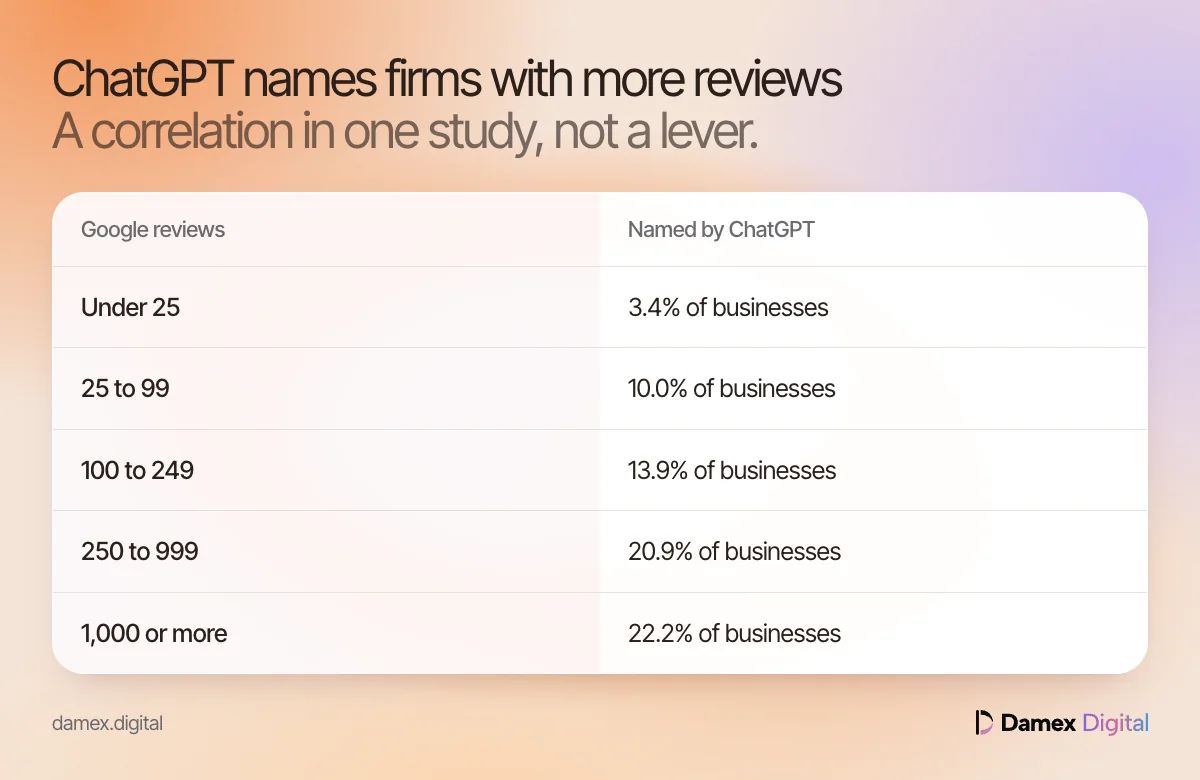
The twist is in 8ight’s review data. “For ChatGPT, the count of Google reviews tracked the chance of being named.” ChatGPT named 3.4% of businesses with under 25 Google reviews, 10.0% with 25 to 99, 13.9% with 100 to 249, 20.9% with 250 to 999 and 22.2% with 1,000 or more. Named businesses had a median of 175 reviews; the rest had 97.
How does a count travel without a link? Nobody outside OpenAI knows. OpenAI’s ChatGPT search help says it may share your location with “trusted third-party providers that help provide more local information, such as nearby business listings.” Listings data can carry review counts. Or busy businesses simply earn reviews and get named for the same reasons. It’s a correlation, not a lever.
Why do the two studies disagree about Yelp?
They measured different things at different times. BrightLocal counted citations across three countries in August 2026. 8ight ran ChatGPT through its API in September 2026 across US cities and Greater Toronto, and found it cited Yelp in none of 1,412 answers. API answers can also differ from the consumer app.
ChatGPT isn’t stable either: asked the same question 39 minutes apart, its answers shared a median of 29% of the businesses named. 8ight sells AI visibility services and says its data “shows where the engines read, not what moves them.” The safe reading: be complete and correct on Google, Yelp, the BBB and your licence record. Our guide to getting recommended by ChatGPT covers the rest.
How do Perplexity, Claude and other AI tools read reviews?
Each engine reads a different mix, and only some have been measured. Claude leaned heavily on Yelp in 8ight’s study. Perplexity searches the web live and cites what it finds. Neither study measured Perplexity, Gemini or Copilot sources, so nobody can yet say which review sites they favour.
Perplexity’s help centre says it searches “the internet in real-time” and that “each answer includes numbered citations”. So the review and directory pages it can find are what it can quote. See how to get your business on Perplexity.
Claude cited Yelp in 202 of 218 local answers in 8ight’s study. That’s 92.7%, the opposite of ChatGPT in the same test. An unclaimed, out-of-date Yelp page may be what Claude reads about you.
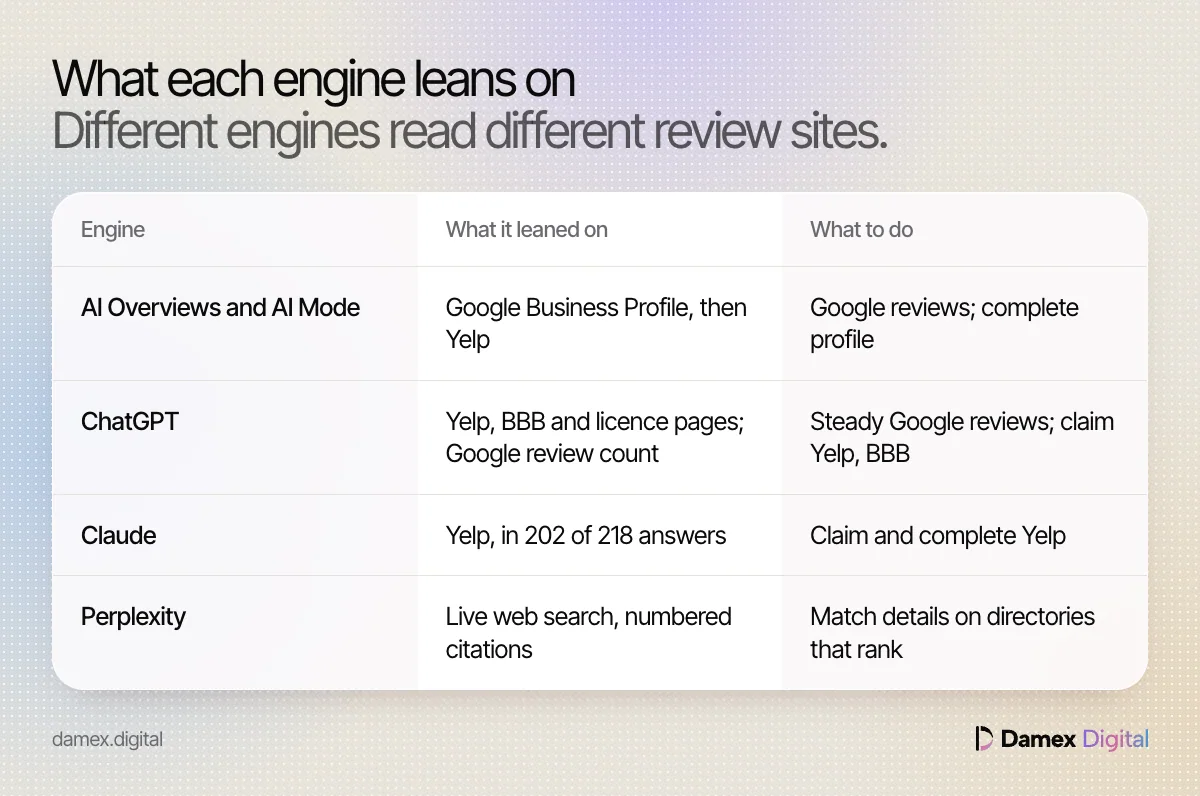
| Engine | What it leaned on for local answers | Evidence | What to do |
|---|---|---|---|
| AI Overviews and AI Mode | Google Business Profile, then Yelp | BrightLocal | Google reviews; complete profile |
| Google Maps with Gemini | AI summaries of your reviews | Ask soon after the job | |
| ChatGPT | Yelp (BrightLocal); BBB and licence pages (8ight); Google review count tracked | BrightLocal, 8ight | Steady Google reviews; claim Yelp and BBB; publish licence |
| Claude | Yelp in 202 of 218 answers | 8ight | Claim and complete Yelp |
| Perplexity | Live web search, numbered citations | Perplexity | Matching details on directories that rank |
What makes a review useful to AI?
Three things: volume, recency and detail in the customer’s own words. Volume tracked with being named by ChatGPT, recency is what customers look for, and detail gives an AI summary something real to repeat. You can’t write reviews, but you control how often you ask and how soon.
Volume
More reviews give every engine more to read. Google says they can help your local ranking, 8ight’s ChatGPT data rose with review count, and 47% of consumers in BrightLocal’s survey won’t use a business with fewer than 20 reviews.
Recency
74% of consumers in BrightLocal’s survey look for reviews from the last three months. A steady trickle beats a burst: see review velocity.
Detail in customers’ own words
“Great service” tells an AI almost nothing. “Fixed our tankless water heater the same afternoon in Round Rock” tells it the job, the speed and the area. Google’s policy says businesses shouldn’t request “that specific content be included”, so you can’t ask for keywords. Ask while details are fresh, and let customers say it their way.
Thanks for choosing us today. Would you leave an honest review of your experience on Google? This link takes you straight there: [your review link]
How do you make your reviews count across AI engines?
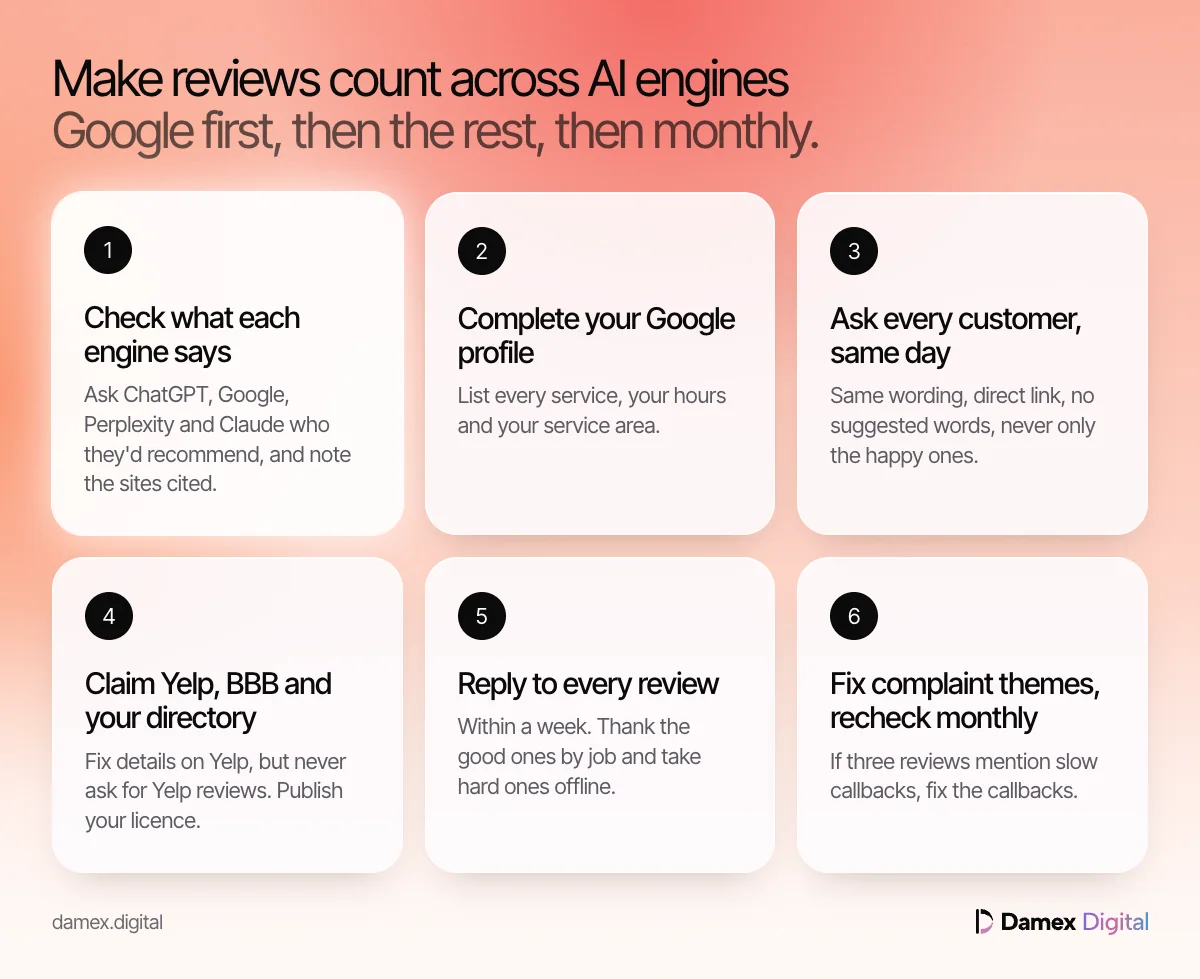
Cover Google first, then the other places engines read, then keep it going monthly. Setup takes a few hours; after that, it’s asking every customer and replying to every review. For message templates and the full how-to, see our Google reviews guide.
- Check what each engine says now. Ask ChatGPT, Google, Perplexity and Claude who they’d recommend for your main job in your city, and note the review sites cited. Our free AI visibility check does this for you.
- Complete your Google Business Profile. List every service you offer, your hours and your service area, so the profile matches the jobs your customers describe in their reviews.
- Ask every customer for a Google review the same day. Same wording, direct link, no suggested words, and never only the happy ones. Our review request templates follow those rules.
- Claim and complete your Yelp page, without asking for reviews. Yelp says its software may not recommend reviews “that seem to be prompted”. Fix the hours, phone, services and photos instead. See our Yelp guide.
- Claim your BBB profile and publish your licence. ChatGPT cited both often in 8ight’s study. Put your licence number on your site. See the BBB guide and state licensing boards.
- Complete your trade’s directory profile. BrightLocal counted Angi and HomeAdvisor among plumbers’ sources, and Zocdoc and Healthgrades among dentists’. Match your name and phone to Google exactly.
- Reply to every review within a week. Thank the good ones by job, take the hard ones offline, and never share private details.
- Fix the theme behind complaints, then recheck monthly. If three reviews mention slow callbacks, fix the callbacks.
Which review sites matter for AI recommendations in your trade?
Google first, Yelp second, then a short tail that changes by trade. BrightLocal’s sector data, combined across AI Overviews, AI Mode and ChatGPT, shows Google with more than half of all citations for plumbers, dentists and car repair. Here are the review and directory sites it counted.
| Sector (BrightLocal) | Google share | Yelp share | Other review and directory sites cited |
|---|---|---|---|
| Plumbers (26,672 citations) | 54% | 13.8% | Angi 2.2%, HomeAdvisor 0.9%, BBB 0.9%, Trustpilot 0.9% |
| Dentists (25,005 citations) | 57% | 15.4% | Zocdoc 1%, Healthgrades 0.5% |
| Car repair (16,902 citations) | 53.9% | 19.4% | BBB 0.8%, DealerRater 0.3% |
| Service businesses (166,499 citations) | 45% | 12.3% | BBB 1.6%, Angi 1.4%, Thumbtack 0.5%, HomeAdvisor 0.5% |
Angi appears in BrightLocal’s data under its old domain, angieslist.com. Small shares still matter: a directory with your old phone number can be the one an engine reads. See our Angi and Healthgrades guides.
How does this work for each trade?
The rules for asking are the same in every trade. What changes is which sites engines read for your trade, when reviews naturally arrive, and what you can say in a reply. Here are six trades, using only data the studies report.
Home services
For HVAC companies
In 8ight’s study, 45.0% of ChatGPT’s HVAC questions produced an answer naming at least one of the businesses checked. HVAC reviews arrive in waves with heat waves and cold snaps, then dry up. Keep asking after spring and autumn tune-ups, so your newest review is never a season old. “Replaced our heat pump before the freeze” gives a summary far more than five stars. See HVAC companies and ChatGPT.
More for HVAC companies: HVAC marketing and AI visibility
For plumbing companies
Plumbers had the clearest directory tail in BrightLocal’s data: Angi at 2.2% of citations, with HomeAdvisor, the BBB and Trustpilot at 0.9% each, behind Google at 54% and Yelp at 13.8%. ChatGPT named at least one checked plumber in 47.4% of plumbing questions in 8ight’s study. Emergency customers remember the hour and the fix, so send the request with the invoice. For the late-night search side, see emergency plumber near me.
More for plumbing companies: Plumbing marketing and AI visibility
For roofing companies
Roofing had the highest named rate of the three home service trades in 8ight’s study, at 50.0%. Roofers face a timing problem: storm work brings a rush of jobs, then reviews stop for months. Ask after the final walk-through, not when the tarp goes on, and keep asking on repairs and inspections between storms. ChatGPT’s use of the BBB and licence look-ups matters most here, because homeowners worry about storm chasers. See getting found after a storm.
More for roofing companies: Roofing marketing and AI visibility
Health practices
For dental practices
Dentists’ sources in BrightLocal’s data were Google at 57%, Yelp at 15.4%, then Zocdoc at 1% and Healthgrades at 0.5%. Ask after the visit, not at the front desk: Google’s policy says businesses “should not require or pressure users” to review on the premises. HHS fined a California practice $23,000 for disclosing patient information in replies to online reviews. Keep every reply general and never confirm the reviewer is a patient. Rules vary by state; check with your attorney. More in our dental AI search guide.
More for dental practices: Dental marketing and AI visibility
For med spas
Neither study broke out med spas, so we won’t name a review site we can’t back with data. Start with Google, then claim your Yelp page without asking for Yelp reviews. In replies, don’t add claims about results or confirm what treatment someone had. Thank them generally and invite questions by phone. Advertising rules for treatments and results vary by state, as our med spa advertising rules post explains; check with your attorney.
More for med spas: Med spa marketing and AI visibility
Auto repair
For auto repair shops
Car repair had one of the highest Yelp shares in BrightLocal’s study at 19.4% of citations, behind Google at 53.9%, with the BBB at 0.8% and DealerRater at 0.3%. So a claimed, accurate Yelp page matters more for a repair shop than most trades, though you still shouldn’t ask for Yelp reviews. Ask for Google reviews once the customer has driven the car, and name the job in replies.
More for auto repair shops: Auto repair marketing and AI visibility
Example: how review recency adds up for a roofer
Steady asking moves a business up 8ight’s review brackets without any burst. Here’s the maths for a roofer. It works the same for any trade.
Say a roofing company has 60 Google reviews. Its newest is four months old, from storm season. It finishes about 20 jobs a month, counting repairs and inspections.
- The habit. It starts asking every customer the same day. Say 1 in 5 leaves a review. That’s 20 × 0.2 = 4 reviews a month.
- Three months on. 4 × 3 = 12 reviews from the last three months, the window 74% of consumers look at.
- Twelve months on. 4 × 12 = 48 new reviews, so 60 + 48 = 108 in total.
- Where that sits in 8ight’s data. 60 reviews is in the 25 to 99 bracket, where ChatGPT named 10.0% of businesses. 108 is in the 100 to 249 bracket, where it named 13.9%.
108
Google reviews after a year of asking every customer: 60 to start, plus 4 a month for 12 months.
Worked example
That’s a correlation in one study, not a promise: no placement is guaranteed on any engine. But the same habit gives Google’s AI and your customers the recent reviews they look for.
Should you reply to every review?
Yes, good and bad. Google says replying “shows that you value their feedback”, and customers expect it: 89% in BrightLocal’s 2026 survey expect owners to respond, and 80% are likely to use a business that responds to all of its reviews. Write replies for the next customer.
Keep replies short, specific and calm. Google’s review help says helpful replies can show you’re responsive. But BrightLocal found templated or generic replies make 50% of consumers unlikely to choose a business. Use a structure, not a script.
- For a positive review, thank them by name, mention the job and invite them back. “Glad the new furnace is keeping your Cedar Park home warm” adds real detail.
- For a negative review, acknowledge the problem, don’t argue, and offer to sort it out by phone.
- Never share private details, such as a customer’s address or what was wrong with a patient’s treatment.
How should you answer negative Google reviews?
Fast, briefly and offline. Reply within a few days, say you’re sorry about the experience, state one fact if something is wrong, and give a name and number to call. Don’t relitigate the job in public. Then fix the cause: faster callbacks beat any wording if late callbacks are the theme. Our negative review reply templates give you structures to adapt.
Themes matter more than single reviews. A few critical ones among many good ones look normal; the same complaint repeated is what a summary can pick up.
How do you deal with fake negative Google reviews?
Report it if it breaks Google’s policies, reply calmly while you wait, and never threaten the reviewer. Google says only reviews that violate its policies are eligible for removal, so an unfair review of a real experience will usually stay.
Google’s reporting help says to select Report next to the review and choose a reason. Track it in the Reviews Management Tool; evaluation “typically takes several days.” It also says: “Do not report a review just because you disagree with it or dislike it.”
The FTC’s review rule bans using “unfounded or groundless legal threats” or intimidation to get negative reviews removed. Rules vary by state; check with your attorney before any legal step.
What are the common mistakes with reviews and AI answers?
Most mistakes come from treating your Google rating as the whole picture, or from shortcuts the platforms ban. Each one leaves engines with less to read or puts your reviews at risk. These eight do the most damage.
- Treating Google stars as the whole story. ChatGPT and Claude lean on Yelp, the BBB and licence records too.
- Asking for Yelp reviews. Yelp asks businesses not to, and may not recommend reviews that seem prompted.
- Asking only happy customers. That’s review gating, which Google’s policy bans.
- Telling customers what to write. Asking for keywords breaks Google’s rule on specific content.
- Letting reviews go stale. A storm-season burst and nothing since looks out of date.
- Pasting the same reply everywhere. Half of consumers are put off by templated replies.
- Confirming patients in replies. Health practices keep every reply general.
- Buying reviews or offering rewards. It breaks Google’s policy and can break the FTC rule.
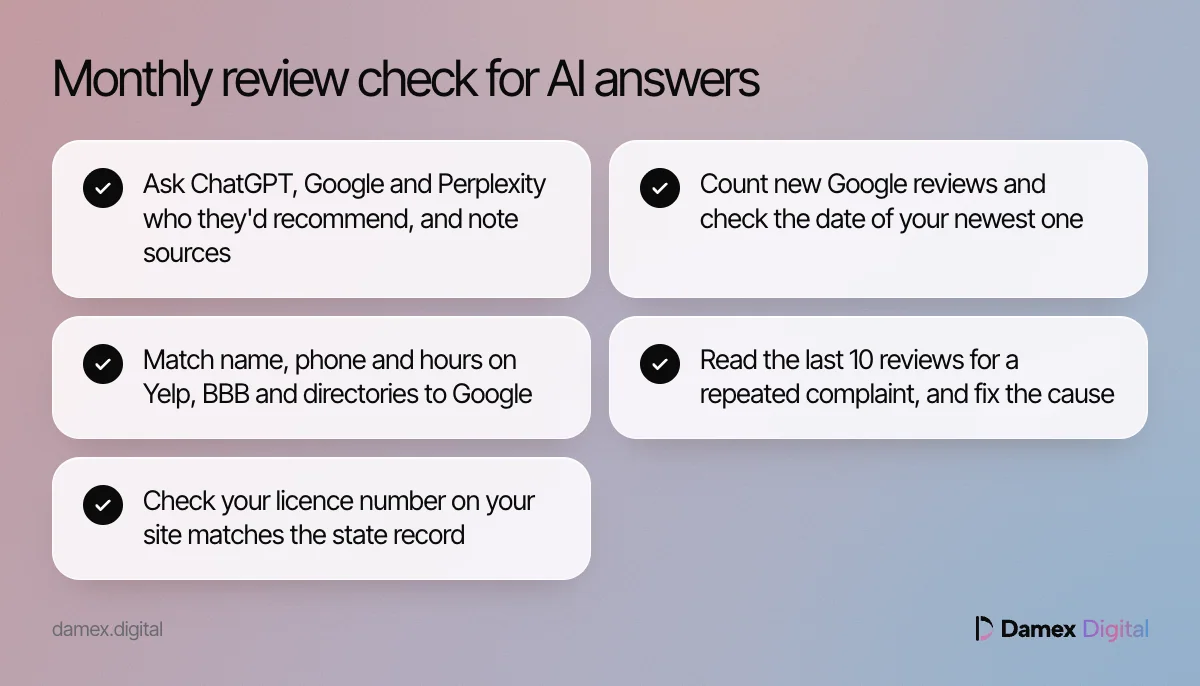
Monthly review check for AI answers
- Ask ChatGPT, Google and Perplexity who they’d recommend for your main job and city, and note the sources cited.
- Count new Google reviews this month and check the date of your newest one.
- Check that your Yelp page, BBB profile and trade directory show the same name, phone and hours as Google.
- Read the last 10 reviews for a repeated complaint, and fix the cause.
- Check your licence number on your site matches the state record.
How Damex does it
Damex runs reviews inside the same program that tracks your AI visibility, so you can see whether more reviews line up with being named more often. Our team shares the work, and a senior marketer owns your account.
- We measure. Every month we ask five AI engines the questions your customers ask about your trade and city, and record which businesses get named.
- The reviews program, on Growth and Authority, asks every customer for a review after each job, with their consent and your direct Google link. A specialist drafts a reply to every review and alerts you to ones that need attention. We never ask for Yelp reviews, and never write or buy them.
- We fix your listings. A specialist corrects your name, address and phone across the directories AI engines and maps read for your trade, including Bing Places and Apple Business Connect.
- We report. You see new reviews, average rating, reply time and AI mentions against the count you started with.
Every reply is checked before it goes out under your name. See the Reviews service, the AI Visibility service and pricing, or read why ChatGPT recommends your competitor.
Questions people ask
Does ChatGPT use Google reviews to recommend businesses?
Not as a source it links to, in the studies so far. BrightLocal found Google Business Profile isn't a top source for ChatGPT, and 8ight found ChatGPT linked to a Google page in no more than 1% of answers. But in 8ight's study, the count of Google reviews still tracked with the chance of being named.
What does Reddit say about whether ChatGPT uses Google reviews?
Threads disagree, and few cite data. The two studies we trust are BrightLocal's 1.9 million citations and 8ight's 1,412 ChatGPT answers. Reddit itself barely shows up as a source: 8ight found it cited in 6 of 1,630 answers, all from ChatGPT.
Should I focus on Google reviews or Yelp reviews?
Ask for Google reviews, because Google says more reviews and positive ratings can help your local ranking. Don't ask for Yelp reviews: Yelp asks businesses not to and may not recommend reviews that seem prompted. Claim and complete your Yelp page and let reviews come on their own.
How many Google reviews do I need for AI to recommend me?
No engine publishes a number. In 8ight's study, ChatGPT named 3.4% of firms with under 25 Google reviews and 22.2% of those with 1,000 or more. BrightLocal's 2026 survey found 47% of consumers won't use a business with fewer than 20 reviews. Aim for a steady flow from every customer.
Do star ratings matter to ChatGPT?
Not in 8ight's data. The median rating was 4.9 for businesses ChatGPT named and for those it didn't. Review count tracked with being named; star rating didn't. Ratings still matter to customers, though.
Should you respond to negative reviews on Google?
Yes. Google says replying shows you value feedback, and BrightLocal's 2026 survey found 89% of consumers expect owners to respond. Acknowledge the problem, don't argue, and offer to sort it out by phone.
How do you deal with fake negative Google reviews?
Report the review from your Business Profile if it breaks Google's policies, then track it in the Reviews Management Tool. Google says not to report a review just because you disagree with it. Reply calmly in the meantime, and never threaten the reviewer.
Can you trust Google reviews?
Mostly, and the rules are tightening. Google bans incentives and selective asking, and under its fake review rule the FTC can seek civil penalties against knowing violators. Look for a steady flow of recent, detailed reviews rather than a burst of short five-star ones.
Do review replies help my Google Business Profile ranking?
Google lists responding to reviews among its tips to improve local ranking and says positive reviews and helpful replies can help a business stand out. It doesn't say replies are a ranking factor on their own.
Can I offer a discount for reviews?
No. Google's policy bans payment, discounts or free goods and services in exchange for reviews, and the FTC rule bans rewards conditioned on a positive or negative review. Ask every customer and accept what they write.
How should a dental practice reply to reviews?
Keep every reply general and never confirm the reviewer is a patient. HHS fined a California dental practice $23,000 after it disclosed patient details in replies to online reviews. Rules vary by state; check with your attorney.
Sources
- BrightLocal: Top sources and directories for local AI search (1.9 million citations)
- PPC Land: ChatGPT names 3.4% of tested local firms with under 25 reviews, 8ight finds
- BrightLocal: Local Consumer Review Survey 2026
- Whitespark: 2026 Local Search Ranking Factors
- Google Business Profile Help: Tips to improve your local ranking on Google
- Google Business Profile Help: Manage customer reviews
- Google Business Profile Help: Report inappropriate reviews on your Business Profile
- Google Maps User Contributed Content Policy: Fake engagement
- Google: New in Maps, inspiration curated with Gemini
- OpenAI Help: ChatGPT search
- Perplexity Help Center: How does Perplexity work?
- Yelp Support: Don't ask for reviews
- FTC: Final rule banning fake reviews and testimonials
- HHS: Settlement with dental practice over disclosures in replies to online reviews (2022)
Cite this post
Badhon, S. U. (2026, October 31). Does ChatGPT use Google reviews? How reviews feed AI answers. Damex Digital Blog. https://damex.digital/blog/do-google-reviews-affect-chatgpt/
Founder, Damex Digital
Led product marketing and go-to-market at weDevs, led marketing at Damex and managed a marketing team at Genex. Founded Damex Digital so local service businesses get the daily work of a good marketing team, measured in calls and booked jobs.