Local service ads for plumbers: are they worth it?
Local service ads for plumbers, from Google's own rules: Google Verified screening, valid leads, credits, bidding, ranking and the move to Performance Max.
The short answer
Local service ads for plumbers are worth it when you answer fast and book well, because Google charges per valid lead, not per click. Plumbing is an urgent category, so Google screens the business, owners and field technicians before the Google Verified badge shows. Judge the ads on cost per booked job. Since August 2026, Google has been moving select US plumbing accounts into Performance Max with pay-per-lead goals.
- You pay for valid leads, such as answered calls, messages and missed calls over 20 seconds during business hours, not for clicks.
- Plumbing is an urgent category, so Google runs background checks on owners and every technician who works in customers' homes.
- Google credits low-quality leads automatically, usually within 30 days, but not leads for job types or areas you don't serve.
- Since August 2026, select US plumbing accounts have been moving into Performance Max with pay-per-lead goals, and manual max-per-lead bids end.
- Judge the ads on cost per booked job after credits. A missed call can cost you twice, once as a charged lead and again as a lost job.
- Who this is for
- Plumbing company owners running or considering Local Services Ads
- What to do first
- Tag last month's leads as booked, not booked or wrong job
- Verification time
- Three to four weeks on average after documents go in, per Google
- Biggest 2026 change
- The move into Google Ads as Performance Max with pay-per-lead goals
On this page 16 sections
- 01Are local service ads for plumbers worth it?
- 02What do the key Local Services Ads terms mean?
- 03Why do Local Services Ads matter to plumbers now?
- 04Which Local Services Ads categories fit a plumbing company?
- 05What does Google Verified screening involve for a plumber?
- 06How do you set up Local Services Ads as a plumber?
- 07How are plumbers charged, and what counts as a valid lead?
- 08What do automatic lead credits cover now?
- 09Which bidding mode should a plumber use?
- 10What decides where a plumbing ad ranks?
- 11What changes when Local Services Ads move to Google Ads?
- 12Local Services Ads vs Google Search ads vs owning your calls
- 13How do you work out cost per booked job?
- 14A weekly lead review routine for plumbers
- 15What are the common mistakes plumbers make with Local Services Ads?
- 16How does Damex run Local Services Ads for plumbers?
It’s Monday morning and you open the leads page with your coffee. Last week brought fourteen charged leads. One wanted a dishwasher installed in a town you don’t cover. Two were the same man calling about the same leak. Four rang while your crew was on a slab job and nobody picked up.
The spend total can’t tell you whether that week paid off. This guide covers local service ads for plumbers end to end, from Google’s own help pages: screening, charges, credits, ranking, the move into Google Ads, and the sums that show whether to keep going. It’s for plumbing company owners in the USA.
Key takeaways
- Local Services Ads charge per valid lead, such as an answered call, a message, or a missed call where the caller waits more than 20 seconds during your business hours.
- Plumbing is an urgent category, so Google runs background checks on the business, the owners and every technician who works in customers' homes.
- Google credits low-quality leads automatically, usually within 30 days, but not leads for job types or areas you don't serve.
- Your rank depends on your bid and how likely you are to turn the ad into a lead, which includes answering calls, reviews, photos and response time.
- Since August 2026, Google has been moving select US plumbing accounts into Performance Max with pay-per-lead goals, and manual max-per-lead bids go away.
- Judge the ads on cost per booked job after credits, and review every lead weekly.
Are local service ads for plumbers worth it?
Local service ads for plumbers are worth it when two things are true. You answer most calls during the hours you advertise, and you book a healthy share of the people you reach. Google charges for valid leads, not clicks, so every missed call and every wrong job raises what each booked job costs you.
Google says lead prices vary with “your location, the job type, the type of lead, or your bidding mode” (How leads work), and it doesn’t publish plumbing prices. The ads pay when the phone gets answered, and they leak money when it doesn’t. Our AI receptionist answers calls, handles common questions and books jobs, and texts back any call it still misses.
What do the key Local Services Ads terms mean?
Five terms come up again and again in Google’s help pages, and each one changes what you pay. Knowing them makes the leads page, the verification dashboard and the bill easier to read, and a wrong charge easier to spot.
- Local Services Ads. Google’s pay-per-lead ads for service businesses, shown on Google Search and Maps with no keywords. See our Local Services Ads glossary entry.
- Valid lead. A contact Google charges for: an answered or returned call, a message, a voicemail, a booking request, or some missed calls.
- Google Verified. The single badge Google shows for businesses that passed its screening. It replaced Google Guaranteed and Google Screened.
- Performance Max with pay-per-lead goals. What Local Services Ads become inside Google Ads.
- Cost per booked job. Ad spend after credits, divided by the jobs it booked. It’s the number that decides whether the ads pay.
Why do Local Services Ads matter to plumbers now?
Google has changed three things that matter to plumbers. It replaced its badges with one Google Verified badge, swapped lead disputes for automatic credits, and in August 2026 began moving plumbing accounts into Google Ads. The trade still runs on urgent calls at night and on weekends.
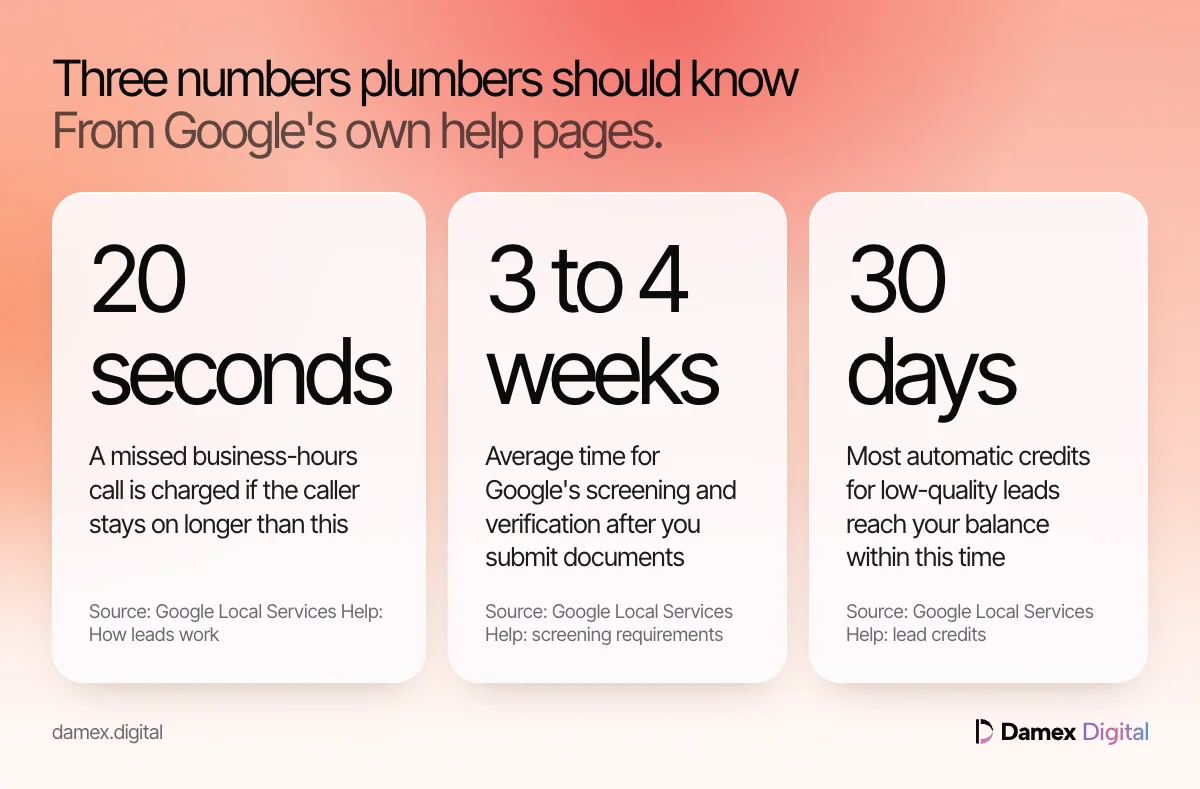
20 seconds
A missed call during your business hours becomes a charged lead if the caller stays on the line for more than 20 seconds.
3 to 4 weeks
Google says screening and verification takes 3 to 4 weeks on average after you submit your documents.
Source: Local Services Help: Business screening and verification requirements, United States
30 days
In most cases, Google applies automatic credits for low-quality leads to your account balance within 30 days.
Source: Local Services Help: About Automated Local Services Ads lead credits
August 2026
The move to Performance Max with pay-per-lead goals began in August 2026 for select US home and storefront service advertisers, plumbing included.
Source: Google Ads Help: Local Services Ads transition to Performance Max
510,600
The Bureau of Labor Statistics counted 510,600 plumber, pipefitter and steamfitter jobs in 2025, and says plumbers are often on call for emergencies, so evening and weekend work is common.
Source: U.S. Bureau of Labor Statistics: Occupational Outlook Handbook
That’s why the 20-second rule bites harder in plumbing: the best calls often come when you’re least likely to pick up.
Which Local Services Ads categories fit a plumbing company?
Plumbing companies usually advertise under Google’s Plumbers category. Google’s US list also includes Water damage services, and a Drain expert category available only in California and Florida. Inside each category you choose job types and service areas, and those choices decide which leads you pay for.
Check eligibility for your area first, because Local Services Ads cover only certain categories and places. Shops that also do heating can add HVAC as a separate category.
Why does Google treat plumbing as urgent?
Google calls plumbing “an urgent category because consumers often call plumbers for time-sensitive, urgent needs, such as a hot water outage” (US requirements). So plumbing professionals get an extra level of screening, including background checks on the people who do the work. HVAC, electricians, garage doors and locksmiths carry the same label, and garage door and locksmith firms also face Advanced Verification.
What does Google Verified screening involve for a plumber?
For a US plumber, Google’s screening can include background checks on the business, owners and field workers, a business registration check, general liability insurance, state licenses and a verified Google Business Profile. Google marks most of these “select users only,” so your verification dashboard has the final list for your business.
Who gets a background check?
The business, every owner and the field worker roster, which Google defines as “employees, contractors, including subcontractors,” and anyone else serving customers in their homes (screening process). Office and clerical staff who don’t serve customers are exempt. The checks cover identity, criminal history and, for the company, judgments and liens. There’s no credit check and no charge. Fail, and you wait 30 days to reapply, then 180 days after a second denial.
Registration, insurance and licenses
- Business registration. Google uses your D-U-N-S number. A new one “can take up to 30 days,” or you can submit Secretary of State registration or your EIN.
- General liability insurance. Send a signed certificate of insurance with a policy number, valid for at least 14 days after you submit it, in the name you advertise under, with an address covering your service area.
- Licenses. Google checks state business and owner licenses against state databases and shows them on your profile. You also confirm county and city licenses, and that every service professional is licensed.
- Google Business Profile. The person completing the checks must be an owner or manager of the profile.
Does Google re-check plumbers later?
Yes. Google says select US advertisers go through risk-based verification. Some get the badge fast through accelerated verification, then have 14 days to finish the remaining steps. Advertisers are “regularly re-evaluated,” and skipping a requested review can cost you the badge, pause your ads or suspend the account.
Google Guaranteed vs Google Screened: which one applies to you?
Neither, any more. Google says it is “launching a single badge for all advertisers,” called Google Verified, and verified advertisers earned it automatically (About Google Verified badge). Google Guaranteed carried a money back guarantee, now discontinued, with reimbursement requests due before December 7, 2025. Google Screened was aimed at professional firms such as law and real estate, though Google’s archived Google Screened page listed home services as eligible too.
So is Google Guaranteed worth it? The question now is whether verified Local Services Ads pay. Google says the badge change doesn’t affect ranking, but completed verification checks still count toward profile quality.
How do you set up Local Services Ads as a plumber?
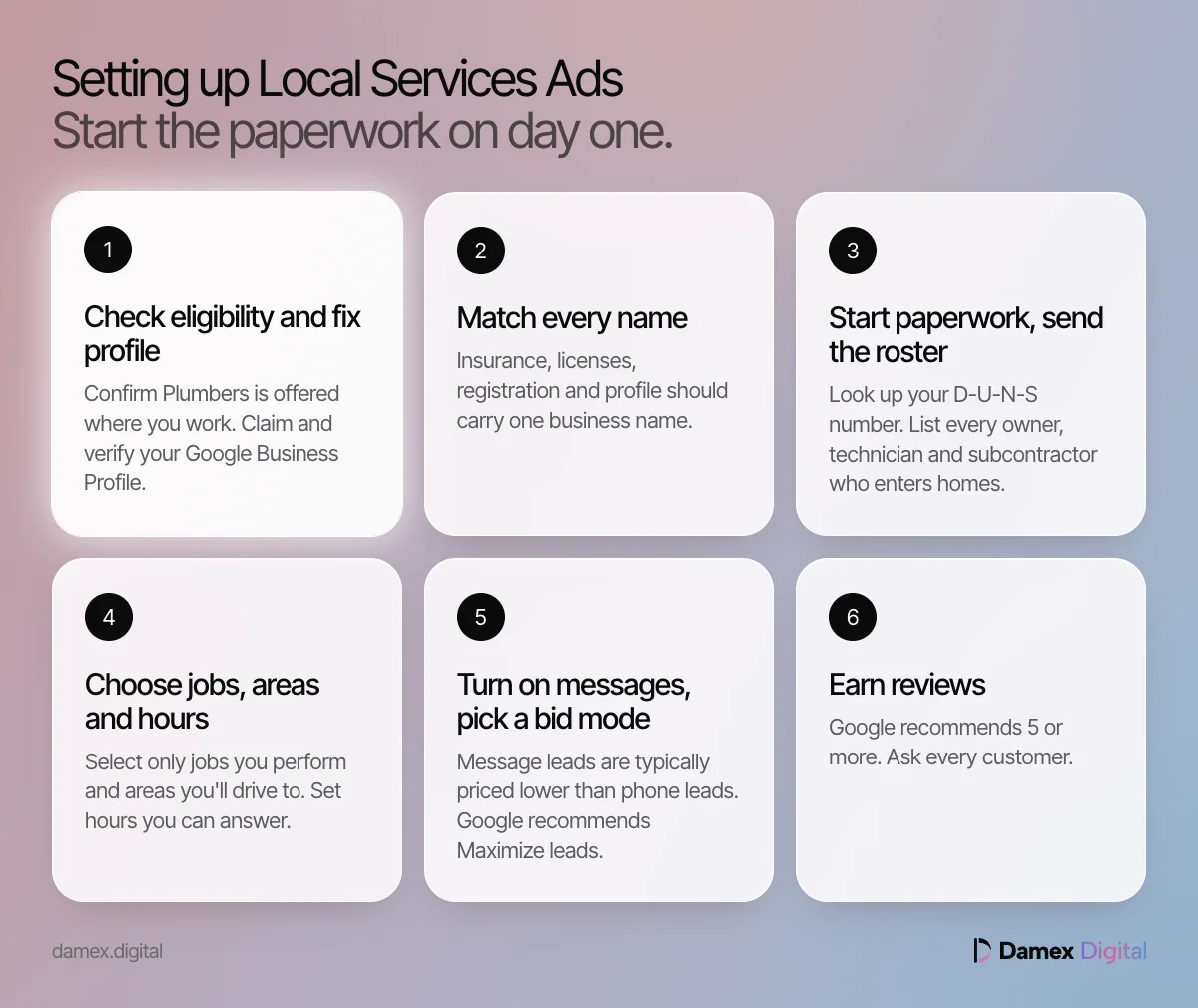
Set up in the order below. Verification paperwork takes longest, so start it on day one, and make every name match. Then choose the jobs, areas and hours you can really serve, because those settings decide which leads you pay for and which get credited.
Setting up Local Services Ads
- Check eligibility. Confirm the Plumbers category is offered where you work, plus any related category such as Drain expert.
- Fix your profile. Claim and verify your Google Business Profile. Its name, address and hours feed the ad.
- Match every name. Insurance, licenses, registration and profile should carry one business name. If not, have a DBA document ready.
- Start the D-U-N-S lookup. Search with the same name and address as your profile.
- Send the roster. List every owner, technician and subcontractor who enters customers’ homes.
- Choose jobs and areas you want. Select only jobs you perform and areas you’ll drive to. Google won’t credit leads outside them.
- Set hours you can answer. Missed calls are charged only within your business hours and ad schedule.
- Turn on message leads. Google says they’re typically priced lower than phone leads and reach people at night and on weekends.
- Pick a bid mode. Google recommends Maximize leads with a budget of at least 10 leads a week, and about 2 weeks to learn.
- Earn reviews. Google recommends 5 or more, and some business types need 5 to show. Ask every customer.
If Google offers pre-badge ads, you can get leads while the last checks finish, listed below providers who have the badge. For review requests that follow Google’s rules, see how to get more Google reviews and the plumbing review request templates.
How are plumbers charged, and what counts as a valid lead?
You’re charged for each valid lead, and each one counts toward your budget. Valid leads are calls you answer or return, messages, voicemails, booking requests, and missed calls during business hours where the caller waits more than 20 seconds. Once you hit your monthly max, the ad stops showing until next month.
Google says “A bid is the most you’d pay for a lead” (How bidding works). Our guide to buying leads vs owning your calls compares this model with Angi and Thumbtack, so this section sticks to the rules that hit plumbers hardest.
How does the 20-second rule work?
- Answered calls aren’t timed. Pick up after any number of rings and it’s an answered call.
- Phone menus. If callers must press 1 for emergencies, the timer starts after the first key press.
- Voicemail counts. Voicemail during business hours is a connected call, charged after 20 seconds, message or not.
- Hours come from your profile. If your ad schedule differs, unanswered calls are charged only when both apply.
Calls arrive through a Google forwarding number with a “Call from Google” message, unless call forwarding or VoIP blocks it (Manage leads and jobs).
Will a repeat caller be charged twice?
No, within limits. Follow-up calls or messages from the same number or email aren’t charged again if there’s been contact within 15 days. After 15 quiet days, a new call is a new lead, which matters when a slow drip becomes a burst pipe a month later.
How are message leads priced?
Message leads are “typically priced lower than the corresponding phone lead price,” though not always. Google prices them on how likely the customer is to book, including whether they contacted other advertisers.
What do automatic lead credits cover now?
Google no longer runs a dispute form for bad leads. Its models reassess charged leads and credit low-quality ones automatically, in most cases within 30 days. You can still rate leads in the feedback survey, but leads for job types or areas you don’t serve aren’t credited at all.
- Wrong jobs and wrong towns. Google “no longer supports credits for ‘job type not serviced’ and ‘geo not serviced’ leads” (About automated lead credits).
- Statuses. Each lead shows Charged, Not charged, In review or Credited. A credited lead’s charge still appears on your invoice, with the credit on your balance.
- Feedback. Rating a lead in the Lead Feedback Survey can earn a bonus credit.
Which bidding mode should a plumber use?
Before migration, Google offers Maximize leads, Target cost per lead and Max per lead. It recommends Maximize leads, with a budget of at least 10 leads a week. After the move into Google Ads, manual max-per-lead bidding isn’t supported, so plan around the automated modes now.
Google says providers with equal quality and budgets on Maximize leads “typically get more leads than those who don’t.”
One change matters to shops running plumbing and HVAC in one campaign. Google Ads doesn’t support separate target CPAs per category, so one campaign-level target applies to both (transition page). If you want water heater installs and furnace repairs bid differently, Google suggests separate campaigns.
What decides where a plumbing ad ranks?
Google ranks Local Services Ads in an auction on your bid and how likely your ad is to produce a lead. That depends on your responsiveness, how well you match the search, including the job, time and location, and profile quality: rating, number of reviews, response time, photos and completed verification checks.
Google says “Missed calls may negatively affect your responsiveness,” and higher quality profiles “may rank higher and may also pay lower costs per lead” (About ad rankings).
- Responsiveness. Answer calls, reply fast, and respond even when you decline a job.
- Reviews. Star rating and review count feed profile quality.
- Hours. The time of the search counts. Message and booking leads help at night and on weekends.
- Location. If several of your locations cover one area, Google shows only the highest ranked.
- Photos. High-quality photos of your team, work or equipment help.
Organic results work differently. Google says “There’s no way to request or pay for a better local ranking” (local ranking help), and local results are mainly based on relevance, distance and popularity. For that side, read how to show up for emergency plumber near me searches.
What changes when Local Services Ads move to Google Ads?
Your campaign becomes a Performance Max campaign with pay-per-lead goals, managed in Google Ads. You still pay only for valid leads, ads still show only on Google Search and Maps, and your Google Verified badge carries over. Budgets, bidding, reports and where you edit business details all change.
When will a plumbing account move?
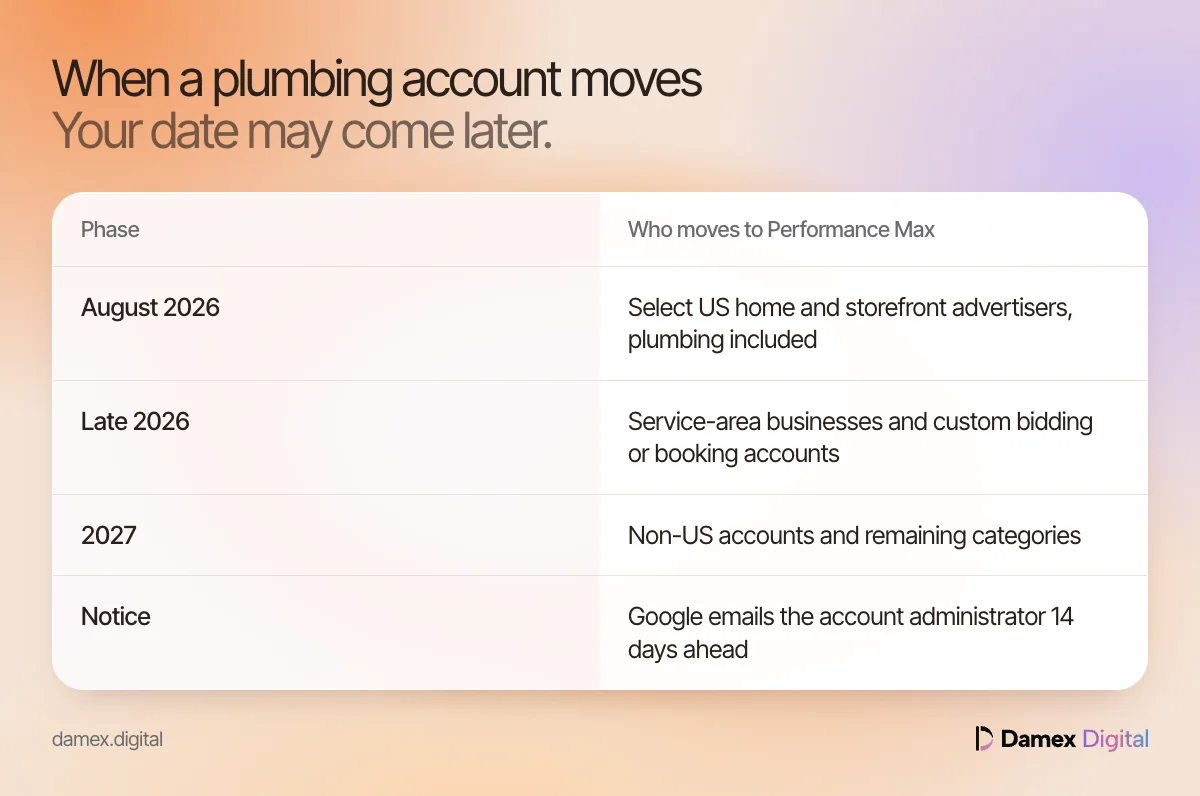
Google’s transition page sets out three phases. August 2026 covers select US home and storefront service advertisers, including plumbing. Late 2026 adds service-area businesses without storefronts and accounts with custom bidding or booking. 2027 covers non-US accounts and remaining categories. Many plumbers are service-area businesses, so your date may come later. Google emails the account administrator 14 days ahead.
What stays and what goes?
- Stays. Pay per valid lead, Search and Maps placement, no keywords, and your badge. Past leads and call recordings transfer.
- Budgets go daily. Your weekly budget is divided by 7, and monthly spend is capped at the daily budget times 30.4.
- Manual bidding goes, and with it separate target CPAs per category.
- BBB callouts go. Add at least 6 other structured callouts.
- Name, address and hours sync one way from your Google Business Profile. Big changes to name, address or primary category trigger a review of 24 to 48 hours, and the campaign may pause.
- Reports don’t move. Download or screenshot them first.
Allow up to two weeks for performance to settle.
Local Services Ads vs Google Search ads vs owning your calls
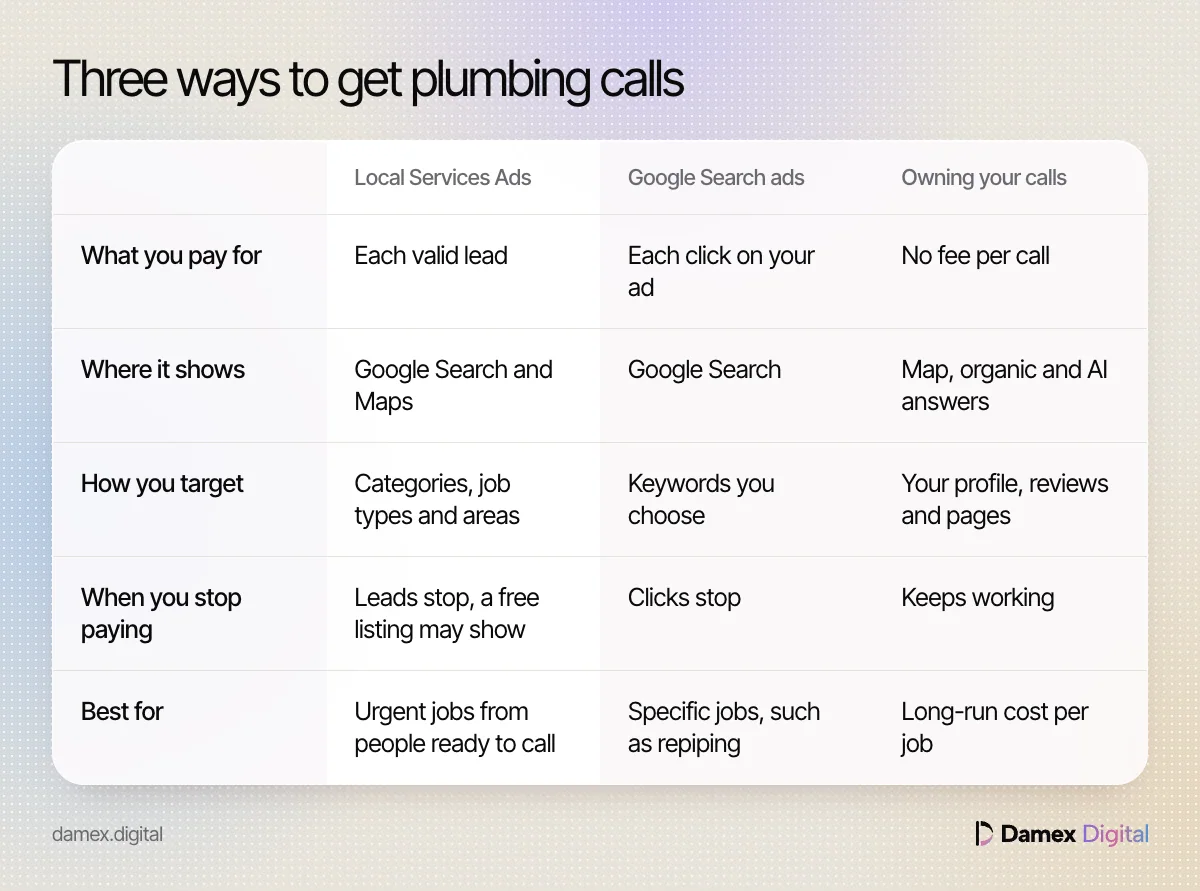
Local Services Ads charge per lead and need screening. Google Search ads charge per click and need keywords and landing pages. Owned calls come from your Google Business Profile, reviews and website, carry no fee per call, and keep coming when you stop paying, but take longest to build.
| Local Services Ads | Google Search ads | Owning your calls | |
|---|---|---|---|
| What you pay for | Each valid lead | Each click on your ad | No fee per call |
| Where it shows | Google Search and Maps | Google Search | Map, organic and AI answers |
| How you target | Categories, job types and areas | Keywords you choose | Your profile, reviews and pages |
| Control over price | Bid modes, max per lead ends at migration | A max cost per click, or automated bids | No media cost |
| When you stop paying | Leads stop, a free listing may show | Clicks stop | Keeps working |
| Best for | Urgent jobs from people ready to call | Specific jobs, such as repiping | Long-run cost per job |
With cost-per-click bidding, Google says “you pay for each click on your ads” (CPC definition). Compare cost per booked job across channels, and use our guide to local marketing costs for every line item.
How do you work out cost per booked job?
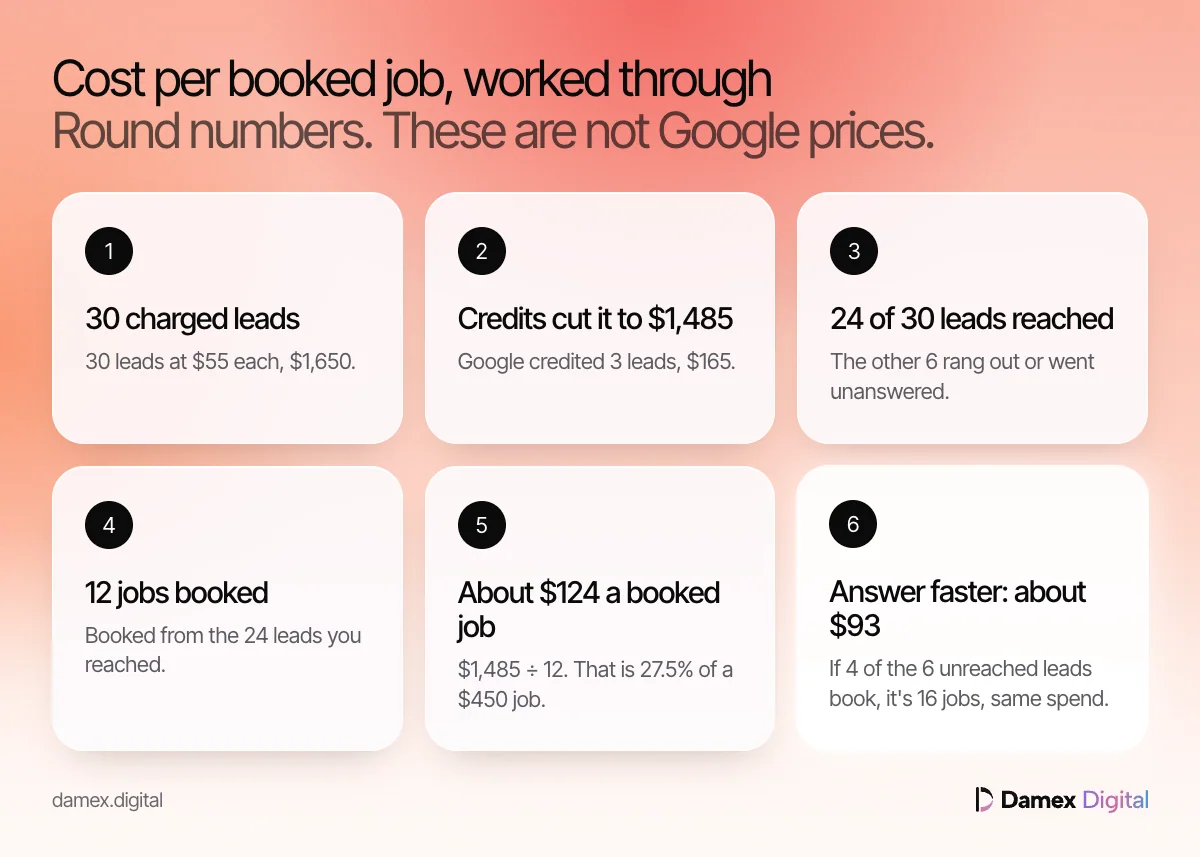
Take what you spent on the ads, subtract credits, and divide by the jobs those leads booked. Then compare that with what a typical job earns you. Cost per lead on its own hides the two things that decide the answer, which are how many leads you answer and how many you book.
Here are round numbers to show the sum. They aren’t Google prices.
| Line | Example |
|---|---|
| Charged leads | 30 at $55 each, $1,650 |
| Credited by Google | 3 leads, $165 |
| Net spend | $1,650 minus $165 = $1,485 |
| Leads reached | 24 of 30 |
| Jobs booked | 12 |
| Cost per booked job | $1,485 ÷ 12 = about $124 |
| Average job value | $450 |
| Ad cost as share of revenue | $123.75 ÷ $450 = 27.5% |
Now say faster answering turns 4 of the 6 unreached leads into jobs. Same spend, 16 jobs, and cost per booked job falls to about $93. The ads didn’t change. The answering did.
$93
The same $1,485 spread over 16 booked jobs instead of 12 drops cost per booked job from about $124 to about $93.
Worked example
To price unanswered calls alone, try the missed-call calculator.
What does the daily budget switch look like?
Example. A $385 weekly budget becomes a $55 daily average, and your monthly cap becomes $55 × 30.4, or $1,672. Daily spend may fluctuate on high-demand days, Google says, but the month won’t pass the cap. In plumbing, think of the first hard freeze.
A weekly lead review routine for plumbers
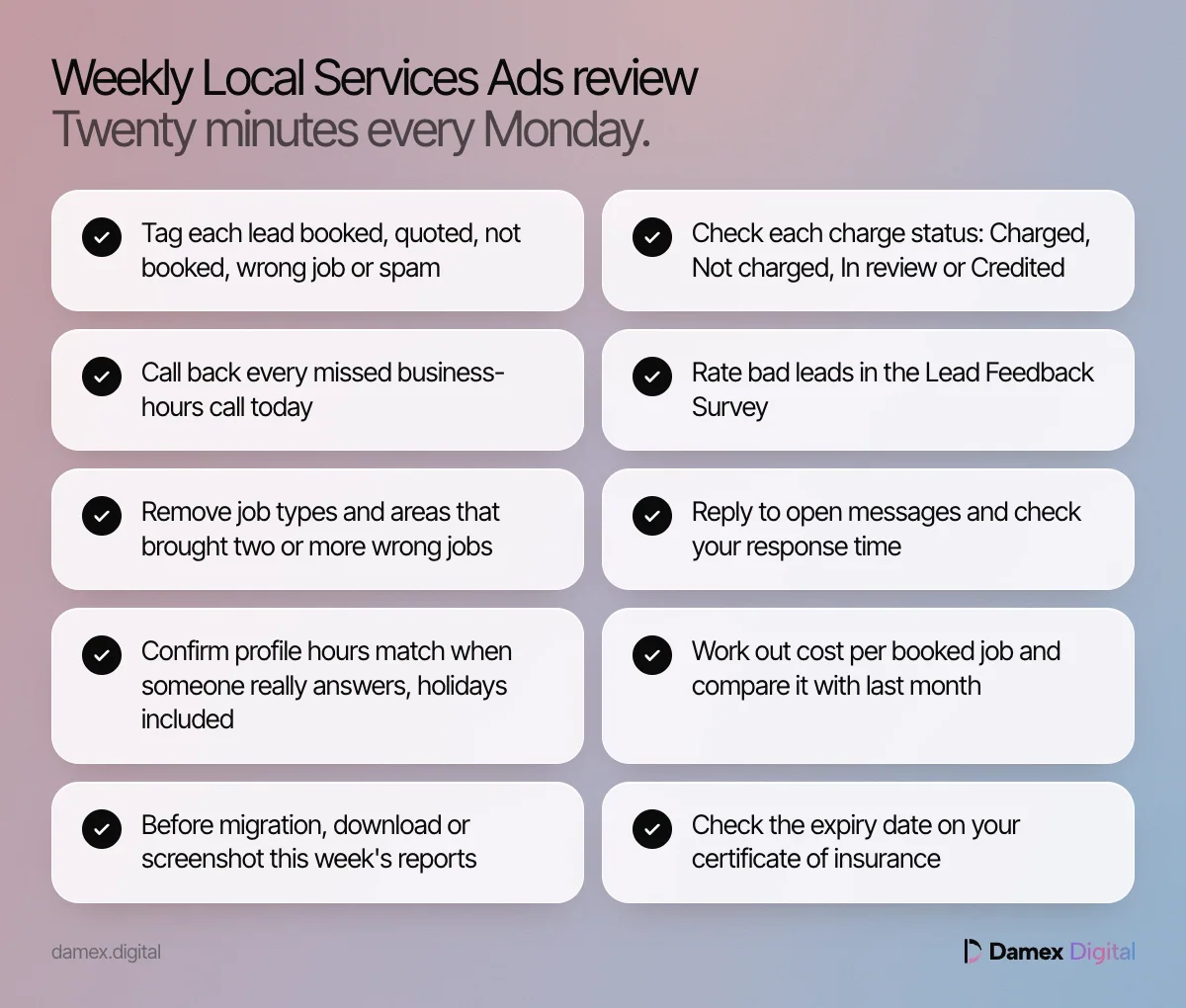
Spend 20 minutes every Monday on last week’s leads. Tag each one by outcome, find the missed calls you paid for, rate the bad ones, prune job types and areas that bring wrong work, and track cost per booked job.
Weekly Local Services Ads lead review
- Tag each lead booked, quoted, not booked, wrong job or spam
- Check each charge status: Charged, Not charged, In review or Credited
- Call back every missed business-hours call today
- Rate bad leads in the Lead Feedback Survey
- Remove job types and areas that brought two or more wrong jobs
- Reply to open messages and check your response time
- Confirm profile hours match when someone really answers, holidays included
- Work out cost per booked job and compare it with last month
- Before migration, download or screenshot this week’s reports
- Check the expiry date on your certificate of insurance
Repeated wrong jobs need a settings fix, and repeated missed calls an answering fix. Start with the missed-call texts for plumbers, and read why missed calls are the cheapest leads you lose.
What are the common mistakes plumbers make with Local Services Ads?
Most wasted Local Services Ads spend comes from a handful of avoidable setup and answering mistakes. Each one either creates charged leads you can’t book, or quietly lowers your rank so you pay more for the leads you do get.
- Letting calls ring out during business hours. You can be charged, and missed calls may hurt your responsiveness.
- Sending business-hours calls to voicemail. It counts as a connected call after 20 seconds.
- A long wait after the menu key press. The timer starts at the first key press, so a caller left waiting can become a charged lead.
- Ticking job types you don’t do. Those leads aren’t credited. If you don’t do gas line work, leave it off.
- Showing 24-hour hours with no one on call. Profile hours decide when missed calls are charged.
- Judging on cost per lead. A cheap lead that never books costs more than a dearer one that does.
- Asking only happy customers for reviews. Google’s rules don’t allow it. Ask every customer, and don’t suggest what to write.
- Renaming the business mid-season after migration. A big name or category change can pause the campaign for 24 to 48 hours.
How does Damex run Local Services Ads for plumbers?
Damex runs Local Services Ads inside your own Google account, within a budget cap you set. A specialist on our team handles the lead review, and a senior marketer owns the results.
- Ads. On the Paid ads add-on, we build and tune your Google Search, Local Services and Meta ads inside your cap, and show spend, calls and cost per call side by side.
- Calls. The AI receptionist add-on answers calls, handles common questions, books jobs and texts back any call it still misses.
- Reviews. On Growth and Authority, we ask every customer for a review, with their consent, and reply to every review.
- Checks. Every piece of work is reviewed before anything goes out under your name.
Our Paid ads service is a $497 a month add-on, including up to $5,000 of monthly spend, then 10% of spend above that. Google bills ad spend to your own account, with no markup. Other prices are on the pricing page, and our plumbing industry page covers the rest. We can’t promise a lead price or a position, because Google sets both in an auction. To see where you stand first, run the free AI Visibility Check.
Questions people ask
Are Local Services Ads worth it for plumbers?
They can be, if you answer most calls during the hours you advertise and book a good share of the people you reach. Google charges per valid lead, so measure cost per booked job after credits and compare it with what a typical job earns you.
How much do Local Services Ads cost a plumber?
Google doesn't publish a price list. It says lead prices vary by location, job type, lead type and bidding mode. You set the budget, and your ad stops showing for the month once you reach your monthly max.
How long does Google Verified take for a plumber?
Google says screening takes three to four weeks on average after you submit your documents, so start as soon as you open the account. If you need a new D-U-N-S number, allow up to 30 days for that as well.
Do my technicians need background checks?
Yes, in plumbing. Google says plumbing professionals undergo service professional background checks, and that covers employees, contractors and subcontractors who work in customers' homes. Office and clerical staff who don't serve customers directly don't need them.
Google Guaranteed vs Google Screened: which one applies to me?
Neither now. Google replaced both with a single Google Verified badge, and existing advertisers who had completed verification earned it automatically. The money back guarantee that came with Google Guaranteed was discontinued.
Will I be charged if I miss a call from my ad?
Sometimes. A missed call during your business hours is a valid lead if the caller stays on the line for more than 20 seconds. Voicemail during business hours counts too. Calls outside your business hours or ad schedule aren't charged as missed calls.
Will I get credit for a lead outside my service area?
No. Google no longer credits leads marked job type not serviced or geo not serviced, so set your job types and service areas tightly.
Can I run Local Services Ads for plumbers in California or Florida?
Yes. Plumbers is a listed US category, and Google's list adds a Drain expert category only in California and Florida. Google checks state licenses against state databases. Licensing rules vary by state, so check with your state board or your attorney.
Do I have to verify again after the move to Performance Max?
No, if you're already verified. Google says your Google Verified badge carries over and insurance and license reverification are no longer required, though it may still ask for business-level checks.
Can I still set a maximum price per lead?
Not after migration. Google says manual bidding, such as setting a maximum cost per lead, is no longer supported in Google Ads.
What does a local service ad look like?
It shows your business with the Google Verified badge and buttons to call or message you. Your profile lists the licenses Google has verified, and an estimated message response time may appear on the ad.
Sources
- Local Services Help: How leads work
- Local Services Help: How bidding works for Local Services Ads
- Local Services Help: About ad rankings
- Local Services Help: Understand the screening and verification process
- Local Services Help: Business screening and verification requirements, United States
- Local Services Help: About Automated Local Services Ads lead credits
- Google Ads Help: Local Services Ads transition to Performance Max campaigns with pay-per-lead goals
- Local Services Help: About Google Verified badge
- Local Services Help: Getting started with Local Services Ads, United States
- Local Services Help: Improve your Local Services Ads performance
- Local Services Help: Manage leads and jobs
- Local Services Help: About Google Screened (archived November 2024)
- Google Business Profile Help: Tips to improve your local ranking on Google
- Google Ads Help: Cost-per-click (CPC) definition
- U.S. Bureau of Labor Statistics: Plumbers, Pipefitters, and Steamfitters
Cite this post
Badhon, S. U. (2026, October 31). Local service ads for plumbers: are they worth it?. Damex Digital Blog. https://damex.digital/blog/local-services-ads-plumbers/
Founder, Damex Digital
Led product marketing and go-to-market at weDevs, led marketing at Damex and managed a marketing team at Genex. Founded Damex Digital so local service businesses get the daily work of a good marketing team, measured in calls and booked jobs.
Keep reading.More on getting found.
- Calls and leadsAI receptionist for a dental office: is it safe and useful?Oct 31, 2026 · 16 min read
- Calls and leadsAI receptionist vs answering service vs voicemail, comparedOct 31, 2026 · 16 min read
- Calls and leadsPay per lead vs owning your calls: roofing, HVAC and plumbing leadsOct 31, 2026 · 16 min read